
Reviewed by PawVerse Veterinary Team
Maybe you found a litter of kittens behind your building, or your own cat just gave birth, and one kitten who seemed fine yesterday is suddenly weak, cold, and barely moving. This is one of the most frightening situations a cat rescuer or new kitten parent can face, and it's also one where knowing exactly what to do in the next few minutes can genuinely change the outcome. This guide walks through what fading kitten syndrome is, the emergency steps to take right now, and what happens after.
If you're reading this because a kitten in front of you is fading right now, skip to the emergency protocol section below and start warming the kitten while you call a vet. Everything else can wait.
What Fading Kitten Syndrome Actually Is
Fading kitten syndrome isn't a single disease; it's a term used to describe a neonatal kitten who suddenly declines and begins to fail, often within their first two weeks of life, sometimes even if they seemed healthy the day before. Newborn kittens have almost no energy reserves and immature organ systems, which means a problem that would be minor in an adult cat can cascade into a life-threatening emergency within hours. This is exactly why more than half of all kitten deaths happen in just the first two weeks of life and why fast recognition matters as much as it does.
Why This Progresses So Fast
A newborn kitten can't regulate its own body temperature effectively for the first few weeks of life, depends entirely on nursing for both nutrition and hydration, and has essentially no fat or glycogen reserves to draw on if something interrupts that routine. When a kitten stops nursing, even for a matter of hours, blood sugar can drop dangerously low. When a kitten gets cold, its body can't warm itself back up unassisted, and a cold kitten's digestive system stops working properly, which is part of why the order of emergency steps below matters so much. This is a fast-moving situation by nature, not because anyone did anything wrong.
What Causes Fading Kitten Syndrome
A fading kitten is often dealing with more than one of these at once. Hypothermia and hypoglycaemia are the two most common immediate causes, frequently triggered by a kitten being separated from the mother, a large litter where one kitten is outcompeted for nursing access, or a queen who isn't producing enough milk. Failure to receive colostrum, the antibody-rich first milk, in the first 24 hours, leaves a kitten without crucial early immune protection. Neonatal infection or sepsis is a serious and common underlying cause that specifically needs veterinary treatment like antibiotics. Congenital defects present from birth, including heart, lung, or gastrointestinal abnormalities, sometimes cause fading that supportive care alone can't fully resolve. Birth trauma, maternal neglect or rejection, and a rarer immune condition called neonatal isoerythrolysis, where a kitten's blood type is incompatible with antibodies in the mother's milk, round out the list of common causes.
Signs to Watch For
Sign | What It Suggests |
The body feels cool or cold, especially paws, ears, and gums. | Hypothermia needs warming immediately. |
Weak or absent sucking reflex, refusing to nurse | Serious weakness, needs urgent attention |
Limp, unresponsive, little reaction to touch or handling | Critical condition |
Constant weak crying or unusual silence | Distress signal: don't wait to see if it passes. |
Laboured or gasping breathing | Needs emergency care immediately |
Pale or bluish gums | Poor circulation or oxygenation, emergency |
Not gaining weight day to day, or losing weight | Failure to thrive needs veterinary evaluation. |
Tacky or dry gums | Dehydration |
Healthy kittens should be gaining weight daily and should feel warm and reasonably firm to the touch, not limp. If you're fostering or caring for a litter, daily weighing is one of the simplest ways to catch a problem before it becomes an emergency.
The Emergency Protocol: Warm, Then Sugar, Then Vet
If a kitten in front of you is showing these signs, the order of these steps matters; doing them out of sequence can cause real harm.
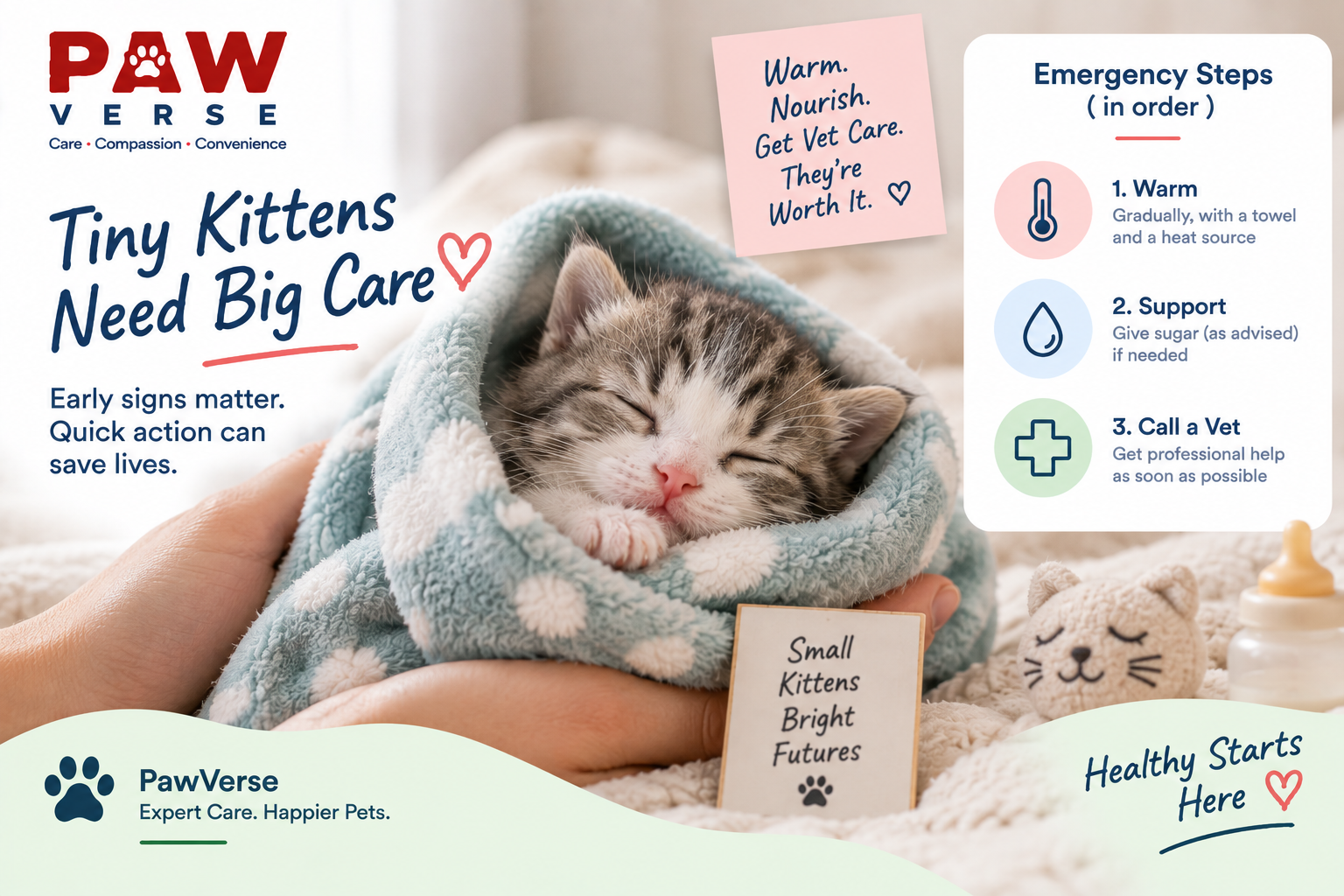
Step 1: Warm the kitten gradually. Wrap the kitten snugly in a towel, sometimes called the "burrito" method, and warm them slowly using a heating pad set on low placed underneath the towel, never in direct contact with the kitten's skin, which can cause burns, or warm water bottles wrapped in cloth. Warming should happen gradually, not with intense direct heat.
Step 2: Once the kitten is warming, address blood sugar. Rub a small amount of Karo syrup, honey, or a sugar-water mixture directly onto the gums, repeating every few minutes. If the kitten is alert enough to swallow safely, you can offer a small amount by mouth. If the kitten is limp or not swallowing normally, only rub the sugar source on the gums; never force liquid into the mouth of an unresponsive kitten. This risks aspiration into the lungs. If low blood sugar is the primary issue, improvement often appears within 20 to 30 minutes.
Step 3: Call a vet or emergency animal hospital immediately, while doing steps 1 and 2, not after. A fading kitten needs professional evaluation regardless of whether initial first aid seems to be helping, since underlying causes like infection or a congenital issue need diagnosis and treatment a vet must provide. Transport the kitten warm, wrapped, with a heat source nearby, as soon as you can safely do so.
What Not to Do
Never feed a cold kitten; formula or milk given before the kitten is properly warmed can't be digested properly and can cause bloating or aspiration, since a cold body's digestive system essentially shuts down. Never force liquid into the mouth of a limp or semi-conscious kitten, for the same aspiration risk. Never place a kitten directly against a heating pad or hot water bottle without a towel barrier; this causes burns on skin too fragile to signal discomfort effectively. And never wait to see if the kitten improves before calling a vet; the call and the first aid should happen at the same time, not one after the other.
Why This Matters Especially in India
Community and street cat rescue is common across Indian cities, and finding a litter of kittens, sometimes without any visible mother nearby, is a situation many compassionate people encounter at some point. These kittens are at particularly high risk of fading, since they may have missed early colostrum, been exposed to monsoon-season cold and damp, or gone an unknown amount of time without nursing before being found. If you've taken in a rescued kitten or litter, the same warm-first, sugar-second, vet-third protocol applies, and it's worth locating a vet comfortable treating very young kittens before you're in the middle of an emergency, similar to the advance-planning principle covered in our guide on choosing a good veterinarian in India.
After Stabilisation: What the Vet Will Do
Once a kitten is warmed and stabilised enough to travel, veterinary care typically focuses on identifying and treating the underlying cause while providing ongoing supportive care, subcutaneous fluids for dehydration, blood glucose monitoring, antibiotics if infection or sepsis is suspected, and close monitoring of weight and vital signs. If a congenital defect is identified, the vet can advise honestly on what that means for the kitten's outlook, which varies enormously depending on what's actually causing the decline.
Being Honest About Outcomes
This is hard to write and harder to read, but it matters more than a falsely reassuring version would. Even with fast, attentive first aid and prompt veterinary care, fading kitten syndrome carries a real risk of loss, and not every kitten survives, particularly if the underlying cause is a serious congenital defect or advanced infection that had already progressed before symptoms became obvious. If you've done the steps above, warmed the kitten, addressed blood sugar, and gotten to a vet as fast as you could, you've done what could reasonably be done. If the outcome is still loss, that isn't a reflection of anything done wrong; fading kitten syndrome is genuinely one of the harder conditions in veterinary medicine to reverse once it's underway, and the kindest thing anyone can do is act quickly and gently, which is exactly what the steps above are for.
Frequently Asked Questions
Q: How fast can fading kitten syndrome actually kill a kitten?
A: It can progress from mild signs to a critical, life-threatening state in as little as 4 to 12 hours, sometimes faster. This is why the first aid steps above should start the moment you notice a problem, not after waiting to see if the kitten improves on its own.
Q: Should I feed a cold, weak kitten right away to give them energy?
A: No, this is one of the most important things to get right. A cold kitten's body cannot properly digest food, and feeding before warming can cause bloating or aspiration. Always warm the kitten first, then address blood sugar with a small amount of sugar source on the gums, and only offer regular feeding once the kitten is warm and alert.
Q: Can fading kitten syndrome be prevented?
A: Some causes can be reduced with good care, ensuring every kitten in a litter nurses within the first 24 hours to receive colostrum, keeping the nesting area warm and draft-free, and monitoring daily weight gain to catch a problem early. Other causes, like congenital defects or maternal complications, aren't preventable in the same way, which is part of why fading kitten syndrome can affect even carefully managed litters.
Q: I don't have Karo syrup at home; what can I use instead?
A: Plain sugar dissolved in a small amount of warm water, or honey, works as a reasonable substitute rubbed onto the gums. The goal is getting some glucose into the kitten's system quickly while you arrange veterinary care, not the specific source.
Q: Is it worth taking a fading kitten to the vet if survival chances seem low?
A: Yes. Outcomes vary enormously depending on the underlying cause; some are very treatable with prompt veterinary care, even when the kitten looks critical at home. A vet is also the only one who can identify whether the cause is something treatable, so it's always worth the attempt rather than assuming the outcome in advance.
The Bottom Line
Fading kitten syndrome is frightening precisely because it moves so fast, but the response is straightforward to remember even under stress: warm the kitten gradually, address blood sugar with a sugar source on the gums, and get to a vet immediately, doing all of this at the same time rather than in sequence with delays between. This isn't a condition with a guaranteed good outcome, but acting quickly and correctly gives a fading kitten the best possible chance, and if you're caring for a rescued or newborn litter, knowing this protocol before you need it is one of the most valuable things you can do.
Talk to a PawVerse vet online now if you have questions about caring for a newborn or rescued kitten, and reach our emergency vet consultation immediately if a kitten in your care is showing signs of fading.
With love, Team PawVerse
Have a question about your pet?
Chat with Captain Scout and reach a verified vet, guaranteed within 30 minutes.
Admin
Part of the PawVerse team, on a mission to make trusted pet healthcare simple and reachable for every Indian pet parent.
Your pet's health does not have to wait
Talk to a verified PawVerse vet from home. No travel, no waiting rooms, real answers within 30 minutes.