Reviewed by PawVerse Veterinary Team
Ten years ago, getting a vet's opinion in India meant one thing: finding a clinic, getting there, and waiting your turn, regardless of what time it was or how far you lived from the nearest one. That model isn't disappearing, but it's no longer the only door in. A pet parent in a small town with no nearby clinic, or a working professional in a metro city who can't get away during clinic hours, now has an option that simply didn't exist a decade ago. This shift isn't a minor convenience update, it's a structural change in how a huge share of Indian pet owners will access veterinary care going forward, and it's worth understanding both what's actually changing and what still isn't.
The Access Gap That Started This
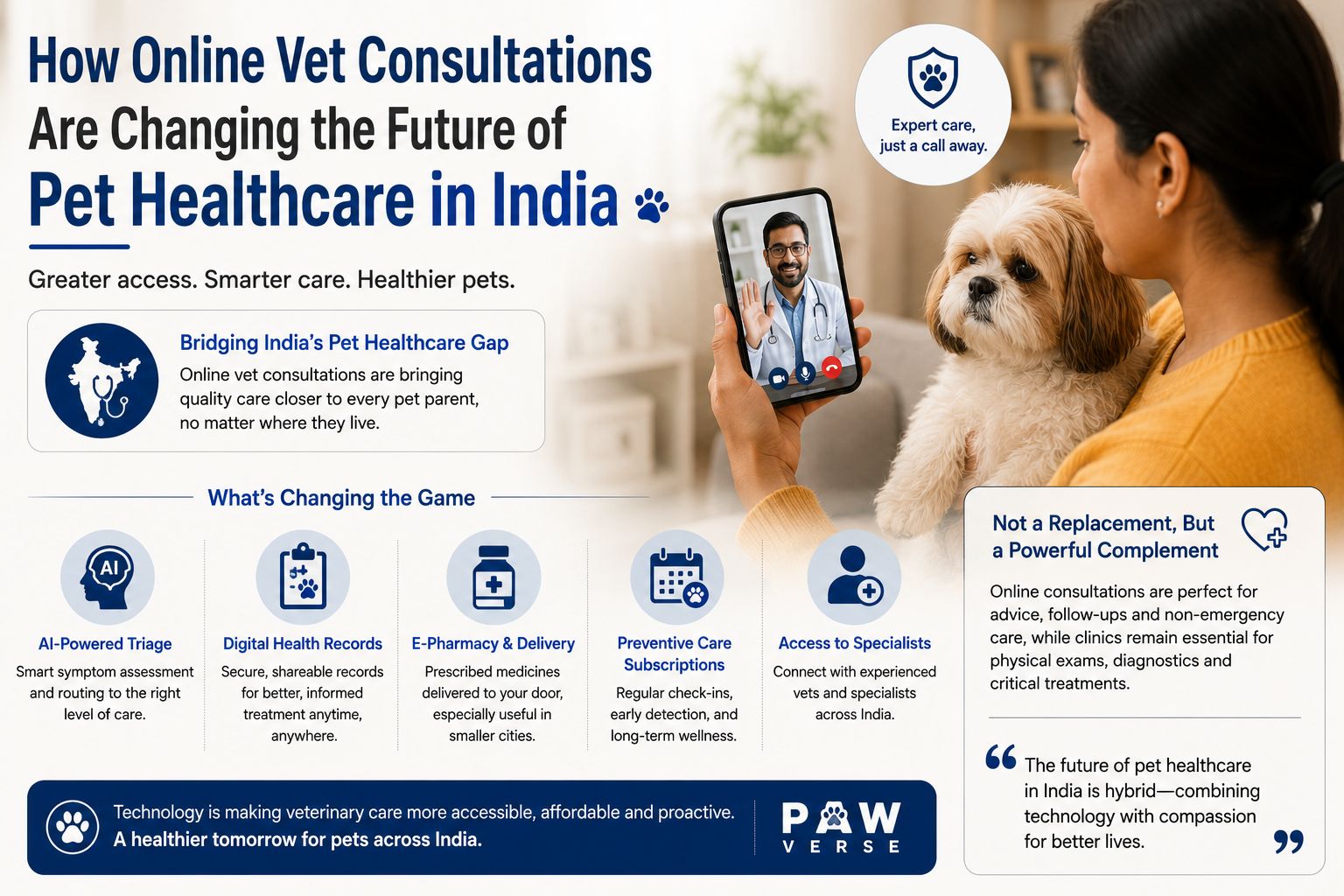
India's pet population has grown far faster than its veterinary infrastructure, and this mismatch is sharpest outside the major metros. High-quality veterinary care remains concentrated in a handful of large cities, while tier 2 and tier 3 cities, which now represent a genuinely significant and fast-growing share of pet ownership in India, face real shortages of veterinary professionals, limited access to specialists, and clinic infrastructure that hasn't kept pace with demand.
This isn't a niche problem. It's the primary reason online veterinary consultation went from a novelty to something a meaningful share of Indian pet owners now rely on. Telemedicine platforms are increasingly recognized across the industry as a genuine, if partial, bridge across this urban-rural and metro-to-smaller-city divide, not a replacement for a functioning clinic in every town, but a real answer for the gap that exists while that infrastructure slowly catches up.
The Numbers Behind the Shift
India's veterinary healthcare market is on a clear growth trajectory, valued at close to two billion dollars in 2026 and projected to keep expanding at a high single-digit annual growth rate over the next several years. What's notable isn't just the overall growth, it's what's driving it: rising pet humanization, government-backed vaccination and disease-prevention programs, and specifically, AI-enabled diagnostic and consultation tools that are being credited with improving access to quality care in both urban and rural regions.
Globally, the veterinary telemedicine and AI-in-animal-health markets are growing even faster than veterinary healthcare overall, with Asia-Pacific, India included, expected to be among the fastest-growing regions. That regional emphasis matters, it reflects an industry-wide expectation that countries like India, with large underserved pet populations and fast-growing smartphone and internet penetration, are where this shift will be most visible over the next several years, not just where it's happening as an afterthought of Western markets.
What's Actually Changing, Beyond "You Can Now Video Call a Vet"
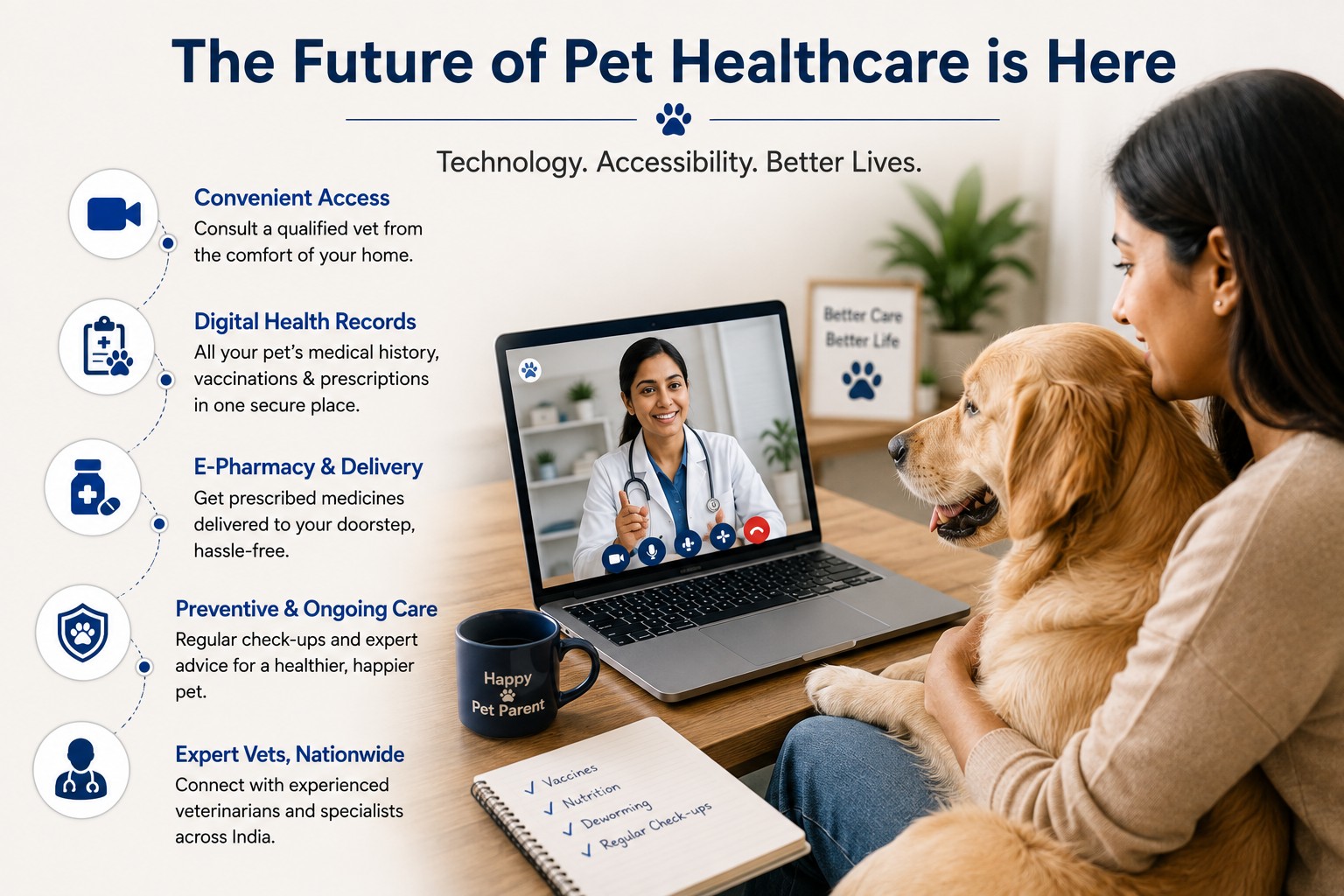
The headline version of this shift, "you can talk to a vet on your phone," undersells what's actually happening underneath it. A few specific developments are doing most of the real work.
AI-assisted triage is becoming the front door to care, not a gimmick bolted onto it. Platforms are increasingly using AI systems to take an initial description of symptoms, weigh urgency, and route pet owners toward the right level of care before a vet is even involved, similar to how PawVerse's Captain Scout works. This matters practically, it means the limited pool of available vets spends more time on cases that actually need their judgment, and pet owners get a faster initial read on whether something is urgent.
Digital health records are replacing the shoebox of old prescriptions. A pet's vaccination history, past diagnoses, and prescriptions living in one persistent, shareable record, rather than scattered across paper slips from different visits, is a genuinely underrated shift. It means a new vet, whether online or in a physical clinic in a different city, has the full picture instead of starting from zero, which matters enormously for pets with chronic conditions or families that relocate.
E-pharmacy and medicine delivery are closing the last-mile gap. A prescription is only useful if the medication is actually accessible, and integrated delivery of prescribed medicines is increasingly standard on serious platforms, particularly valuable in smaller cities where the nearest well-stocked pharmacy might itself be a real distance away.
Subscription and preventive care models are shifting the industry's center of gravity. Historically, veterinary care in India has been overwhelmingly reactive, you go when something is visibly wrong. The growth of subscription-based and ongoing-access healthcare models is a sign the industry is starting to build toward preventive, continuous care, catching issues through regular check-ins rather than only reacting once a problem is already serious.
The Regulatory Catch-Up Still Underway
None of this growth has been matched by an equally fast-moving regulatory framework, and it's worth being honest about that rather than glossing over it. Human telemedicine in India operates under a dedicated framework introduced in 2020. Veterinary telemedicine does not yet have an equivalent, purpose-built structure for companion animal care specifically, even as adoption accelerates well ahead of it. We've covered this gap in more depth in our online vet consultation guide, but the short version is that responsible platforms are currently filling that gap through self-imposed standards, individually verifying vets against the Veterinary Council of India, being transparent about what can and can't be handled remotely, rather than waiting for regulation to formally catch up.
This is worth watching over the next few years. As the market matures, dedicated regulatory guidance specific to companion animal telemedicine seems likely, and when it arrives, it will probably formalize practices that the more responsible platforms are already following voluntarily.
What This Means for Pet Parents Right Now
For someone deciding how to actually use this shift today, a few practical implications stand out. Geography matters less than it used to for getting a first opinion, a pet owner in a small town with no nearby specialist can now get a qualified read on a skin condition or a behavioral concern that would previously have meant a long trip or simply going without. Cost and time for routine and follow-up care are dropping meaningfully for the situations that don't need a physical exam, covered in more detail in our online vet vs clinic comparison. And preventive, ongoing care is becoming genuinely more accessible, rather than something only pet owners near a well-resourced metro clinic could realistically maintain.
None of this replaces the value of a good in-person vet relationship, and it isn't meant to. It changes what's possible in between those visits, and for a lot of Indian pet owners, in the gaps where a clinic visit was never realistically going to happen anyway.
What's Still Missing
It's worth being direct about the limits of this shift rather than presenting it as a complete solution. Physical exams, diagnostics, surgery, and vaccination still require in-person infrastructure that telemedicine cannot replace, and no responsible platform claims otherwise. Rural connectivity remains a real barrier, the areas with the least access to physical veterinary care are sometimes also the areas with the least reliable internet access, which limits how far telemedicine alone can close the gap. And trust and verification remain uneven across the industry, not every platform calling itself a vet consultation service is actually staffed by verified veterinarians, which means the burden of checking credentials still falls partly on pet owners, a topic we cover in how to choose a good veterinarian in India.
Where This Is Headed
A few developments seem likely over the next several years based on where investment and industry attention are currently concentrated. AI's role will likely expand beyond triage into more sophisticated pattern recognition, flagging subtle changes in a pet's health record over time that a single visit wouldn't catch. Regulatory frameworks specific to companion animal telemedicine will likely formalize, converging with what already exists for human telemedicine. And the line between online and in-person care will likely blur further, home vet visits, hybrid models combining remote triage with scheduled in-person follow-ups, and integrated health records that travel between both settings seamlessly.
What seems unlikely is online consultation fully replacing physical veterinary infrastructure, nor should it. The more realistic trajectory is a genuinely integrated system, where the choice between online and in-person isn't a tradeoff pet owners have to research and stress over, it's simply routed to whichever is appropriate for the situation at hand.
Frequently Asked Questions
Q: Is online vet consultation actually replacing traditional clinics in India?
A: Not replacing, complementing. Physical exams, diagnostics, surgery, and vaccination still require in-person care. What's changing is that routine, follow-up, and triage care is increasingly happening online first, reducing unnecessary clinic visits rather than eliminating the need for clinics altogether.
Q: How big is the online pet healthcare market in India expected to become?
A: India's broader veterinary healthcare market is projected to grow from around 1.76 billion dollars in 2026 to over 2.6 billion dollars by 2031, with telemedicine and AI-enabled tools cited as key growth drivers within that. Precise online-specific figures for India alone are harder to isolate, but the trend across every available industry report points toward continued strong growth well ahead of the sector overall.
Q: Is AI actually diagnosing pets now, or just assisting?
A: Currently, AI in this space is primarily used for triage and pattern recognition, assessing symptom descriptions to gauge urgency and route pet owners appropriately, rather than replacing a vet's diagnosis. Actual diagnosis and treatment decisions remain with licensed veterinarians, and that division is unlikely to change fundamentally even as the technology improves.
Q: Why doesn't India have clear regulations for veterinary telemedicine yet?
A: Veterinary telemedicine has grown faster than the regulatory frameworks built around human telemedicine, which had a dedicated structure introduced years earlier. This is a recognized gap in the industry, and responsible platforms currently operate through voluntary standards, like verifying vets against the Veterinary Council of India, while formal regulation is expected to catch up over time.
Q: Will this trend actually help pet owners outside major cities?
A: This is arguably the biggest driver of the whole shift. Tier 2 and tier 3 cities, which face the sharpest veterinary access shortages in India, stand to benefit disproportionately from telemedicine's ability to connect pet owners with qualified vets regardless of local clinic availability, though rural connectivity remains a real limiting factor in the most remote areas.
The Bottom Line
Online vet consultation isn't a passing convenience trend in India, it's a structural response to a genuine gap between how fast pet ownership has grown and how slowly veterinary infrastructure has kept pace, particularly outside major cities. The technology, AI-assisted triage, digital health records, integrated e-pharmacy, is maturing quickly, and the regulatory framework is playing catch-up in the way new industries often require.
For pet parents, the practical takeaway is straightforward: this shift is expanding what's possible for your pet's care, especially in the gaps between clinic visits, without replacing the clinic itself. Understanding both sides of that, what's genuinely improving and what still requires in-person care, is what actually lets you use it well.
Talk to a PawVerse vet online now, every vet on our platform is verified against the Veterinary Council of India, or explore our Pet Health Blog for more on where pet healthcare in India is headed.
With love, Team PawVerse
Have a question about your pet?
Chat with Captain Scout and reach a verified vet, guaranteed within 30 minutes.
Admin
Part of the PawVerse team, on a mission to make trusted pet healthcare simple and reachable for every Indian pet parent.
Your pet's health does not have to wait
Talk to a verified PawVerse vet from home. No travel, no waiting rooms, real answers within 30 minutes.