

Reviewed by PawVerse Veterinary Team
You get to this stage with every new puppy owner eventually. It's 11pm, the puppy has just done something you've never seen a dog do before and you're not sure if it's completely normal or the start of an emergency. This is probably where online vet consults earn their keep the most, not for dramatic crises but for the sheer volume of small, anxious, “is this okay?” questions that come with the first few months of puppy ownership.
This guide covers the questions new puppy owners bring to online consultations most often, what's genuinely urgent versus normal puppy weirdness, and how to get the most out of a consultation during this specific stage. For the full vaccination timeline, see our puppy vaccination schedule for India, and for broader first-year care, our puppy care guide India covers feeding, house training, and socialization in depth.
Why Puppies Generate So Many Consultation Questions
Puppies do a lot of things that look alarming to a first-time owner and are actually completely normal, and separating the two without experience is genuinely hard. A puppy's digestive system is more sensitive than an adult dog's, meaning minor stomach upset happens more often. Their immune systems are still developing through the vaccination window, which raises the stakes on symptoms that would be minor in a fully vaccinated adult dog. And nearly everything is a "first," the first time they vomit, the first limp, the first weird poop, without a baseline of what's normal for this specific dog yet established.
Online consultation is perfect for this stage because so many of these moments don’t require physical exam to resolve but an experienced vet to say “this is normal, here are the warning signs” or “this warrants a same day visit” quickly enough that the advice is actually useful at 11pm.
The Questions New Puppy Owners Ask Most
Vaccination timing and catch-up questions. By far the most common category is whether a dose was given on schedule, what to do about a missed or delayed appointment, and how much outdoor exposure is safe before the series is complete. Our puppy vaccination schedule India has the full timeline but a quick consultation is often the fastest way to sort a specific scheduling worry without waiting for a scheduled clinic slot.
Is this poop or vomit normal? Puppies produce a genuinely wide range of stool and occasional vomiting that falls within normal, especially during a food transition or after eating something they shouldn't have. A quick photo and description usually resolves this faster than an anxious night of googling.
Eating and appetite questions. Questions that come up all the time are what to feed, how much to feed, is my puppy underweight or overweight, and how to deal with changes in feeding. This is especially true because puppy food feeding guidelines on packaging are usually generic and not geared specifically to a puppy’s breed and activity level.
Crying, whining, and sleep issues. Especially in the first week or two, new owners often want reassurance about whether ongoing nighttime crying is normal adjustment or something more.
Teething and chewing behavior. Questions about excessive chewing, bleeding gums during teething, and how to manage destructive chewing phases are common enough to be a category of their own.
House training setbacks. Regression after initial progress worries owners more than it probably should, and it's a frequent, low-urgency but high-anxiety consultation topic.
Puppy-Specific Red Flags That Change the Urgency
A few patterns matter more in puppies than they would in an adult dog, and it's worth knowing them before you're in the moment.
Vomiting or diarrhea lasting more than a few hours is a bigger concern in puppies than adults due to how quickly they can become dehydrated relative to their small size. Not eating for more than 12 to 24 hours carries more weight in a puppy than the 24-to-48-hour guideline that applies to adult dogs. Lethargy that's unusual for that specific puppy, especially paired with any other symptom, deserves faster attention, since puppies can decline quickly relative to their limited reserves. Any symptom in an unvaccinated or partially vaccinated puppy that could suggest parvovirus, lethargy, loss of appetite, and vomiting or bloody diarrhea together, needs immediate veterinary attention rather than an online consultation first, given how serious and fast-moving parvovirus can be. Our dog emergency symptoms guide covers the broader list of signs that mean skip online consultation and get to a clinic directly.
Getting the Most Out of a Puppy Consultation
There are a few things that will help make a puppy consultation more beneficial. Keep handy your puppy’s exact age, breed and weight, as normal ranges for eating, sleeping and behaviour change quickly during this stage and a vet needs that info immediately. Roughly write down your puppy's vaccination dates because you'll be asked about scheduling all the time and a vet can move faster if they have the dates in front of them rather than trying to piece together history from memory. For anything physical, a limp, a rash, unusual stool, a short video or clear photo gets you a faster, more specific answer than a description alone. And if you're not sure whether something is worth a consultation at all, it usually is, the cost of asking is low, and a fast "that's normal" is worth the few minutes it takes.
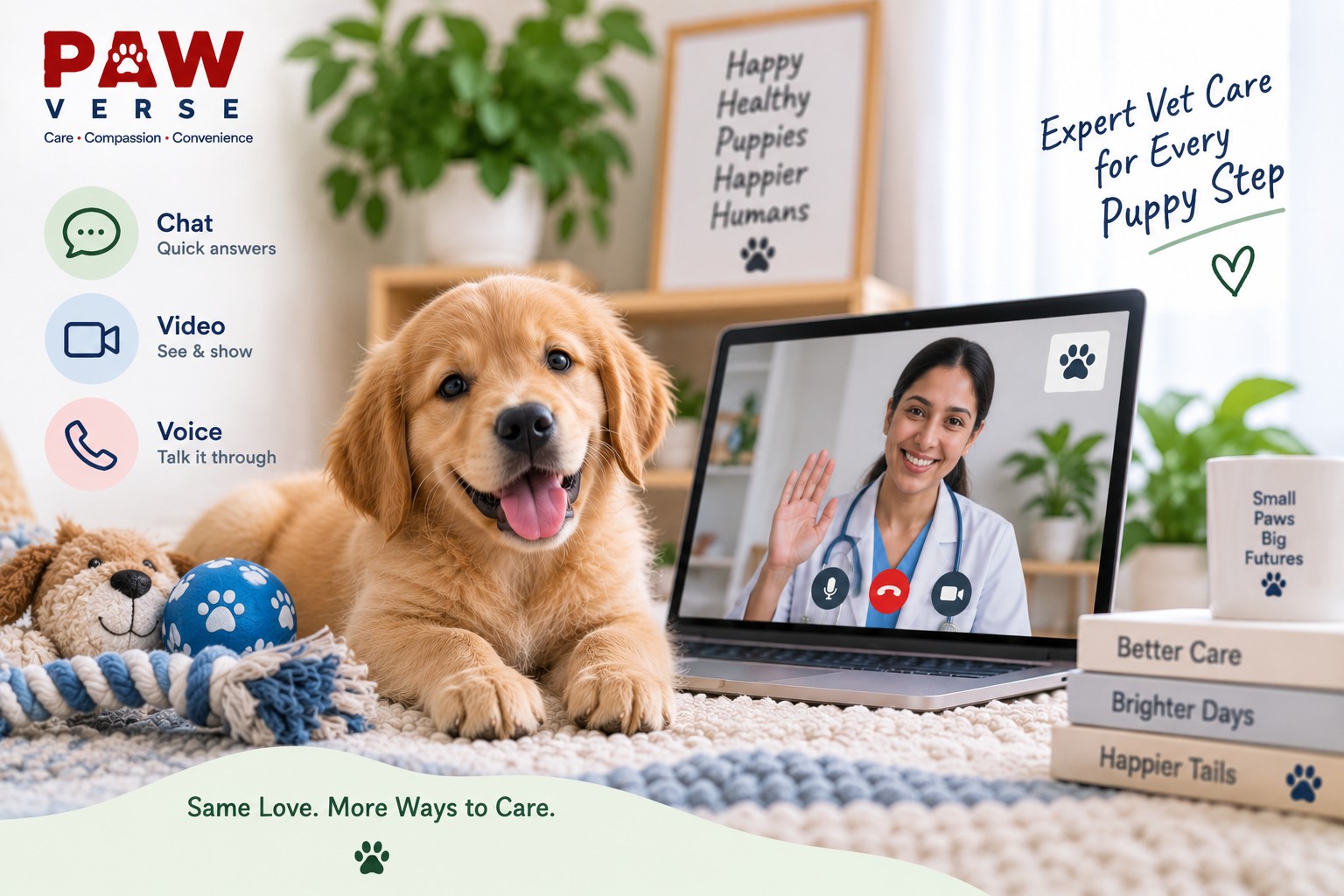
For guidance on choosing between chat, video, or voice for a specific concern, our guide on online vet consultation formats covers how to match the format to what you're actually trying to communicate.
When to Skip Online Consultation and Go Straight to a Clinic
Sign | Why It's Different in Puppies |
Vomiting or diarrhea lasting more than a few hours | Faster dehydration risk than in adult dogs |
Not eating for 12 to 24+ hours | Lower reserves than an adult dog |
Lethargy unusual for that puppy | Can decline quickly, don't wait to see if it passes |
Suspected parvovirus signs in an unvaccinated puppy | Fast-moving, serious, needs immediate care |
Pale gums | Possible shock or anemia |
Any fall, trauma, or suspected toxin ingestion | Needs evaluation regardless of visible symptoms |
Frequently Asked Questions
Q: Is it worth an online consultation for something as minor as puppy diarrhea?
A: “Online consultation is good for this kind of thing,” yes. A vet can help you tell the difference between mild diarrhoea that will resolve on its own and a pattern that requires a visit in person, so you don’t have to guess or sit on your hands waiting to see if the situation gets worse overnight.
Q: Can an online vet help with a missed vaccination dose?
A: Yes, a vet can review your puppy's schedule and advise whether to simply resume the series or restart part of it, depending on how long the gap has been. This is one of the more common and most useful puppy consultation topics.
Q: My puppy seems fine but I'm just anxious about something small, is that a waste of a consultation?
A: No. A large share of puppy consultations exist precisely for this kind of reassurance, and getting a quick, confident answer from a vet is a completely legitimate use of the service, not something to feel like you need to justify.
Q: Should I use video or chat for a puppy vaccination question? A: Chat usually works well for scheduling and timing questions since there's nothing visual to assess. Save video for anything physical, a rash, a limp, unusual stool, where the vet benefits from actually seeing what's going on.
Q: How is a puppy consultation different from an adult dog consultation? A: The underlying platform and process are identical, but the urgency threshold shifts. Symptoms that would be minor in a healthy adult dog, a day without eating, an afternoon of vomiting, carry more weight in a puppy due to lower physical reserves and, during the vaccination window, incomplete immune protection.
The Bottom Line
Puppy ownership generates a huge number of small, anxious questions, and online consultation is genuinely well suited to most of them, vaccination timing, feeding, house training, and distinguishing normal puppy weirdness from something that needs a closer look. The main thing to hold onto is that puppies carry a lower margin for waiting than adult dogs do, so when something crosses from "small question" into one of the red flags above, that's the moment to move from chat to a clinic rather than staying online.
Talk to a PawVerse vet online now for your puppy questions, or explore our puppy care guide India for the fuller first-year picture.
With love, Team PawVerse
Have a question about your pet?
Chat with Captain Scout and reach a verified vet, guaranteed within 30 minutes.
Admin
Part of the PawVerse team, on a mission to make trusted pet healthcare simple and reachable for every Indian pet parent.
Your pet's health does not have to wait
Talk to a verified PawVerse vet from home. No travel, no waiting rooms, real answers within 30 minutes.