
Reviewed by PawVerse Veterinary Team
Kittens bring a different flavour of new-owner anxiety than puppies do. It’s less “is this behaviour normal” and more “is my kitten actually okay,” because kittens tend to hide discomfort even at a few weeks old, an instinct they carry for life as cats. It makes the initial months harder to read than puppy ownership, and that's precisely why online consultation has become such a popular first stop for new kitten owners grappling with everything from litter training to a concerning sneeze.
This guide covers the questions new kitten owners bring to online consultations most often, what's genuinely urgent versus normal kitten development, and how to make a consultation as useful as possible during this stage. For the full vaccination timeline, see our cat vaccination schedule for India, and our cat not eating and cat litter box guides cover two of the most common kitten-adjacent concerns in more depth.
Why Kittens Are Harder to Read Than Puppies
Cats, even very young ones, are instinctively built to mask illness and vulnerability, a trait carried over from being both predator and prey in the wild. A kitten that seems "a little quiet" is often further along in a developing issue than the same behavior would suggest in a puppy, who tends to show discomfort more openly. This isn't just a personality quirk, it genuinely changes how new kitten owners should approach the threshold for reaching out, leaning toward asking sooner rather than waiting to see if something resolves on its own.
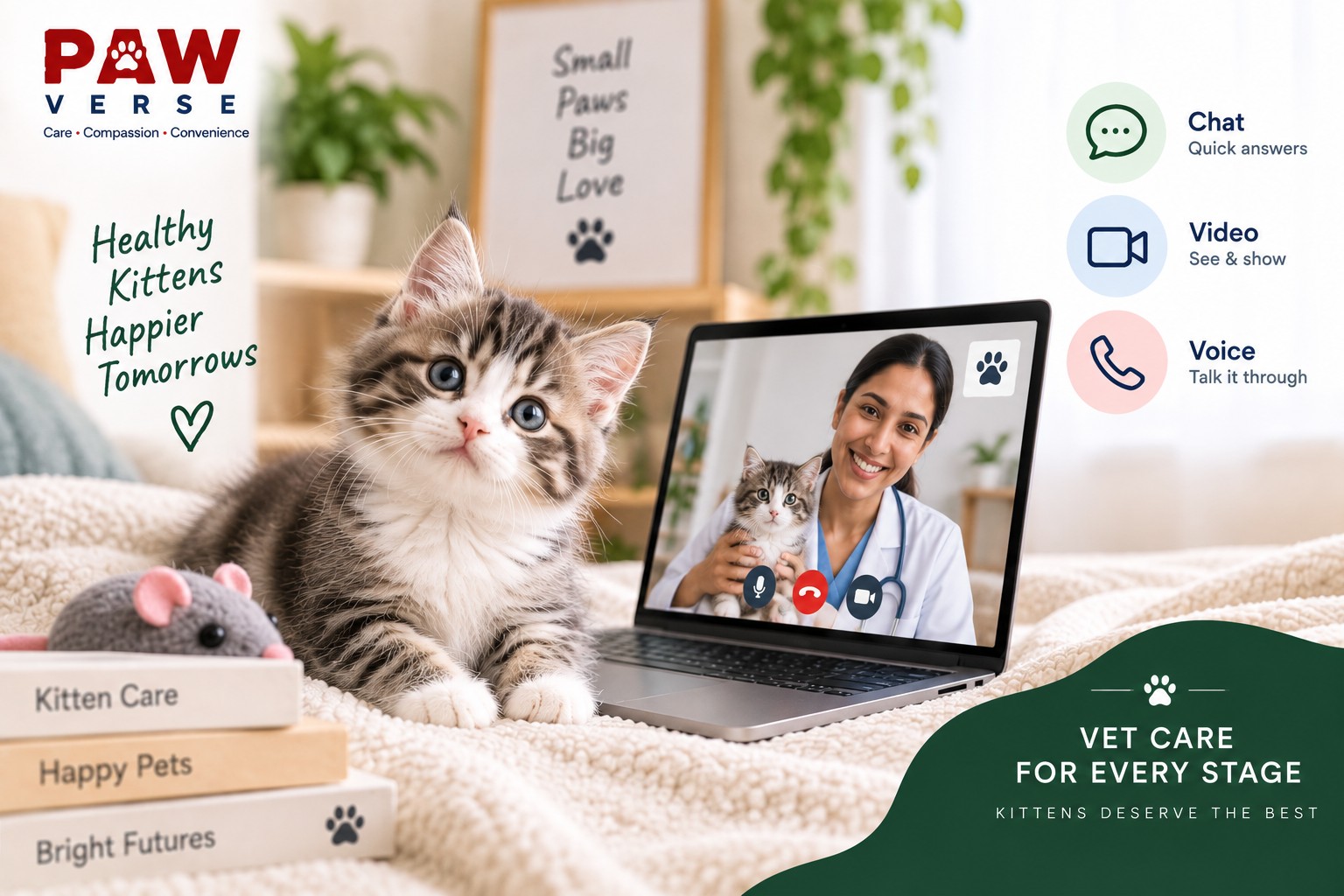
Online consultation fits this stage well for exactly this reason. A quick conversation about a subtle change, hiding a bit more, eating slightly less, a change in how a kitten is grooming, often reveals whether it's worth immediate attention in a way that waiting at home to see if it gets more obvious does not.
The Questions New Kitten Owners Ask Most
Litter box introduction . Accidents . Some of the most common questions during the early kitten stages are how to get a new kitten to use the litter box consistently, how to handle early accidents, and what type of litter and box setup to choose. Our guide to cat litter boxes goes into this more in depth, but a quick consult gets you over a particular set-up or behaviour hurdle faster.
Weaning and feeding schedules. Very young kittens have different feeding needs and frequency than adult cats, and questions about transitioning from a mother's milk or bottle feeding to solid kitten food come up constantly for anyone who's adopted an especially young kitten.
Sneezing and eye discharge. Upper respiratory infections in kittens are very common, particularly in kittens from shelters or multi-cat environments. Mild sneezing or runny eyes is one of the single most common kitten consultation topics because it is genuinely hard for a new owner to judge whether it is minor or needs treatment.
First vaccination and deworming timing. Similar to puppies, scheduling anxiety is common, confirming dates, catching up on a delayed dose, and understanding which non-core vaccines like FeLV actually apply to a specific kitten's lifestyle.
Socialization and handling questions. How much handling is appropriate at what age, introducing a kitten to other pets or children, and managing early biting or scratching during play all come up frequently as behavioral consultation topics.
Worms and deworming concerns. Visible worms, a pot-bellied appearance, or simply confirming a deworming schedule are common enough to be their own category, particularly for kittens with any outdoor-exposed history before adoption.

Kitten-Specific Red Flags That Change the Urgency
A few patterns carry more weight in kittens than the equivalent would in an adult cat, and it's worth knowing them in advance rather than discovering them under pressure.
Not eating for more than 12 hours is a bigger concern in kittens than the already-tighter guideline for adult cats, since very young kittens have minimal fat reserves and can develop dangerously low blood sugar quickly. Lethargy or a kitten that feels cold to the touch needs prompt attention, since young kittens can't regulate body temperature as well as adult cats. Persistent sneezing with reduced appetite, rather than mild, occasional sneezing, suggests an upper respiratory infection serious enough to need treatment rather than home monitoring. Diarrhea lasting more than a few hours risks rapid dehydration given a kitten's small size. Suspected panleukopenia signs in an unvaccinated kitten, lethargy, vomiting, and diarrhea together, needs immediate in-person care given how serious and fast-moving this illness is in young, unprotected kittens.
Getting the Most Out of a Kitten Consultation
There are a few things that make a kitten Consultation really more useful. Have your kitten's estimated age and weight ready because normal ranges change week-to-week a lot more at this age than for an adult cat. If your kitten came from a shelter or the street with no history, tell your vet up front, a vet will approach vaccination and general health assessment differently for a kitten with an unknown background than one with a known, documented history. For anything involving sneezing, eye discharge or visible symptoms, a short video or clear photo gives a vet far more to work with than a description alone. And because kittens hide illness well, don't wait for a symptom to become obvious before reaching out, a quiet, slightly-off kitten is worth a conversation sooner rather than later.
For guidance on choosing between chat, video, or voice for a specific concern, our guide on online vet consultation formats covers how to match the format to what you're actually trying to communicate, video tends to be especially useful for kittens given how much of their distress shows up in subtle body language rather than anything easy to type out.
When to Skip Online Consultation and Go Straight to a Clinic
Sign | Why It's Different in Kittens |
Not eating for 12+ hours | Risk of dangerously low blood sugar at this age |
Lethargy or feels cold to the touch | Limited ability to regulate body temperature |
Persistent sneezing with reduced appetite | Possible serious upper respiratory infection |
Diarrhea lasting more than a few hours | Faster dehydration risk given small body size |
Suspected panleukopenia signs, unvaccinated kitten | Fast-moving, serious, needs immediate care |
Pale or very pale gums | Possible anemia or shock |
Any fall, trauma, or suspected toxin ingestion | Needs evaluation regardless of visible symptoms |
Frequently Asked Questions
Q: Is it normal for kittens to sneeze sometimes?
A: Occasional, mild sneezing without other symptoms is common and often nothing to worry about but frequent sneezing especially with eye discharge or loss of appetite is one of the most common reasons kitten owners seek a consultation and is worth having checked rather than assuming it will go away on its own.
Q: Can an online vet help figure out a feeding schedule for a very young kitten?
A: Yes, feeding frequency and amount shift quickly during the first few months, and a vet can give you a schedule tailored to your kitten's estimated age and weight, which is especially useful if you're unsure of your kitten's exact age due to an unknown background.
Q: My kitten seems a little quiet but nothing obvious is wrong, should I still reach out? A: Yes. Because kittens and cats generally hide illness so effectively, subtle behavior changes are worth checking rather than waiting for something more obvious to develop. This is one of the most valuable uses of online consultation for kitten owners specifically.
Q: How is a kitten consultation different from an adult cat consultation?
A: The platform and process are the same, but the urgency threshold is tighter. Kittens have far less physical reserve than adult cats, meaning things like appetite loss or diarrhea become concerning faster, and certain illnesses, like panleukopenia in unvaccinated kittens, are specifically tied to this early life stage.
Q: Should I use video for a kitten litter box question?
A: Usually chat is enough for a general setup or training question, but if there's a specific behavior you're trying to describe, straining, a particular posture, video can help a vet assess it more accurately than a written description alone.
The Bottom Line
Kittens require a bit more vigilance than puppies do, not because they're more fragile in every sense, but because they're better at hiding when something's wrong. Online consultation fits this stage well, litter training, feeding schedules, sneezing, and vaccination timing are all common, low-friction topics, but the real value is in catching the subtle, easy-to-dismiss signs early rather than waiting for them to become impossible to ignore.
Talk to a PawVerse vet online now for your kitten questions, or explore our cat vaccination schedule for India for the full early vaccination timeline.
With love, Team PawVerse
Have a question about your pet?
Chat with Captain Scout and reach a verified vet, guaranteed within 30 minutes.
Admin
Part of the PawVerse team, on a mission to make trusted pet healthcare simple and reachable for every Indian pet parent.
Your pet's health does not have to wait
Talk to a verified PawVerse vet from home. No travel, no waiting rooms, real answers within 30 minutes.