
Reviewed by Dr. Gautam Unny, B.V.Sc, M.I.S.V.S. (Surgery), PGCVH (Veterinary Homeopathy), PGDSAT (GYNAECOLOGY)
Bringing home a kitten in India often comes with a flood of conflicting advice. The breeder says one thing, a neighborhood WhatsApp group says another, and half the vaccination charts you find online are built for American or European schedules that don't quite match how vets approach it here. What you actually want is simple: which shots, at what age, and why.
This guide lays out the full cat vaccination schedule used across Indian clinics, what each vaccine protects against, realistic costs, and the situations that come up often here, like vaccinating a rescued street kitten with no records. For a broader look at vaccination across both dogs and cats, our Complete Pet Vaccination Guide for India covers that ground as well.
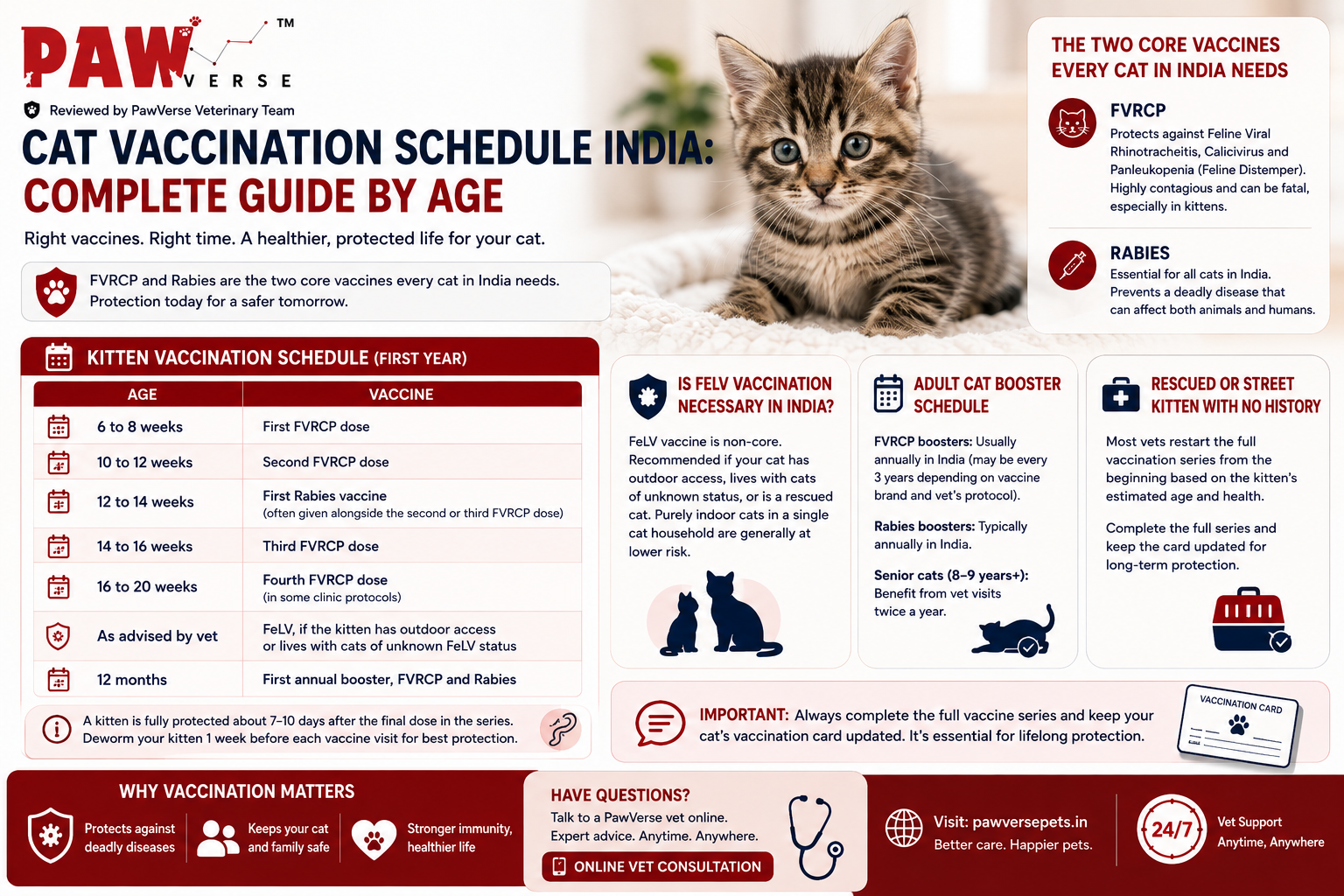
The Two Core Vaccines Every Cat in India Needs
Regardless of breed, indoor or outdoor lifestyle, or how the cat came into your home, two vaccines are considered essential for every cat in India.
FVRCP is a combination vaccine protecting against three viral diseases: feline viral rhinotracheitis, calicivirus, and panleukopenia. Panleukopenia in particular, sometimes called feline distemper, is highly contagious and can be fatal in kittens, which is the main reason this series starts so early and needs multiple doses.
Rabies is the other non negotiable vaccine, and this matters more in India than in most countries. India accounts for a large share of the world's human rabies deaths, largely tied to the scale of the stray dog and cat population and inconsistent vaccination coverage. Cats can both contract and transmit rabies, so this isn't a vaccine to treat as optional, even for a cat that never goes outside.
Kitten Vaccination Schedule (First Year)
Age | Vaccine |
6 to 8 weeks | First FVRCP dose |
10 to 12 weeks | Second FVRCP dose |
12 to 14 weeks | First Rabies vaccine (often given alongside the second or third FVRCP dose) |
14 to 16 weeks | Third FVRCP dose |
16 to 20 weeks | Fourth FVRCP dose, in some clinic protocols, particularly for kittens with an unclear vaccination start date |
As advised by vet | FeLV, if the kitten has outdoor access or lives with cats of unknown FeLV status |
12 months | First annual booster, FVRCP and Rabies |
A kitten isn't considered fully protected until about a week to ten days after the final dose in the series, so it's worth keeping a new kitten away from unknown or unvaccinated cats until that point. Ask your vet to confirm deworming timing as well, since parasites can reduce how well a kitten responds to vaccination, and most Indian vets recommend deworming a week or so before each vaccine visit.
Is FeLV Vaccination Necessary in India?
Feline Leukemia Virus vaccination is considered non core, meaning it's recommended based on lifestyle rather than for every cat automatically. It's worth discussing with your vet if your cat has any outdoor access, lives in a multi-cat household with cats of unknown status, or is a rescued cat whose history isn't fully known. Purely indoor cats in a single cat household are generally at lower risk, though your vet can advise based on your specific situation.
Adult Cat Booster Schedule
After the kitten series and the first annual booster, the schedule generally settles into a routine, though the exact interval depends on the vaccine brand and your vet's protocol.
FVRCP boosters are commonly given annually in India, though some vets space certain components out to every three years based on the specific vaccine used and the cat's health and lifestyle. Rabies boosters are typically given annually as well, even when a vaccine label suggests longer lasting protection, largely because of India's elevated rabies risk and the safety margin most vets prefer to build in.
Older cats, generally from around 8 to 9 years onward, benefit from more frequent overall vet visits, sometimes twice yearly, not necessarily because vaccine frequency changes but because age related health issues are easier to catch and manage early with more regular checkups.
Vaccinating a Rescued or Street Kitten With No History
This comes up often in India, where many cats are adopted from the street or rescued without any medical records. In this situation, most vets don't try to guess at a partial history. Instead, they treat the cat as unvaccinated and restart the full core series from the beginning, building a fresh catch up schedule based on the cat's estimated age and current health.
If you've recently adopted a cat with no vaccination history, bring them in for an exam as soon as possible so your vet can assess overall health, check for parasites, and start the series properly rather than assuming any prior protection.
How Much Does Cat Vaccination Cost in India?
Vaccine | Approximate Cost per Dose |
FVRCP | Rs 500 to Rs 1,500 |
Anti-Rabies | Rs 300 to Rs 800 |
FeLV (if applicable) | Rs 800 to Rs 1,500 |
Full kitten first-year series | Rs 2,000 to Rs 6,000 |
Annual adult booster | Rs 500 to Rs 2,500 |
These figures vary by city, clinic, and vaccine brand, and often include a consultation fee bundled into the visit. Metro clinics in cities like Mumbai, Delhi, and Bengaluru tend to sit toward the higher end of these ranges, while smaller cities and towns are often lower. Many clinics offer a bundled first-year package that works out more cost effective than paying per visit, so it's worth asking about package pricing when you bring in a new kitten.
Is It Normal for a Kitten to Feel Unwell After a Vaccine?
Yes, mild reactions are common and expected. These include a temporary dip in energy, slightly reduced appetite, mild fever, and soreness at the injection site, all of which usually resolve within 24 to 48 hours without any treatment needed.
What isn't normal, and needs same day veterinary attention, includes facial swelling, hives, persistent vomiting, difficulty breathing, or a fever lasting more than 48 hours. These signs of a stronger reaction are uncommon but do need prompt care when they happen.
Warning Signs After Vaccination
Sign | What It May Mean |
Mild lethargy or appetite loss, 24 to 48 hours | Normal, expected reaction |
Slight swelling or soreness at injection site | Normal, should resolve within a few days |
Facial swelling or hives | Possible allergic reaction, contact vet same day |
Difficulty breathing | Emergency, seek care immediately |
Persistent vomiting | Contact vet same day |
Fever lasting more than 48 hours | Needs evaluation |
A firm lump at the injection site that grows over weeks | Needs evaluation, though most injection site swelling resolves quickly |
What If a Booster Has Been Missed?
A short delay, a week or two, generally isn't a major setback, but don't assume it's fine to simply pick up wherever convenient without checking in. Contact your vet, since depending on how long it's been since the last dose, they may recommend resuming the schedule as is or restarting part of the series to rebuild proper immunity.
When to Contact a Vet
Reach out to a vet if:
You've adopted a kitten or adult cat with no known vaccination history
You're unsure whether FeLV vaccination applies to your cat's lifestyle
A booster has been missed by more than a couple of weeks
Your cat shows facial swelling, hives, or breathing difficulty after a vaccine
Fever or lethargy continues beyond 48 hours after a vaccine visit
You're moving cities and want to confirm any local registration requirements tied to vaccination
You don't need to visit a clinic in person for scheduling questions or general guidance. Through PawVerse, you can book an online vet consultation to go over your cat's specific vaccination plan. For facial swelling, breathing difficulty, or any reaction that feels severe, this is an emergency, our emergency vet consultation is available around the clock.
Frequently Asked Questions
Q: Do indoor cats really need vaccines in India?
A: Yes. Both FVRCP and rabies are recommended for every cat in India regardless of indoor or outdoor lifestyle. Indoor cats can still be exposed to viruses brought in on clothing or through brief contact with an outdoor cat near a window or door, and rabies exposure risk, while lower for strictly indoor cats, isn't zero given how easily a cat can slip outside unnoticed.
Q: At what age does a kitten get its first vaccine in India?
A: The first FVRCP dose is typically given between 6 and 8 weeks of age, with the rabies vaccine usually added starting around 12 weeks, depending on the vaccine label and your vet's protocol.
Q: How many FVRCP doses does a kitten need?
A: Most kittens need three doses, spaced three to four weeks apart, finishing between 16 and 20 weeks of age. Some vets extend to a fourth dose if the kitten's exact starting age is uncertain, which is common with rescued kittens.
Q: Is the FeLV vaccine necessary for every cat?
A: No, FeLV is considered a non core vaccine and is generally recommended based on lifestyle risk, particularly for cats with outdoor access or contact with cats of unknown FeLV status, rather than for every cat automatically. Your vet can help assess whether it applies to your specific cat.
Q: My cat was adopted from the street with no vaccination records, what happens now?
A: Most vets in this situation treat the cat as unvaccinated and start the full core series from the beginning, since there's no reliable way to confirm any prior protection. Bring the cat in for a health check as soon as possible so the series can start properly.
Q: How much does a full year of kitten vaccination cost in India?
A: A full first year kitten series, covering FVRCP and rabies, typically runs somewhere between Rs 2,000 and Rs 6,000 depending on the city and clinic, often with a bundled package available that reduces the overall cost compared to paying per visit.
The Bottom Line
Cat vaccination in India follows a fairly consistent pattern: an FVRCP series through the first four to five months, rabies starting around 12 weeks, an annual booster at one year, and consistent boosters after that. FeLV is worth a conversation with your vet if your cat has any outdoor exposure, and rescued cats with no history should be treated as a fresh start rather than an assumption.
If you're ever unsure where your cat stands, it's worth checking in with a vet rather than guessing, particularly with rabies given how much weight it carries in India specifically.
Talk to a PawVerse vet online now, or explore our Pet Health Blog for more India specific guides on keeping your cat healthy.
With love, Team PawVerse
Have a question about your pet?
Chat with Captain Scout and reach a verified vet, guaranteed within 30 minutes.
PawVerse Editorial Team
Practical pet health guides from the PawVerse team, written to help Indian pet parents understand what they are seeing and when to talk to a vet.
Your pet's health does not have to wait
Talk to a verified PawVerse vet from home. No travel, no waiting rooms, real answers within 30 minutes.