
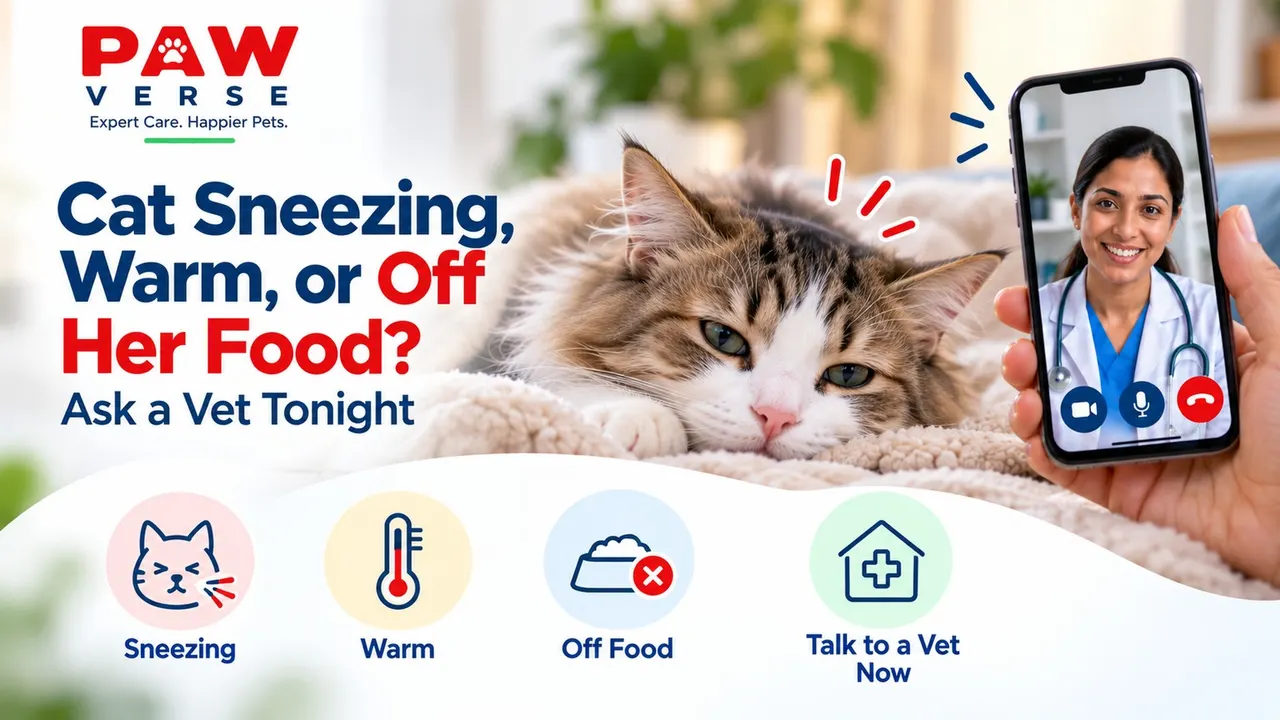
It's late. Your cat has sneezed four times in a row, her nose is wet, and she has gone to sit somewhere dark. Her dinner is still in the bowl. You touch her ear and it feels warm, but you've no idea whether that means anything.
A sneezing cat is usually dealing with something mild. But a cat who sneezes and has also stopped eating is a different situation, and that second part is the one to take seriously. The good news is that you can usually tell which kind of night you're having in a few minutes.
Cat sneezing, hiding, or turning down her food? Ask a vet about her now → A short video call is often enough to sort out what happens next.
VCI-registered vets · About ten minutes to connect, never over thirty · Video lets a vet see her eyes, nose, and posture · Delhi NCR and across India
Which Cat Is Yours?
The cat who sneezes but carries on. She's bright, still eating and drinking, still using the litter tray, and sneezing a few times a day, with maybe a little clear fluid from her eyes or nose. What it usually means: a mild upper respiratory infection, or just dust and irritation. Home care and close watching are usually enough. Talk to a vet if it hasn't improved after about a week.
The cat who sneezes and has gone off her food. She's quieter than usual, her nose is blocked, and she has eaten little or nothing today. What it usually means: cat flu is the most likely cause, and eating is now the thing to protect. Talk to a vet today.
The cat who is struggling. She is breathing with her mouth open or working hard to breathe, her gums look pale or bluish, her eyes are swollen shut or cloudy, there are ulcers in her mouth, she has eaten nothing for more than a day or two, or she is a young kitten or an elderly cat who is clearly unwell. What it usually means: this can't wait. Go to a clinic now, and call ahead.
If you're unsure which cat you have, that's exactly the question a vet can answer in minutes.
Why She Stops Eating, and Why It Matters
Cats eat with their noses first. A blocked nose dulls her sense of smell, so food stops being interesting, and some of the viruses behind cat flu also cause sore ulcers in the mouth, which makes eating painful. She isn't being fussy. She genuinely can't smell her dinner, or can't enjoy it.
The danger is what happens next. A cat who goes without food for more than about a day is at risk of fatty liver disease (hepatic lipidosis), which can develop quickly. Our guide on why cats stop eating covers it in depth, and the short version is this: if she hasn't eaten a meaningful amount in 24 hours, stop managing it at home and call a vet. By 48 hours it is an emergency.
Is She Running a Fever?
It's hard to say by touch. Warm ears or a warm nose don't reliably show a fever, and a cool one doesn't rule it out. Signs that suggest she isn't well include hiding, lethargy, shivering, and refusing food. Normal body temperature for a cat is roughly 38 to 39.2°C, and a reading above about 39.5°C counts as a fever. But taking a cat's temperature takes practice, and struggling with a frightened, unwell cat isn't worth it. Describe what you see, and let a vet judge.
What You Can Do Tonight
Warm her food. Slightly warming wet food releases more smell and often tempts a congested cat to eat. A strong-smelling food helps too.
Create some steam. Sit with her in a bathroom while a hot shower runs for about ten minutes, with her kept out of the water and the heat, to loosen the congestion.
Wipe her face gently with a warm, damp cloth, using a separate cloth for each eye and the nose.
Keep water available, and offer wet food for extra fluid.
Keep her warm and quiet.
Keep her apart from other cats. Cat flu spreads through sneezes, shared bowls, bedding, and even hands and clothes, so wash your hands between cats.
Please avoid:
Human cold and flu tablets, or any painkiller. Paracetamol, for example, is dangerous for cats, as our pet first aid kit guide explains.
Vapour rubs, menthol, eucalyptus, and essential oils, which can be toxic to cats.
Leftover antibiotics, which only help some infections and can do harm when they aren't needed.
Forcing food into her mouth.
Not sure which cat yours is? Let a vet decide in minutes →
Who Can Catch It
The viruses behind most cat flu, feline herpesvirus and feline calicivirus, spread easily between cats, but they don't pass to people or dogs. A cat who has had herpesvirus usually carries it for life, and it can flare up again when she's stressed. Calicivirus can linger in the environment for weeks, so it's worth cleaning bowls and bedding thoroughly, and keeping a sick cat away from others for a while after she looks better.
Kittens, elderly cats, and cats who aren't vaccinated are the most vulnerable. Our cat vaccination schedule for India covers the core vaccines that help prevent cat flu, and our guide on conjunctivitis in cats covers the eye side of it.
What a Vet Does With a Sneezing Cat
Sorts the urgency: go now, talk today, or watch.
Looks at her on video: her eyes, her nose, her posture, and how she's breathing.
Asks about eating and drinking, how long it has been, her age, and her vaccination history.
Tells you whether she needs an in-person exam, especially if she has stopped eating, has mouth ulcers, or is a kitten or a senior.
Sets up a plan: supportive care at home, what to watch for, and when to escalate. Many cases are viral and settle with supportive care, and a vet will tell you plainly if medicine is needed and whether an exam should come first.
Records it all, and arranges a follow-up, with medicine delivery if something is prescribed.
A screen can't look properly inside her mouth, run tests, or feed her if she won't eat. If she needs any of that, you'll hear it early.
How it works
Describe her to Captain Scout: the sneezing, her eating, and her energy.
A VCI-registered vet reviews her on video.
You leave with tonight's plan, and a clear list of signs that mean "go now."
Ready? Start now →
Questions Before You Book
Is a bit of sneezing normal for a cat?
Yes, an occasional sneeze in a bright, eating cat with no discharge usually isn't a concern. Frequent sneezing with eye or nose discharge is more likely an infection.
How long does cat flu last?
Mild cases often clear within 7 to 10 days with supportive care. A week with no improvement, or any worsening, is the cue to talk to a vet.
She's sneezing but eating fine. Do I need a vet?
Not necessarily tonight. Watch her closely, and book a consultation if she goes off her food, the discharge changes colour, or it carries on for more than a week.
How long can a cat go without eating?
Not long. Past 24 hours without a meaningful meal is a reason to call a vet, and 48 hours is an emergency.
Can I give her the antibiotics I have at home?
Please don't. Many cases are viral, and the right medicine depends on the cause.
Can my dog or I catch it?
The common viruses behind cat flu are cat-specific, and aren't known to spread to people or dogs.
Who will I speak to, and how fast?
A VCI-registered vet, typically within about ten minutes, and thirty is the guarantee. Start now →
Reaching Us About Your Cat
The quickest route is to start a consultation. For a question that can wait until morning, WhatsApp us on +91 96255 21168 (8am to 10pm IST). If she's breathing with her mouth open, her gums are pale or blue, or she's collapsed, call the emergency line on +91 96255 21168.
The Bottom Line
A cat who sneezes and carries on is usually fine. A cat who sneezes and stops eating needs help within a day, and a cat who is struggling to breathe needs help now. Warm her food, keep her comfortable and apart from other cats, skip the human medicines, and let a vet tell you which kind of night this is.
A cat who won't eat shouldn't be left overnight to see what happens. Get a vet's read →
With love, Team PawVerse
Have a question about your pet?
Chat with Captain Scout and reach a verified vet, guaranteed within 30 minutes.
PawVerse Editorial Team
Practical pet health guides from the PawVerse team, written to help Indian pet parents understand what they are seeing and when to talk to a vet.
Your pet's health does not have to wait
Talk to a verified PawVerse vet from home. No travel, no waiting rooms, real answers within 30 minutes.