
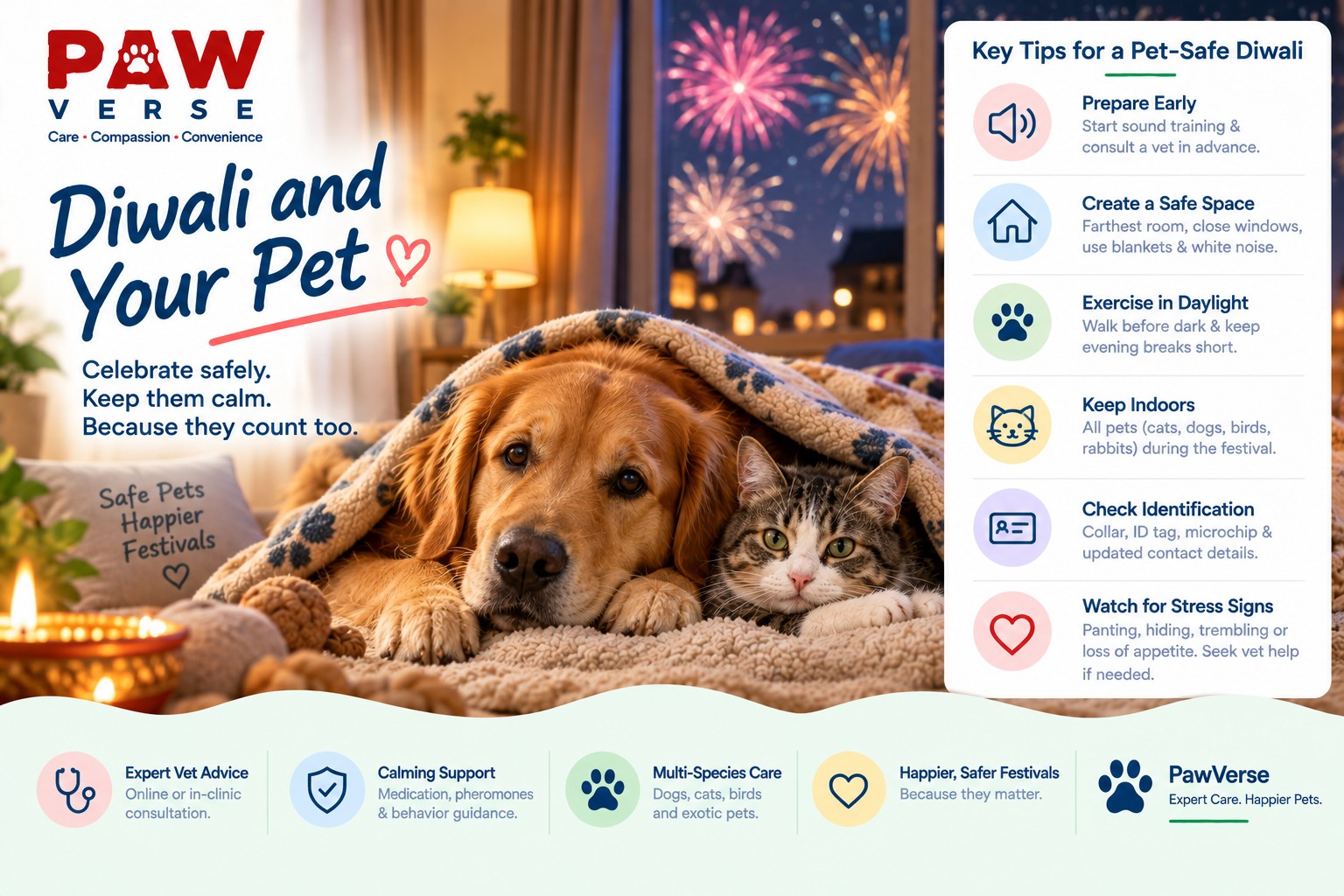
Diwali falls on Sunday, November 8, 2026, with the wider festival running from Dhanteras on November 6 to Bhai Dooj on November 10. That is about six weeks away, and it matters more than it sounds. The most effective things you can do for a pet who fears loud noise, gradual sound training, a proper conversation with a vet about medication, and sorting out identification, all need lead time. Leave everything to the night itself and you are left with crisis management instead of preparation.
Around half of all dogs show some level of fear of fireworks, and that fear tends to get worse year after year when nothing is done about it. Cats, rabbits, birds, and other small pets are affected too, often more quietly, which makes their distress easier to miss. This guide is a practical countdown, plus the hazards beyond noise that catch pet owners off guard every Diwali.
Why Diwali Is So Hard on Pets
Dogs and cats hear far better than we do, and sounds that are merely loud to us can be overwhelming, even painful, to them. Fireworks are also unpredictable. There is no pattern to prepare for, just sudden bangs, flashes of light, and the smell of smoke, often coming from every direction at once.
The other problem is duration. Diwali is not one night. Fireworks start around Dhanteras and continue through the festival, and in some regions celebrations run later, such as the delayed Igas celebration in parts of the Himalayan region on November 20, or Dev Deepavali in Varanasi on November 24. A pet who is already anxious can spend days in a state of stress rather than a single bad evening. It also helps to know that many noise-fearful dogs have some separation anxiety too, so being left alone during the noise usually makes things worse.
Signs Your Pet Is Struggling
Dogs commonly show panting, pacing, trembling, drooling, whining, hiding, or trying to escape or destroy things. Cats are quieter about it, and the signs are easy to miss: hiding for hours, wide pupils, refusing food, litter box accidents, or sudden overgrooming. Birds may thrash in the cage or panic at night, and rabbits and guinea pigs may freeze, hide, or stop eating.
One reassurance worth knowing: hiding on its own is not necessarily a problem. If your pet retreats to a safe spot and returns to normal soon after the noise stops, that is a healthy coping response, not a warning sign. The behaviors to take most seriously are attempts to bolt, since a panicked pet running into traffic is one of the most common Diwali emergencies.
Your Countdown Plan
Now to mid-October: start early
Begin gradual sound training. Play a recording of fireworks at a very low volume while your pet is doing something enjoyable, eating, playing, or getting treats, then raise the volume slowly over several weeks. The rule is to stay below the level that makes your pet anxious, and to stop and go back a step if they show fear. This approach is more established for dogs than for cats. If your pet is already severely noise-phobic, work with your vet or a veterinary behaviourist rather than trying it alone, since going too fast can make the fear worse.
Book a vet conversation now, not the week of Diwali. An online consultation counts. The point is to decide whether your pet needs more than home measures, and to leave enough time for a vet to advise on any medication properly, including how your pet is likely to respond to it. Our guide on what to expect in your first online vet consultation walks through how this works if you have not used one before.
Check identification. Make sure your pet wears a collar with an ID tag carrying your current phone number, that any microchip is registered with your up-to-date details, and that you have a clear recent photo of your pet saved on your phone.
Late October to the first week of November: build the safe space
Set up the retreat. Choose the room farthest from the noise, ideally with few or no windows, and add familiar bedding, water, and blankets to muffle sound. A crate can work, but only if your pet already sees it as a safe place, otherwise it can add to the panic. Let your pet spend calm time there beforehand so it is familiar rather than new on the night.
Add calming supports. Pheromone diffusers, Adaptil for dogs and Feliway for cats, work best plugged in near the safe space a few days before, rather than the same evening. Compression wraps, calming chews, and frozen stuffed toys are all worth trying before Diwali so you know what your pet actually tolerates. Have a white noise machine or a playlist ready to mask the sound.
Diwali week, November 6 to 10
Exercise in daylight. Walk your dog before it gets dark, and keep evening potty breaks short and on a leash, even in a fenced area. A tired dog copes better, and a leash removes the risk of a sudden bolt.
Keep cats and small pets indoors. This applies for the whole week, not just Diwali night itself.
Close windows and curtains, and play sound. Leave the TV, music, or white noise on at a volume that covers the fireworks. Feed earlier in the evening, before the noise builds.
Stay home if you can. Pets generally do better when they are not left alone during fireworks. Offering calm comfort is fine and can help, so there is no need to ignore a frightened pet. What does not help is punishment, which deepens the fear rather than fixing it.
Escape-proof the house. Diwali means visitors and open doors, so check that gates are shut, and be especially careful with balconies and windows in apartments. A pet in panic will try routes they would never usually consider.
After Diwali
Most dogs settle within an hour of the fireworks ending, but roughly one in twenty takes a week or more to fully recover. If your pet is still anxious, eating poorly, or behaving differently after several days, check in with a vet. Diwali is also the right moment to start a proper year-round desensitization plan, since the fear tends to escalate if left alone.
Medication and Calming Products: What Is and Is Not Safe
Many pets manage well with drug-free measures alone, pheromones, compression wraps, white noise, and enrichment. For pets with severe fear, a vet can prescribe anti-anxiety medication suited to the individual animal, sometimes short-term for the festival period and sometimes alongside a longer training plan.
What you should never do is give a human sedative, sleeping pill, or a leftover medication from another pet. Doses that are safe for people can be dangerous for pets, and the wrong drug can leave a frightened animal unable to move but still terrified. Our guides on why you should not buy pet medicine without a prescription and how online vet prescriptions work cover how to do this safely, and the practical point is to sort it out weeks ahead rather than in the last few days.
Cats, Birds, and Small Pets
Cats tend to hide, and that is fine. Give them a quiet interior room, a hiding spot such as a box or covered bed, and a Feliway diffuser, keep them strictly indoors, and let them come out on their own terms rather than pulling them out.
Birds should be moved to a quiet interior room away from windows, with the cage partly covered to reduce flashes and reduce the sense of exposure. Sudden noise at night can trigger panicked thrashing, so a calm, dim space matters. Our guide on pet bird care covers the broader picture of keeping birds healthy, including how easily stress affects them.
Rabbits and guinea pigs are prey animals and can be severely stressed by loud noise, so move them indoors into a quiet interior room and give them somewhere to hide. Rabbits in particular can decline quickly under stress, and a rabbit that stops eating is a same-day emergency, as covered in our guide on raising a rabbit in India. Our guinea pig care guide covers the same warning about appetite loss in guinea pigs.
Street and community animals are the ones with no safe room at all. If you feed strays, leave water and, where you can, a sheltered spot away from where crackers are being burst, and never tie up or restrain an animal near fireworks.
Diwali Hazards Beyond the Noise
Hazard | Why It Matters | What to Do |
Spent or unburnt fireworks | Contain oxidisers and metal salts that are harmful if chewed or swallowed, and curious pets sniff and mouth debris on walks | Keep pets away from burst areas, and call a vet immediately if ingestion is suspected, bringing the packaging if possible |
Chocolate and mithai | Chocolate is toxic to dogs and cats, and sugar-free sweets may contain xylitol | Keep sweets out of reach, and see our pet poisoning emergency guide |
Raisins, grapes, and dry fruit | Grapes and raisins can cause kidney failure in dogs, with no safe amount known | Keep dry fruit boxes closed and off tables |
Snacks with onion or garlic | Toxic to dogs and cats, even in small cumulative amounts | Do not share festival snacks |
Very oily, fried food | Can trigger vomiting or pancreatitis | Stick to the regular diet |
Diyas, candles, and sparklers | Burns, and cats can singe whiskers or tails | Place lamps high and out of reach, and never let pets near sparklers |
Smoke and poor air quality | Can worsen breathing in brachycephalic breeds, cats with asthma, and pets with heart disease | Keep windows closed on smoky evenings, and see our guides on dog breathing and coughing |
A Note on the Rules
The rules on firecrackers vary by state and city, and this year they are actively being revised. In Delhi-NCR, the Supreme Court permitted only certified green crackers for a limited period during Diwali 2025, with bursting restricted to fixed evening windows, and in August 2026 it asked the pollution regulator to consider relaxing noise limits ahead of this year's festival. Check your local orders closer to the date rather than relying on what applied last year.
For pet owners, the practical takeaway is that it does not change the plan. Restricted hours can help you predict the loudest window, but illegal bursting happens outside them, and even permitted fireworks are loud enough to frighten a noise-sensitive pet. Prepare for noise regardless of what the rules say.
If Your Pet Escapes or Is Injured
If your pet bolts, act quickly. Search the immediate area first, since frightened pets often hide close by rather than running far. Tell neighbors, post a clear photo on local community and WhatsApp groups, and contact nearby shelters and vets. A current ID tag and microchip are what make a lost pet findable, which is why they are on the checklist above.
Contact a vet immediately if your pet has chewed or swallowed firework remnants, has burns, is injured, or shows tremors, seizures, breathing difficulty, or pale or blue gums. Clinic hours often shift around festival days, so confirm your nearest emergency option in advance, our guide on finding a vet clinic near you covers how to do that. Our dog emergency symptoms and cat emergency symptoms guides cover the signs that mean go straight to in-person care.
The Bottom Line
Diwali is stressful for a large share of pets, but most of what helps is simple and works best when it starts early: a quiet safe space, gradual sound training, secure identification, and a conversation with a vet before the week begins rather than during it. Alongside the noise, the festival brings its own hazards, sweets, spent fireworks, and smoke, that are just as worth planning around.
Talk to a PawVerse vet online now to plan for your pet's Diwali, the best time to sort out a calming plan is weeks before the festival, not the night of. For anything urgent during the festival, our emergency vet consultation is available around the clock.
With love, Team PawVerse
Have a question about your pet?
Chat with Captain Scout and reach a verified vet, guaranteed within 30 minutes.
Frequently Asked Questions
Search close by first, alert neighbors and community groups with a clear photo, and contact local shelters and vets. Having a current ID tag and a registered microchip before Diwali makes recovery far more likely.
PawVerse Editorial Team
Practical pet health guides from the PawVerse team, written to help Indian pet parents understand what they are seeing and when to talk to a vet.
Your pet's health does not have to wait
Talk to a verified PawVerse vet from home. No travel, no waiting rooms, real answers within 30 minutes.