
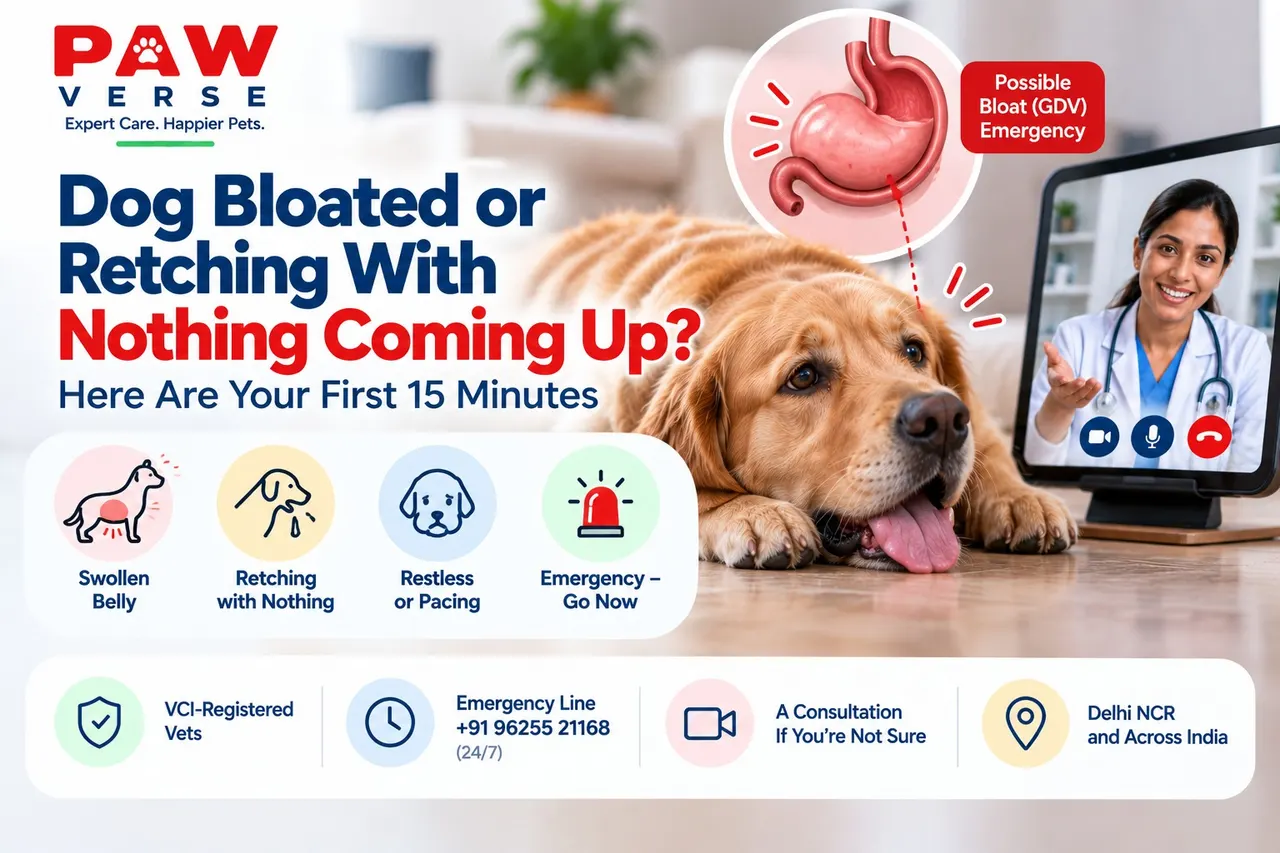
If your dog's belly looks swollen and tight, and he keeps heaving as if to be sick but nothing comes up, stop reading and move. This could be bloat, and bloat is one of the fastest emergencies a dog can have.
Everything below is arranged around the next fifteen minutes. Read the first section, make the call, and come back to the rest later.
Swollen belly and retching with nothing coming up? Go to an emergency clinic now, and call ahead. If you don't know where to go, call the emergency line on +91 96255 21168, which takes calls at any hour.
VCI-registered vets · Emergency line for go-now situations · A consultation if you're not sure · Delhi NCR and across India
Is It Bloat? The Two-Sign Test
Bloat, medically called gastric dilatation-volvulus (GDV), happens when the stomach fills with gas and can twist, cutting off its own blood supply. The tell-tale sign is unproductive retching: he tries to vomit, again and again, and little or nothing comes up, perhaps a little foam.
Likely bloat | More likely an upset stomach | |
|---|---|---|
Retching | Repeated heaving, with little or nothing coming up | Brings up food, bile, or liquid, and often feels better afterwards |
Belly | Swollen, hard, or tight like a drum, especially behind the ribs | Soft |
Behaviour | Restless, pacing, can't get comfortable, drooling heavily | Tired, but able to settle |
Breathing and gums | Fast, shallow breathing, pale or grey gums | Normal |
Later | Weakness, collapse | Improves with rest |
Unproductive retching, with or without a swollen belly, is reason enough to go. If you are unsure, treat it as bloat. Being wrong costs you a night. Being right and waiting can cost his life.
The First 15 Minutes
Minutes | What to do |
|---|---|
0 to 2 | Take away food and water. Give him nothing, no tablets, no home remedy, no oil. Note the time the retching began and when he last ate |
2 to 5 | Call a clinic that is open, or the emergency line. Ask one question before you leave: can you do emergency stomach surgery tonight? Not every clinic can, and you don't want to lose time at the wrong door |
5 to 10 | Get him into the car. A big dog is hard to lift alone, so get a second person, and use a blanket as a sling if he can't walk. Keep him calm, and don't let him jump |
10 to 15, and on the road | Have someone sit with him. Keep the clinic informed if you're delayed. Take only what you need: your phone, and any packaging if you think he swallowed something |
What to Tell the Clinic
Say these four things in the first thirty seconds:
His breed, size, and age
That he has a swollen belly and unproductive retching, and when it started
When he last ate and drank, and what
Any collapse, pale gums, or fast breathing
Then ask whether they can operate tonight, and how long they'll need to prepare for you.
What Not to Do
Don't wait to see if it passes, or until morning.
Don't give gas medicines, antacids such as Eno, oils, or any home remedy. There's no home treatment for bloat.
Don't try to make him vomit.
Don't walk him around to settle him.
Don't drive around looking for a clinic without phoning first.
Don't wait for a consultation before leaving. If the signs are there, go.
Why the Hurry
When the stomach twists, the tissue starts losing its blood supply almost immediately, and the longer treatment is delayed, the more damage becomes permanent. Untreated, bloat is fatal, and it can progress in a matter of hours. With prompt treatment, most dogs survive, with reported survival rates of roughly 75 to 90 percent, and how alert a dog is when he arrives is closely linked to how well he does.
None of that can be managed at home. The only treatment is emergency decompression and, if the stomach has twisted, surgery.
Which Dogs Are Most at Risk
Large and giant breeds with deep, narrow chests. Great Danes, German Shepherds, and Standard Poodles are the breeds most often named, and other deep-chested breeds such as Dobermans, Boxers, Rottweilers, and Saint Bernards are commonly listed too.
Dogs with a close relative who has bloated
Dogs who eat one large meal fast, and anxious dogs
Older dogs, although it can strike at any age
Any dog can bloat, so don't rule it out in a smaller breed.
After the Emergency: Preventing a Repeat
A dog who has bloated is very likely to do it again. Without surgery to tack the stomach to the body wall, called a gastropexy, the recurrence rate is reported at well over 75 percent. For high-risk breeds, vets also discuss doing a gastropexy at the same time as spaying or neutering, before an emergency ever happens. Our Golden Retriever health guide covers neutering timing for one of the breeds this question comes up for.
Day-to-day measures are commonly advised: smaller, more frequent meals, calmer mealtimes, and avoiding hard exercise around meals, though the evidence for some of these is mixed. One study linked raised food bowls to a higher risk, so they aren't recommended.
Where a Consultation Fits, and Where It Doesn't
If your dog has the signs above, a consultation is not the next step. The next step is the clinic. Where a PawVerse vet can help:
When you're unsure. A single bout of retching, or a full belly after a big meal in a small dog, can be triaged in minutes.
After the emergency. Questions about recovery, feeding, and whether a gastropexy makes sense.
Before one ever happens. If you have a deep-chested breed, a plan for feeding, risk signs, and the neutering conversation.
What a video call can't do is take an X-ray, decompress a stomach, or operate. If your dog needs any of those, you'll be told to go, not to wait.
How it works
Tell Captain Scout your dog's breed and what you're seeing.
A VCI-registered vet joins and tells you whether to go now.
You get a plan, saved to his health record.

Not sure whether it's bloat? Ask a vet right now →
Quick Answers
How fast can bloat kill?
In some dogs, within hours of the stomach twisting. It is treated as a same-hour emergency, not a next-day one.
My dog's belly is swollen but he isn't retching. Is it still bloat?
It can be. A swollen, hard belly in a large dog is reason enough to call a clinic straight away.
Can small dogs get bloat?
It is far more common in large, deep-chested breeds, but it is not limited to them.
Is there anything I can give him at home?
No. Giving him something can waste time and make things worse.
How much does bloat surgery cost in India?
It varies widely by city and clinic. Major emergency surgery in a metro can run from tens of thousands of rupees into six figures, as our vet visit cost guide explains. Ask for an estimate when you phone, but don't delay leaving to negotiate it.
He survived. Will it happen again?
It is likely without a gastropexy, which is why vets discuss it after a first episode.
How soon will someone pick up if I'm not sure?
Usually around ten minutes, with half an hour as the longest wait. Start now →
Keep This Number
Save +91 96255 21168 in your phone now. It's the emergency line, and it takes calls at any hour. For prevention questions and anything that isn't urgent, use a consultation, or our phone line, +91 96255 21168 (8am to 10pm IST).
The Bottom Line
Retching with nothing coming up, plus a belly that is getting bigger or harder, is the one combination you should never wait out. Pick up the bowls, give him nothing else, phone ahead, confirm the clinic can operate, and set off. The rest, including prevention, can wait until he's safe.
If you're asking whether to wait, the answer is no. Phone +91 96255 21168 now, or ask a vet →
With love, Team PawVerse
Have a question about your pet?
Chat with Captain Scout and reach a verified vet, guaranteed within 30 minutes.
PawVerse Editorial Team
Practical pet health guides from the PawVerse team, written to help Indian pet parents understand what they are seeing and when to talk to a vet.
Your pet's health does not have to wait
Talk to a verified PawVerse vet from home. No travel, no waiting rooms, real answers within 30 minutes.