Most people find their vet like that, a neighbour said, or the nearest clinic showed up first on a map search and that became the default for years without much thought. It usually turns out all right. But when something does go wrong, a diagnosis that doesn't sit right, a treatment that isn't working, a bill that isn't adding up, that's when people realise they never actually evaluated whether this was a good vet, just a convenient one.
This guide tells you what really separates a good vet from a mediocre one in India, what credentials to look for, what questions to ask before you need them in an emergency, and what signs to look for if it’s time to switch. Once you have found the right vet, our Complete Pet Care Guide is a good read to have on hand as a companion to everyday care.
Why This Is Worth Getting Right
A good vet relationship grows over the lifetime of your pet. They build a history of your individual animal, notice subtle changes because they know what's normal for your pet specifically, and you build enough trust to actually follow through with their advice instead of second guessing it or shopping around every time something comes up. A mismatched vet relationship tends to do the opposite, appointments that seem rushed, explanations that don't quite land and a nagging sense you're not getting the full picture.
This matters more in India specifically because veterinary regulation and quality control vary more widely than in some other countries, which puts more responsibility on pet owners to do a bit of their own vetting, no pun intended, before committing to someone long-term.
Credentials Worth Actually Checking
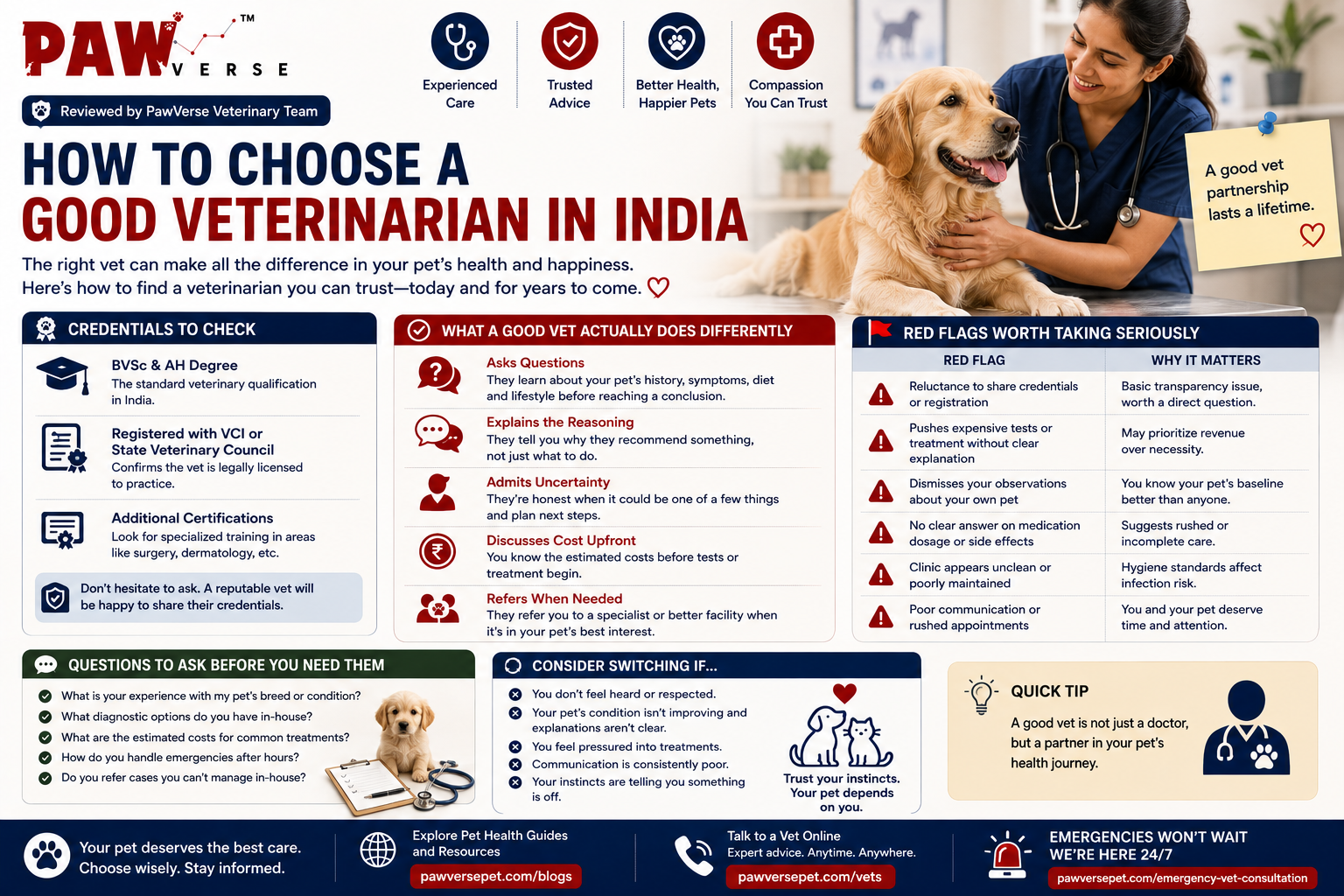
A BVSc & AH degree. This stands for Bachelor of Veterinary Science and Animal Husbandry, the standard veterinary qualification in India. It's reasonable to ask directly, or look for it displayed in the clinic, most legitimate vets have no issue with this being visible or confirmed.
Registration with the Veterinary Council of India or a state veterinary council. This is the professional registration that confirms a vet is legally licensed to practice. Reputable clinics and platforms display this, and it's a fair question to ask if it isn't obvious.
Additional certifications for specialized care, if relevant to your situation. Surgery, dermatology, and internal medicine sometimes have vets with additional focused training or experience beyond the base degree, worth asking about if your pet has a specific ongoing condition.
None of this means an unregistered or newly qualified vet is automatically bad, but for anything beyond routine care, verifying basic credentials is a low-effort way to rule out a real risk.
What a Good Vet Actually Does Differently
Credentials set a baseline, but they don’t tell the whole story of what makes a truly good vet vs. an average one. Some practical signs to look for in real visits:
They ask questions before they make a diagnosis. So a vet who looks at your pet for thirty seconds and immediately prescribes something without asking about symptoms, timeline, diet or history is moving faster than what is generally considered good diagnostic practice.
They explain the why behind it not just the instruction. “Give this medication twice daily” is an instruction. “This is likely a bacterial infection based on what I’m seeing so we’ll start antibiotics and recheck in a week if it’s not improving” is reasoning you can actually evaluate and remember.
They are upfront about the uncertainty. For ambiguous symptoms , a vet who says " this could be one of a few things , lets start with the most likely and reassess " is often more trustworthy than one who sounds certain about everything on a first look .
They discuss costs before they start testing or treatment, not after. Surprise billing is a common complaint in Indian veterinary care and a good clinic manages expectations from the beginning.
They will tell you when something is beyond their scope. A vet who will refer you to a specialist or a better facility for something serious is putting your pet’s outcome ahead of keeping the visit in house.
Red Flags Worth Taking Seriously
Red Flag | Why It Matters |
Reluctance to share credentials or registration | Basic transparency issue, worth a direct question |
Pushes expensive tests or treatment without clear explanation | May prioritize revenue over necessity |
Dismisses your observations about your own pet | You know your pet's baseline behavior better than a vet meeting them once |
No clear answer on medication dosage or side effects | Suggests rushed or incomplete care |
Clinic appears visibly unclean or poorly maintained | Hygiene standards affect infection risk, especially for surgery |
Unwilling to provide a written prescription or invoice | Makes it hard to get a second opinion or track treatment history |
Consistently unavailable for follow-up questions | Ongoing care needs some accessibility beyond the single visit |
One red flag in isolation isn't necessarily disqualifying, everyone has an off day. A pattern across visits is what actually matters.
Questions Worth Asking Before You Need Them
It's easier to evaluate a vet calmly during a routine visit than during a crisis. A few worth working into an early conversation:
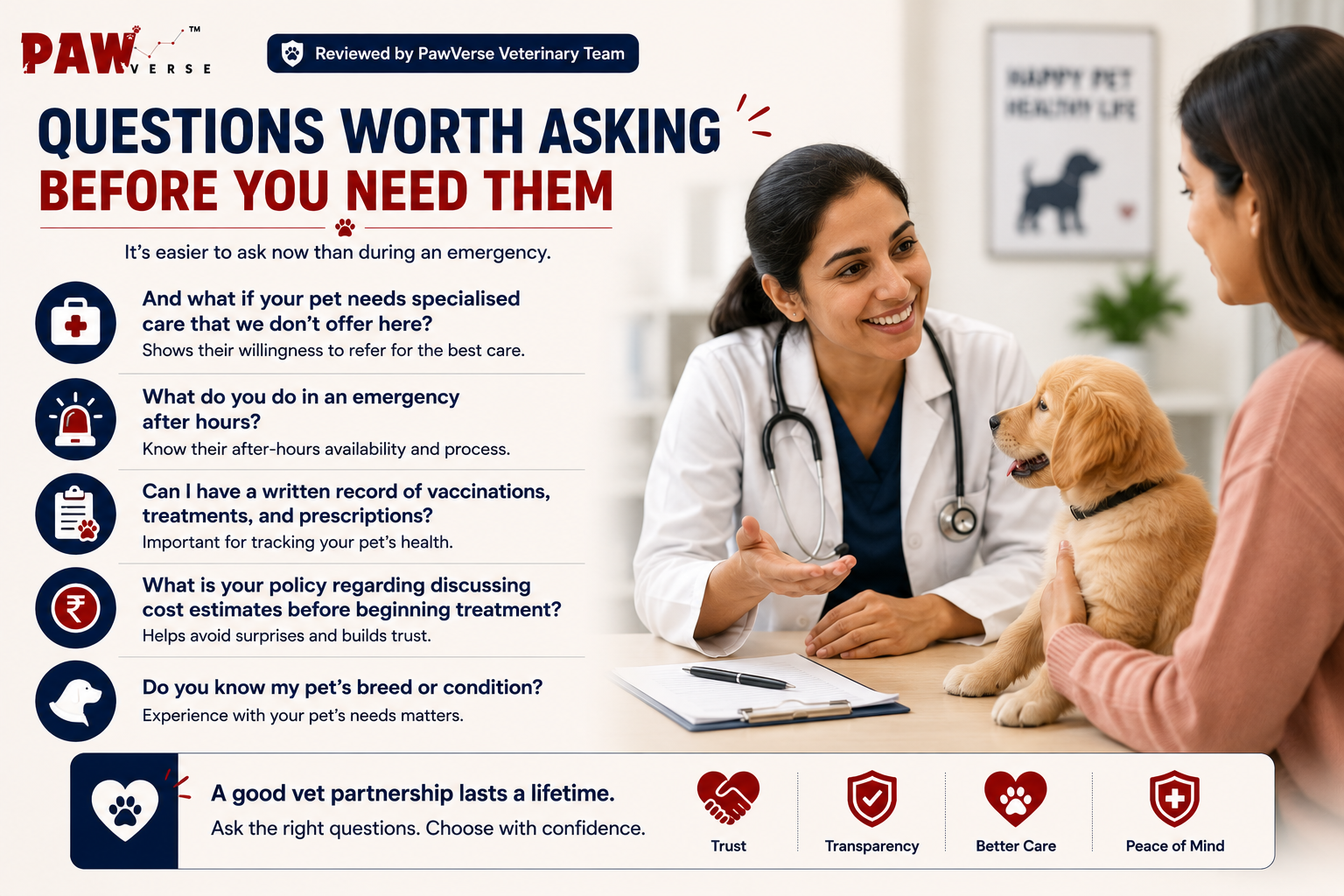
And what if your pet needs specialised care that we don’t offer here?
What do you do in an emergency after hours?
Can I have a written record of vaccinations, treatments, and prescriptions?
What is your policy regarding discussing cost estimates before beginning treatment?
Do you know my pet’s breed or condition?
A vet's answers to these, and how comfortable they seem answering them, tells you a lot more than a single successful visit for a minor issue would.
In-Person vs Online: Different Tools, Not Competing Ones
A good veterinary relationship is increasingly a combination of in-person and online, and it’s worth considering what each is really good for rather than choosing one. In-person vets are still needed for physical exams, diagnostics like bloodwork and imaging, surgery and vaccination. Online consultation is great for triage, follow-ups, second opinions and everyday questions that don’t require hands-on examination, discussed in more detail in our online vet consultation guide.
The same credential-checking logic applies to online platforms. A platform that verifies its vets against the Veterinary Council of India and is transparent about which vet you're actually speaking to is a meaningfully different experience than one that treats vets as interchangeable and anonymous.
Choosing a Vet for Specific Needs
For puppies and kittens, look for a vet who's clear and organized about vaccination scheduling, since a missed or poorly tracked dose can leave a real gap in protection, covered in our puppy vaccination schedule for India.
For senior pets, a vet who proactively discusses age-related screening, kidney function, joint health, dental disease, rather than only reacting to symptoms as they appear, tends to catch issues earlier.
For a specific breed with known predispositions, some experience with that breed's common issues is genuinely useful, a vet who's treated many Golden Retrievers will likely be faster to recognize breed-typical joint or skin issues than one encountering the breed for the first time.
For exotic pets, birds, or less common animals, not every clinic has relevant experience, and it's worth confirming this specifically before an emergency arises, rather than discovering the gap under pressure.
When It's Time to Switch Vets
One bad visit isn't a reason to leave, these things happen. However, there are a few patterns that are worth taking as a real signal: a diagnosis or treatment plan that just doesn’t seem to work and isn’t being reassessed; communication that consistently leaves you confused rather than informed; a pattern of cost surprises; or just a persistent gut feeling that you’re not getting the full picture. “Trusting an instinct and getting a second opinion when something feels off isn’t being difficult, it’s standing up for a pet who can’t stand up for themselves.”
Getting a second opinion doesn't require confrontation with your current vet. A written record of vaccinations, treatments, and diagnoses, which any transparent clinic should readily provide, makes this straightforward.
Frequently Asked Questions
Q: How do I verify a vet's registration in India?
A. You can ask the vet or clinic directly for their registration number with the Veterinary Council of India or state veterinary council. Any vet who is legitimately practicing should be able to give this to you without any hesitation. This verification process is usually clearly detailed on reputable online platforms as part of their own network vetting procedures.
Q: Is a more expensive clinic automatically a better one?
A: Not always. Sometimes, higher prices mean better equipment, more experienced staff, and more thorough care. Sometimes, it is just location and overhead costs. Cost is one of the signals in this guide that you should consider, but not the only one – you should also consider communication quality and transparency.
Q: Should I stick with one vet or is it fine to see different vets for different issues?
A: Having one primary vet who knows your pet's history well is generally valuable, especially for ongoing conditions, but seeking a specialist or a second opinion for a specific complex issue is completely reasonable and doesn't need to replace your primary relationship. Many good primary vets will refer you out themselves when appropriate.
Q: What should I do if I disagree with a diagnosis?
A: Ask the vet directly what led to that conclusion and what alternatives were considered, a confident, transparent vet should be able to walk you through their reasoning. If you're still unsure, seeking a second opinion, in person or through an online consultation, is a normal and reasonable step, not something that should require justifying to your current vet.
Q: How important is it that a vet has treated my specific breed before?
A: That's a real benefit for breeds that have known predispositions. The speed of recognition makes a difference in things like joint issues in large breeds or brachycephalic airway issues in flat-faced breeds. However, a good general vet with good diagnostic habits can be an excellent vet even if he doesn't have extensive breed experience. There are many common health issues that don't depend on the breed.
Q: Can an online vet replace my regular in-person vet entirely?
A: No, and a good online platform will tell you that. Online consultation is great for triage, follow-up and everyday questions, but physical exams, diagnostics, surgery and vaccination require in-person care. The two work best as complementary parts of your pet’s overall care, rather than as a replacement for each other.
The Bottom Line
A good veterinarian in India is identifiable through a combination of verifiable credentials, transparent communication, and a pattern of care that holds up over multiple visits, not just a convenient location or a single good experience. Taking the time to check credentials and ask a few direct questions early, before you're in a stressful situation, makes a real difference when it actually counts.
If you're currently choosing between vets, or reconsidering your current one, trust the pattern you're seeing over any single visit, good or bad.
Talk to a PawVerse vet online now, every vet on our platform is verified against the Veterinary Council of India, or explore our Pet Health Blog for more guides on navigating pet healthcare in India.
With love, Team PawVerse
Have a question about your pet?
Chat with Captain Scout and reach a verified vet, guaranteed within 30 minutes.
PawVerse Editorial Team
Practical pet health guides from the PawVerse team, written to help Indian pet parents understand what they are seeing and when to talk to a vet.
Your pet's health does not have to wait
Talk to a verified PawVerse vet from home. No travel, no waiting rooms, real answers within 30 minutes.