
Reviewed by PawVerse Veterinary Team
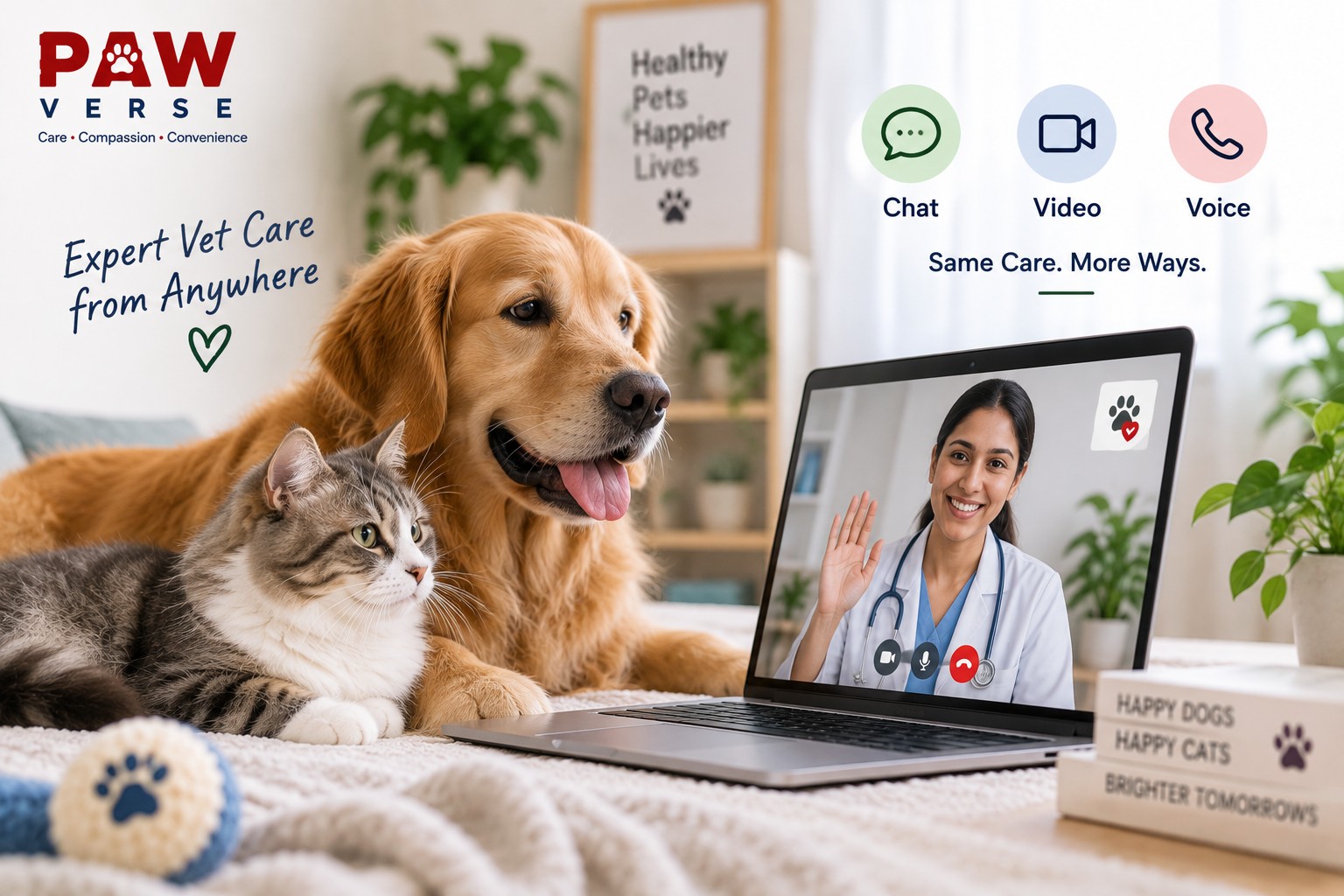
Your dog won't stop licking one paw, or your cat's been hiding under the bed since yesterday, and you're reaching for your phone rather than your car keys. Whether you type it out in a chat, hop on a video call, or just want to talk it through by voice, the goal is the same: a real answer from a real vet, fast. This guide covers what online vet consultation actually looks like for dogs specifically, for cats specifically, and which format, chat, video, or voice, actually fits which situation.
The Quick Answer
Online vet consultation works well for both dogs and cats for the same broad set of situations, symptom triage, follow-ups, behavioral questions, medication questions, and diet guidance. The species-specific difference isn't really about the platform, it's about what to watch for: dogs tend to show distress more visibly, while cats hide illness far more effectively, which changes how quickly you should act on subtle signs. As for format, chat suits quick, factual questions, video suits anything visual like a skin issue or limp, and voice sits in between, good for a detailed conversation when you don't need to show anything on camera.
For the full breakdown of how online consultation works end to end, cost, and when a clinic is still necessary, our online vet consultation guide and our online vet vs clinic comparison cover that ground in depth. This guide focuses specifically on the dog-versus-cat distinction and the chat-versus-video-versus-voice decision.
Online Vet Consultation for Dogs
Dogs are generally easier to read than cats, which makes online consultation a strong fit for a wide range of everyday concerns. Symptom triage covers most of what dog owners actually use this for, a limp that appeared overnight, a bout of vomiting, a skin patch that's suddenly itchy, situations where you need to know quickly whether this is a wait-and-monitor issue or something that needs a same-day clinic visit.
Beyond triage, online consultation for dogs works well for follow-up care after a diagnosis, medication and dosage questions, weight and diet management, and behavioral concerns like anxiety, reactivity, or house-training setbacks that benefit more from a detailed conversation than a rushed in-person visit. Puppy owners in particular use online consultation heavily for vaccination schedule questions and general first-year guidance, covered in more depth in our puppy care guide India.
Where online consultation stops being appropriate for dogs is anything matching a true emergency, difficulty breathing, a suspected bloat, seizures, collapse, or uncontrolled bleeding. Our dog emergency symptoms guide covers the full list of signs that mean skip the online consult and get to a clinic immediately. A good online vet will also recognize these patterns from your description and redirect you to in-person care right away rather than trying to manage them remotely.
Online Vet Consultation for Cats
Cats present a genuinely different challenge, and it's worth understanding why before assuming the same rules apply equally to both species. Cats are instinctively built to hide weakness and illness, a survival trait from being both predator and prey in the wild, which means a cat that seems "a little off" is often further along in a developing problem than the same behavior would suggest in a dog. This changes the calculus for online consultation in a specific way: the threshold for reaching out should be lower for cats, even when the visible signs seem mild.
Online consultation is well suited to the same broad categories for cats, litter box changes, appetite shifts, skin and coat issues, behavioral concerns, and follow-up care. It's particularly useful for the kind of subtle pattern a cat owner might otherwise dismiss, hiding more than usual, a change in grooming habits, or slightly reduced appetite, since describing these patterns to a vet, even without anything visually dramatic to show, often reveals whether it's worth a same-day clinic visit.
A few situations carry more urgency in cats specifically than the equivalent would in dogs. Not eating for more than 24 hours is a genuine concern in cats due to the risk of hepatic lipidosis, a serious liver condition that can develop surprisingly fast. Straining in the litter box, especially in male cats, can indicate a urinary blockage that becomes dangerous within a day or two. Our cat emergency symptoms guide covers these and other patterns that need immediate in-person care rather than an online conversation first.
Chat vs Video vs Voice: When Each Format Actually Works Best
This is less about which format is "better" and more about matching the format to what you're actually trying to communicate.
Chat consultation is the right choice for quick, factual questions that don't depend on anything visual, confirming a medication dosage, asking about a vaccination schedule, checking whether a specific human food is safe, or a fast follow-up question after a previous consultation. It's also useful when you're somewhere you can't easily talk, at work, in a quiet space, or managing a distressed pet with both hands.
Video consultation earns its place for anything visual. Skin issues, limping or gait changes, eye or ear problems, a wound, or behavior you want the vet to actually observe, a cat's breathing pattern, a dog's reluctance to put weight on a leg, all come through far more clearly on video than in a text description alone. Video is also generally the better choice for a new or first-time concern, where the vet benefits from more information than a written description or a static photo can provide.
Voice consultation sits in between the two, well suited to a detailed conversation where you don't need to show anything on camera, working through a complex history, discussing a chronic condition's management plan, or talking through behavioral concerns where the back-and-forth of conversation matters more than any visual. Some pet parents also simply find voice more natural for explaining a nuanced situation than typing it out.
Situation | Best Format |
Confirming a medication dose or timing | Chat |
New skin issue, rash, or wound | Video |
Limping, gait, or mobility concern | Video |
Vaccination schedule question | Chat |
Behavioral or anxiety concern | Voice or Video |
Quick follow-up after a diagnosis | Chat |
First-time symptom you can't easily describe | Video |
Managing an ongoing chronic condition | Voice |
Checking if a food or plant is toxic | Chat |
Something you want the vet to see move or breathe | Video |
Most platforms, including PawVerse, let you choose the format that fits rather than locking you into one, and it's reasonable to start in chat and switch to video mid-conversation if the vet asks to actually see something.

Does the Species Change Which Format You Should Use?
Not fundamentally, the chat-versus-video-versus-voice logic above applies the same way to both dogs and cats. What does shift slightly is how often video ends up being the more useful choice for cats specifically, since cats communicate distress through subtle body language and behavior that's genuinely hard to describe in text, a particular way of sitting, a change in how they're grooming, a reluctance to jump that's easier to show than explain. If you're on the fence about format for a cat concern, leaning toward video is often worth it.
Frequently Asked Questions
Q: Is online vet consultation for dogs as reliable as an in-person vet?
A: For triage, follow-ups, and everyday questions, yes, provided the vet is properly verified and licensed. For anything requiring a physical exam, diagnostics, or treatment, an in-person visit remains necessary, and a good online vet will tell you clearly when that's the case rather than trying to stretch a video call further than it should go.
Q: Is online vet consultation for cats different from dogs in any meaningful way?
A: The platform and process are the same, but the urgency threshold shifts. Cats hide illness more effectively than dogs, and specific situations like not eating for over 24 hours or straining in the litter box carry more immediate risk in cats, which means acting sooner on subtle signs matters more with a cat than it typically would with a dog showing similar mild symptoms.
Q: Can I chat with a vet online instead of a video call?
A: Yes, chat consultation is well suited to quick, factual questions that don't depend on visual information, medication questions, vaccination timing, or a fast follow-up. For anything visual, a new skin issue, a limp, a wound, video is the more useful format since it gives the vet far more to work with than a written description.
Q: Which is faster, chat or video consultation?
A: Chat is often faster for very simple questions since there's no need to coordinate a live video window, but for anything requiring back-and-forth diagnostic questions, video or voice usually resolves faster overall since the conversation moves in real time rather than through typed messages.
Q: Can online vet chat handle a dog or cat emergency?
A: No, and no responsible platform will claim otherwise. True emergencies, difficulty breathing, collapse, suspected bloat, seizures, uncontrolled bleeding, need immediate in-person or emergency clinic care regardless of format. Our dog emergency symptoms and cat emergency symptoms guides cover exactly which signs fall into this category for each species.
Q: Do I need a video call for a follow-up appointment?
A: Usually not. Follow-ups on an existing diagnosis are one of the strongest use cases for chat consultation specifically, since the vet already has context from the previous visit and you're typically confirming progress or adjusting a plan rather than presenting something entirely new.
The Bottom Line
Online vet consultation works essentially the same way for dogs and cats, the real differences are in what to watch for and how quickly to act, not in the platform itself. Cats need a lower threshold for reaching out given how well they hide illness, while dogs tend to show distress more visibly but still deserve the same attention to true emergency signs. As for format, match it to what you're trying to communicate, chat for quick factual questions, video for anything visual, and voice for detailed conversations that don't need a camera.
Talk to a PawVerse vet online now, by chat, video, or voice, whichever fits what's going on with your pet.
With love, Team PawVerse
Have a question about your pet?
Chat with Captain Scout and reach a verified vet, guaranteed within 30 minutes.
Admin
Part of the PawVerse team, on a mission to make trusted pet healthcare simple and reachable for every Indian pet parent.
Your pet's health does not have to wait
Talk to a verified PawVerse vet from home. No travel, no waiting rooms, real answers within 30 minutes.