
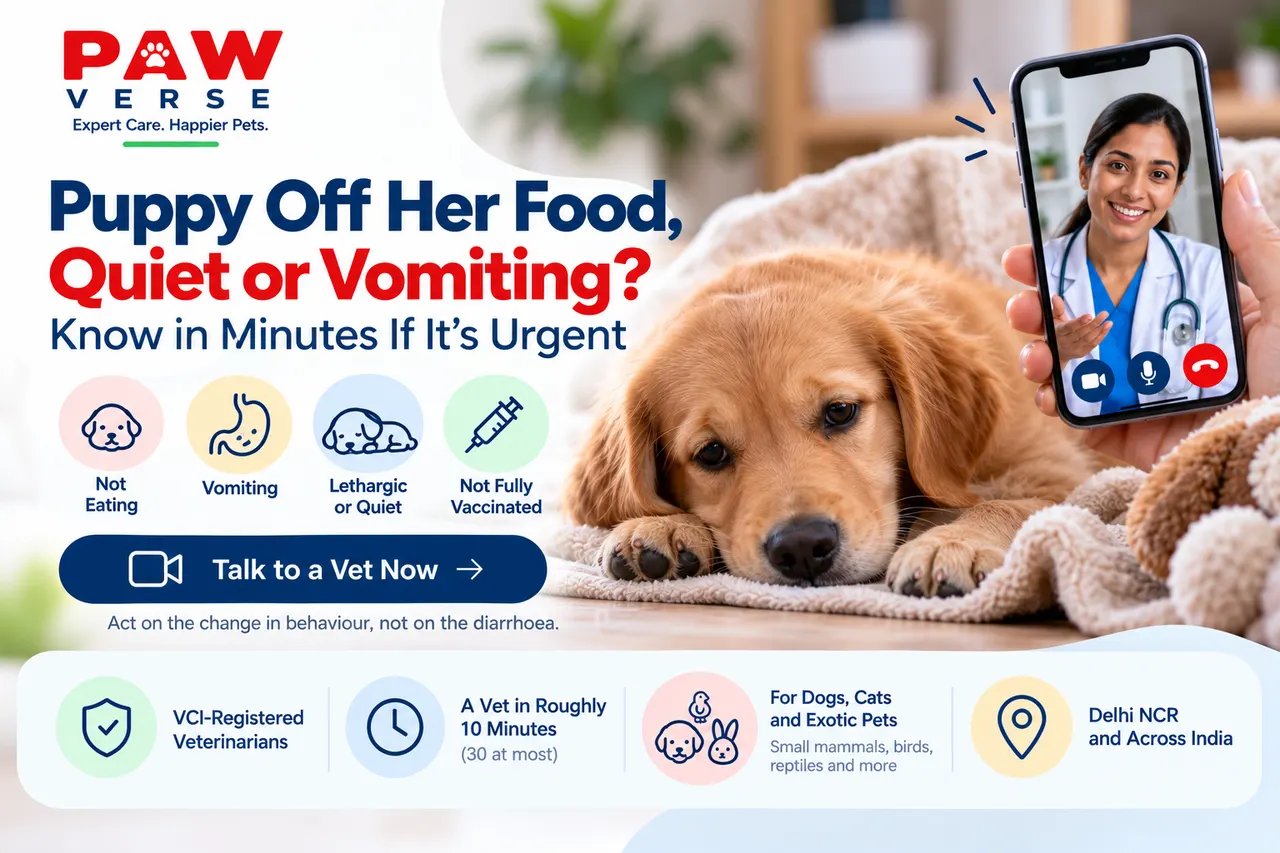
She's ten weeks old, one vaccine down, the second booked for next week. Tonight she won't play, she turned her nose up at dinner, and she has gone to lie in the corner. There's no diarrhoea. Nothing is obviously wrong.
That "nothing obviously wrong" is exactly the problem. In a puppy who isn't fully vaccinated, quiet and off her food can be the first sign of parvovirus, and the hours before the classic symptoms appear are the ones that matter most. You don't need to panic. You need four answers.
Puppy off her food, quiet, or vomiting, and not fully vaccinated? Talk to a vet now → Act on the change in behaviour, not on the diarrhoea.
VCI-registered veterinarians · A vet in roughly ten minutes (thirty at most) · Emergency line for collapse or heavy bleeding · Delhi NCR and across India
The Four Questions That Decide It
Answer these honestly, in order.
Question | What the answer means |
|---|---|
1. How many vaccine doses has she had, and when was the last one? | Fewer than the full series, or one given less than a week or two ago, means she is unprotected or only partly protected |
2. How old is she? | Roughly six weeks to six months is the highest-risk window, because her mother's protection fades before the vaccines take over |
3. What has changed? | Quiet, hiding, not eating, vomiting, or loose stool. Behaviour often changes before anything else |
4. Could she have been exposed? | Parks, streets, strays, other dogs, a vet, groomer, or pet shop, a new puppy at home, or someone who has handled other dogs |
Reading your answers
Unprotected or partly protected, in the risk window, with any change in Question 3: treat it as possible parvo. Go to a clinic now, and call ahead.
Unprotected, but only a minor change (one loose stool, bright, eating, drinking): talk to a vet today, and watch her closely.
Fully vaccinated, with signs: parvo is less likely but not impossible. Talk to a vet, who will decide.
Any red flag below: go now, whatever the vaccine history.
Red Flags: Go Now
Repeated vomiting, or she can't keep water down
Diarrhoea that is bloody, black, or foul-smelling
Pale, white, or grey gums
She can't stand, or feels cold and limp
She won't drink, or is clearly dehydrated
A swollen, painful belly
Our parvovirus guide explains what the disease is, how treatment works, and how much faster the outcome improves when treatment starts early. This page is about the next ten minutes.
Before You Leave: Call Ahead
Parvovirus spreads easily, and clinics keep infected puppies away from other dogs. A phone call lets them prepare, and spares other puppies in the waiting room. Say something like this:
"I'm bringing a [age]-week-old puppy with [x] vaccines. She has [vomiting / is lethargic / has diarrhoea].
It could be parvo. Where should I bring her?"
Then:
Carry her in, wrapped in a towel, and don't let her touch the waiting-room floor.
Keep other dogs away, both at home and at the clinic.
Bring a sample of stool or vomit in a sealed bag, if you can collect one safely, and her vaccination card.
Wash your hands, and change your clothes afterwards, before handling other dogs.
If You Can't Get There Tonight
Parvovirus can't be managed at home, so the goal is to get her to hospital as soon as you can. If you're struggling to find an open clinic, call the emergency line (+91 96255 21168), which can help you find one. Meanwhile, keep her warm, quiet, and apart from other dogs, and don't give any human anti-vomiting or anti-diarrhoea medicine. Our guide on buying pet medicine without a prescription explains why.
What a Consultation Does Here
A video call can't test for parvo or treat it. What it does is get you to the right decision quickly:
Triage in minutes, using your four answers and what the vet can see.
A look at her gums, posture, and hydration on camera.
A review of any photos of stool or vomit.
A clear call: go now, talk now, or watch, with the reasons.
Help with what to tell the clinic, so the first few minutes there count.
A catch-up vaccination plan once she's through this, so the gap doesn't open again.
Home cleaning and isolation advice, with our parvovirus guide for the detail.
A saved record and a follow-up.
If a vet thinks parvo is possible, you'll be told to go to a clinic, not to wait for a call back.
How it works
Tell Captain Scout her age and vaccine history, and what has changed.
A VCI-registered vet joins by video, voice, or chat.
You get your next step, and a record saved for her.
Ready? Start now →
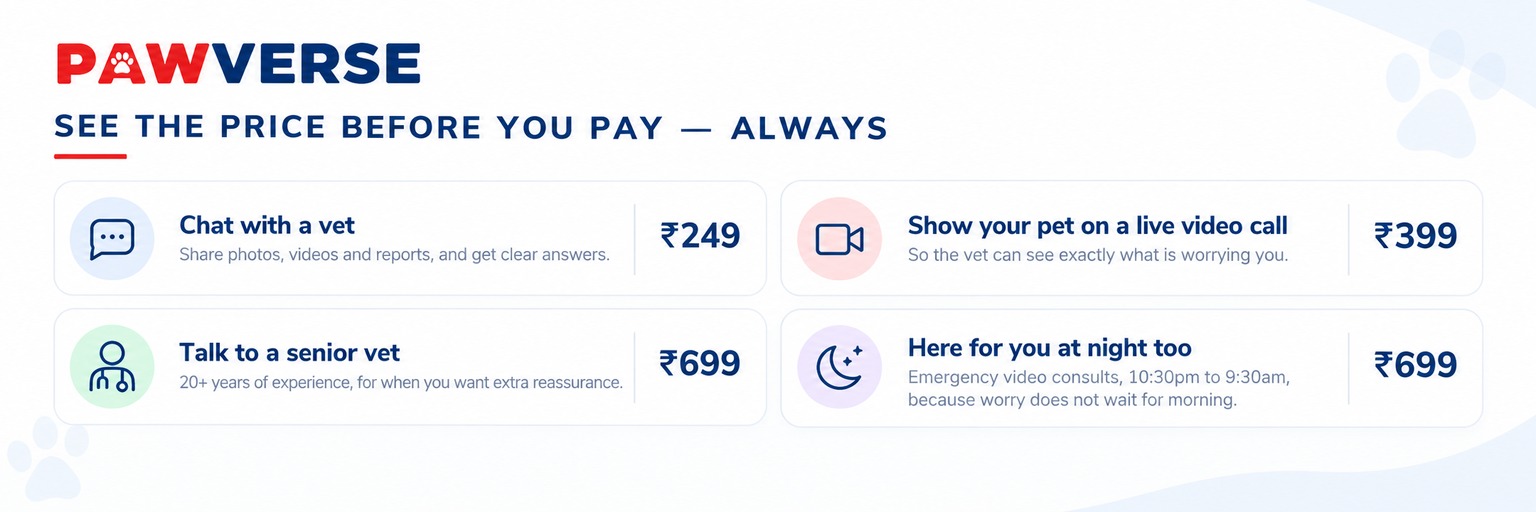
If It Turns Out to Be a Simple Upset
Plenty of puppy tummy troubles are nothing more than a food change, something chewed, stress, worms, or a rough car ride. A vet can help you tell the difference, and advise on what to feed. Puppies shouldn't be fasted without a vet's guidance, since they have little in reserve. Even then, keep an eye on her for the next day and call back if anything gets worse.
Close the Gap So It Doesn't Happen Again
Most parvo cases happen in the window between a puppy losing her mother's protection and finishing her own vaccine series. A vet can give you a dated schedule, answer questions about timing, and help you decide when she can safely meet other dogs. Our puppy vaccination schedule for India covers the timeline, and our puppy care guide covers the rest of the first year.
Want a vaccine plan that doesn't leave gaps? Get a dated schedule from a vet →
Questions Before You Book
Can a fully vaccinated puppy get parvo? It's uncommon, but no vaccine is perfect, and a series that is incomplete or poorly timed leaves a gap. A fully vaccinated puppy with signs should still talk to a vet.
Can I wait for the diarrhoea to confirm it? Please don't. By then she may be seriously ill, and the early hours matter most. Act on the behaviour change.
How fast can it get serious? In days, sometimes within a day or two of the first signs, which is why waiting is risky.
Is parvo catching for my other pets? It's very contagious to other dogs who aren't vaccinated, and it doesn't infect people. If you have cats or kittens at home, ask your vet whether they need any precautions.
Can I take her for walks before her vaccines are finished? Avoid places where other dogs have been, such as parks and streets, until your vet says otherwise. Carrying her and using a clean, private space can help with early socialisation.
How is parvo tested? Usually with a quick stool test done at a clinic, with blood tests alongside. It has to be done in person.
How soon will I reach a vet, and are they qualified? Typically in about ten minutes, never later than half an hour, and the vet is VCI-registered. Talk to a vet →
Who to Call, in Order
Your nearest clinic, if she has any red flag. Call ahead and go.
The emergency line, +91 96255 21168, if you can't find an open clinic, or she is collapsing. It takes calls at any hour.
A consultation, started here, if she's quiet, off her food, or unwell and you're not sure how urgent it is.
WhatsApp, +91 96255 21168 (8am to 10pm IST), for questions that can wait, such as the vaccine schedule.
The Bottom Line
An under-vaccinated puppy that has gone quiet should be treated as a possible emergency until a vet says otherwise. Check her vaccine history, her age, what has changed, and where she might have been, call ahead, and don't wait for the diarrhoea. And once she's safe, close the vaccine gap properly.
If you're asking yourself whether to wait, don't. Talk to a vet now →
With love, Team PawVerse
Have a question about your pet?
Chat with Captain Scout and reach a verified vet, guaranteed within 30 minutes.
PawVerse Editorial Team
Practical pet health guides from the PawVerse team, written to help Indian pet parents understand what they are seeing and when to talk to a vet.
Your pet's health does not have to wait
Talk to a verified PawVerse vet from home. No travel, no waiting rooms, real answers within 30 minutes.