
Written by Deepak Bhatt
You notice a round, bald patch on your cat's ear or face. The skin looks scaly, maybe a little crusty, and a day later you notice a similar spot on your own forearm. This is the point where most people google "ringworm," and then immediately worry about two things: how to treat the cat, and how to stop the rest of the household catching it.
The good news is that ringworm is very treatable. The less welcome news is that treatment takes weeks to months, and the work you do at home, cleaning, isolating, and handwashing, matters almost as much as the medicine itself. This guide covers how to recognise it, how vets confirm it, what treatment involves, and a practical plan for keeping it contained.
Think your cat may have ringworm? Show a PawVerse vet by video → We can help you triage the signs and plan how to isolate your cat while you arrange testing.
What Ringworm Actually Is
Despite the name, ringworm has nothing to do with worms. It is a fungal infection of the skin, hair, and sometimes claws, known medically as dermatophytosis, and in cats it is most often caused by a fungus called Microsporum canis. It is both contagious and zoonotic, meaning it can pass between animals and to people.
The fungus spreads through tiny spores that drop from infected hairs and flakes of skin. It can be caught from direct contact with an infected cat or from contaminated bedding, furniture, carpets, brushes and carriers. Spore can remain in the environment for many months so the home is very important in the treatment.
Some cats develop an obvious infection, others harbour the fungus with few or no signs, and transmit it silently. Kittens, older cats, cats with a weakened immune system and cats coming from shelters or street environments are more at risk and long haired breeds such as Persians are more often affected. Warm, humid conditions are conducive to fungal growth, something to think about in many parts of India, along with the social contact that comes with community cats and rescued kittens.
How to Identify Ringworm in a Cat
There is no single look, but these are the signs to watch for:
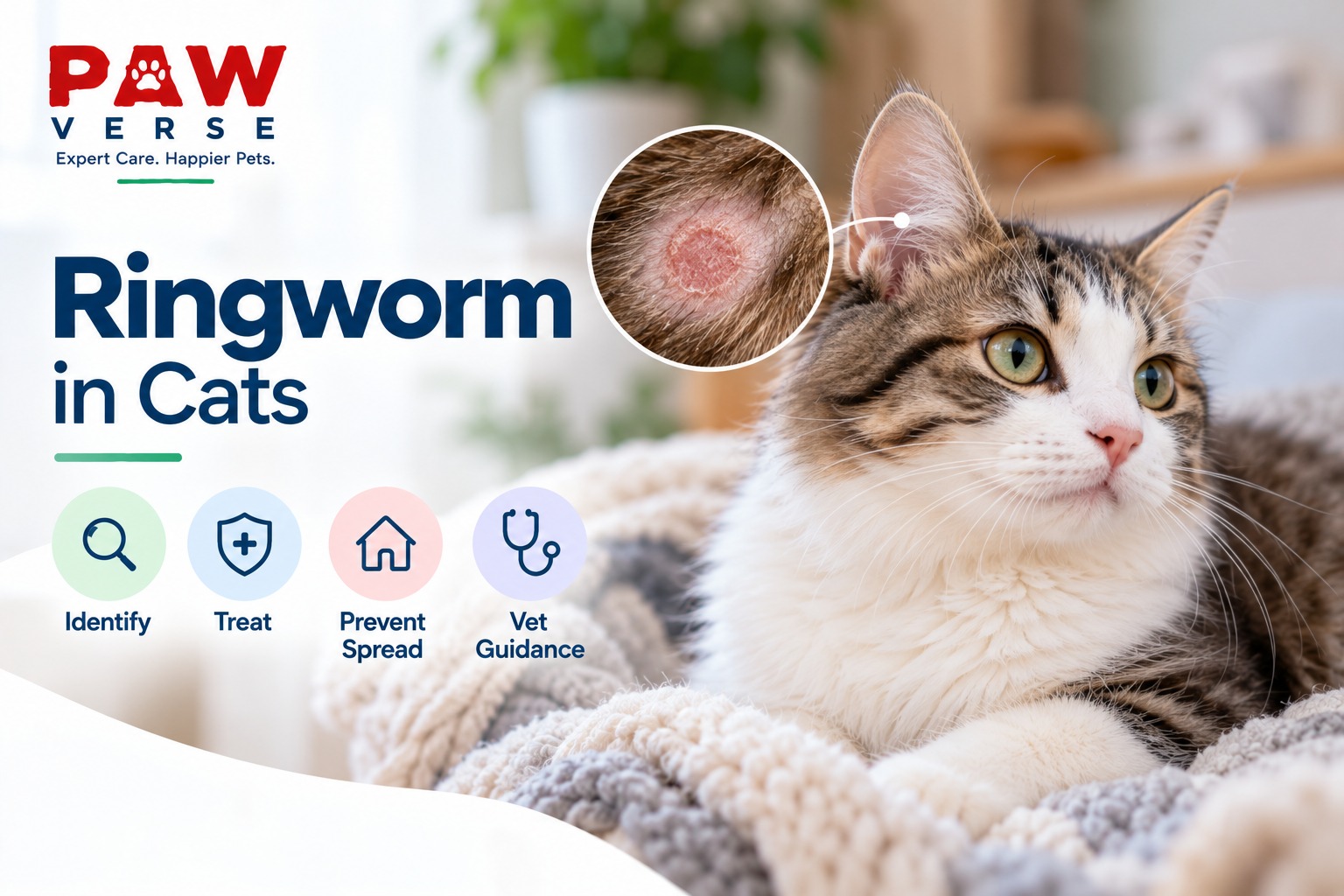
Circular or irregular patches of hair loss, often with broken, stubbly hairs at the edges
Scaly, flaky, or crusty skin in the patch, sometimes dandruff-like
Lesions on the face, ears, paws, and tail, which are common sites
Mild redness, with itching that varies from none to quite a lot
Rough, brittle, or deformed claws
In kittens, patches that spread quickly
The tricky part is that many other conditions look similar, and ringworm is easy to mistake for something else.
Condition | How It Differs |
Ringworm | Scaly, round or irregular bald patches, often on the face, ears, and paws, and contagious to people |
Flea allergy | Crusty bumps around the neck, back, and tail base, with intense itching |
Mites | Often dark debris in the ears, or visible flaky debris moving across the coat |
Bacterial skin infection | Redness, pus, or moist sores, often secondary to something else |
Overgrooming from stress | Symmetrical hair loss with skin that looks mostly normal |
Our guide on why cats scratch so much covers these look-alikes and how cats hide itching by overgrooming. The key point is that you cannot reliably diagnose ringworm by eye, and a vet needs to confirm it before treatment starts.
A useful tip before a consultation: take a clear, well-lit close-up of each patch, plus one wider photo, and note the date. Progress photos taken the same way every week make it much easier to see whether treatment is working.
How Vets Confirm It
There is no single perfect test, so vets usually combine a few.
Test | What It Does | Things to Know |
Wood's lamp | A UV light that makes some infected hairs glow apple-green | A useful screening tool, but not all strains glow, and some other things do, so it can't confirm or rule out ringworm alone |
Microscopy of hairs | Looks for fungal spores on plucked hairs | Quick, and good for initial screening |
Fungal culture | Grows the fungus from a hair or brush sample | The most definitive method, but results can take 2 weeks or more |
PCR | Detects fungal DNA | Gives results in days, but is not typically used to monitor whether treatment has worked |
Vets often take samples by brushing a new, clean toothbrush over the lesions, which can then be pressed onto culture medium. Your city, and the clinic, will dictate what tests are available - ask what your vet can do locally, and how long results typically take.
Treatment: Three Parts That Work Together
Ringworm treatment works best when it combines three things: medication on the skin, medication by mouth, and cleaning the environment. Skipping any one of them is the most common reason ringworm drags on.
1. Topical treatment. Vets often use lime sulphur dips or rinses, or a miconazole and chlorhexidine shampoo, applied to the whole coat, usually a couple of times a week. Lime sulphur is one of the best options, but it has a strong sulphur smell, will stain light-colored fur and fabrics, and must be mixed and applied exactly as your vet directs. For a small spot, a vet may apply an antifungal cream but creams alone rarely clear the infection since cats lick them off and the fungus resides in the hairs around the lesion as well.
2. Oral antifungal medication. A vet will usually prescribe a tablet or liquid such as itraconazole, although other drugs such as terbinafine or fluconazole may be used. These medications are calculated based on your cat's weight and condition, so never use a leftover medication, a dog's dose, or a human antifungal. Our guide to buying pet medicine over the counter explains why.
3. Treating the home. This is covered in full below, and it is not optional.
How long it takes. In a healthy cat, ringworm often clears up on its own in about three months. Treatment, however, speeds up recovery and, more importantly, reduces the risk to other pets and people. This will take several weeks to a few months, with repeat testing so your vet can confirm when fungus is gone. A cat can look perfectly healthy and still be shedding spores so don't stop treatment just because the coat is back.
What Not to Do
Don't rely on home remedies. Tea tree oil and other essential oils are toxic to cats, and "natural" options such as neem oil or turmeric paste are unproven for ringworm, get licked off, and some can be harmful. Check with a vet before applying anything, and see our pet poisoning emergency guide.
Don't use steroid creams or sprays on the lesions, since they can make fungal infections worse.
Don't treat with a human antifungal cream alone. It is rarely enough, and cats lick it off.
Don't shave or clip at home unless your vet advises it. Clipping can spread spores and nick the skin, though vets sometimes recommend it for long coats.
Don't stop early. Finishing the full course and the follow-up tests is what prevents relapse.
Don't mix cleaning products. Never combine bleach with other cleaners.
Preventing Spread at Home: A Practical Plan
Think of this as running a small, temporary quarantine.
Set up a recovery room. Pick a room where surfaces are easy to clean and there are not a lot of soft furnishings and keep the cat in this room for the duration of treatment. In many Indian homes floors are tiled or of marble which are much easier to decontaminate than carpets. Keep the door shut and don't let the cat escape out of the room.
Remove what you can't clean. Items such as cushions, fabric scratchers and soft toys that are porous are difficult to disinfect and should be removed or replaced during treatment. Make bedding machine washable.
Follow a daily and weekly routine:
When | What to Do |
Every day | Give the prescribed treatment, and vacuum hair and dander from the floor and surfaces in the cat's room. Seal and dispose of the vacuum contents safely. |
Every day | Wipe hard surfaces the cat touches, then wash your hands and forearms thoroughly. |
Every week, or as your vet advises | Wash all bedding and any washable fabrics in hot water. |
Every week, or as your vet advises | Disinfect hard, non-porous surfaces with diluted bleach (commonly 1 part bleach to 10 parts water) or an accelerated hydrogen peroxide cleaner, then rinse, as your vet recommends. |
Throughout | Clean brushes, carriers, bowls, and litter trays, and don't share grooming tools with other pets. |
Use bleach safely. Only use on non porous surfaces. Ensure room is ventilated. Wear gloves. Keep your cat and other pets away from treated surfaces until dry. Never mix with other cleaning products. Test a small area first in a hidden spot as it may stain surfaces.
Protect the people in your home. Wear gloves when applying treatment, particularly lime sulfur, and wash your hands and forearms after handling your cat. Avoid close face-to-face contact, and keep young children, elderly relatives, and anyone with a weakened immune system away from the cat as much as possible.
Check other pets. Dogs and other cats in the household can pick it up or carry it without signs, so ask your vet whether they should be examined or treated too.
If a Person or Another Pet Seems Affected
If any person in your household develops a round, red, scaly, itchy patch on the skin, see a doctor and tell him the cat. Human treatment is a medical decision, and should be made by a doctor, not this article. If another pet develops patches, have it checked out, do not assume it is the same problem.
When Is the Cat Cured?
Your vet makes this decision based on the appearance of the skin and coat and usually the results of the follow-up fungal culture. Continue isolating and cleaning until your vet says the infection is gone, then gradually bring your cat back into the house and keep up a lighter cleaning routine for a while. The most frequent reason for relapse is stopping treatment prematurely.
Where a Teleconsultation Helps (and Where It Doesn't)
A vet will usually want a confirmed diagnosis, through microscopy, culture, or PCR, before starting oral antifungals, and that testing has to happen in person. Where online consultation is genuinely useful is everything around it:
Triage, including whether the lesions look like ringworm or something else
Planning how to set up the recovery room and isolate your cat
Reviewing your weekly progress photos
Answering questions about medication, bathing, and cleaning
Follow-ups, with prescriptions where the vet considers them appropriate, which can then be delivered, as covered in our guides on how online vet prescriptions work and pet medicine delivery
Our guide on choosing between chat, video, and voice explains why video suits skin problems best.
Want a vet to review your cat's patches and plan the next step? Start a PawVerse teleconsultation →
Warning Signs Table
Sign | What It May Mean |
Round, scaly, bald patches on a cat, especially a kitten | Possible ringworm, see a vet for testing |
A similar patch on a person in the household | See a doctor, and tell your vet |
Rapidly spreading patches, or lesions all over the body | Needs prompt veterinary attention |
Pus, open sores, or a strong smell | Possible secondary bacterial infection |
Lethargy, not eating, or fever alongside skin changes | Needs veterinary evaluation, may be a wider problem |
No improvement after several weeks of treatment | Review the plan with your vet, including whether the home is being fully treated |
The Bottom Line
Ringworm in cats is common, annoying, and very treatable, but it asks for patience and consistency: a confirmed diagnosis, a combination of skin and oral treatment, a recovery room, and a regular cleaning routine, carried on until your vet says the infection has gone. Looking after the people and other pets in your home matters just as much as treating your cat.
Not sure if it's ringworm, or need help with the plan? Talk to a PawVerse vet online now → Share clear photos, get your questions answered, and find out what to do next.
With love, Team PawVerse
Have a question about your pet?
Chat with Captain Scout and reach a verified vet, guaranteed within 30 minutes.
Frequently Asked Questions
A: No. It is a fungal infection of the skin and hair, and the name comes from the circular, ring-like patches it can cause.
PawVerse Editorial Team
Practical pet health guides from the PawVerse team, written to help Indian pet parents understand what they are seeing and when to talk to a vet.
Your pet's health does not have to wait
Talk to a verified PawVerse vet from home. No travel, no waiting rooms, real answers within 30 minutes.