
Walk down the pet food aisle of any Indian store or browse through one of the delivery apps and the choice can become overwhelming very quickly. All bags are labelled “complete and balanced.” All brands claim to be vet recommended. Somewhere in all that marketing is a real answer for your real dog, and it usually has less to do with the most eye-catching packaging than people think.
This guide covers how to actually evaluate dog food and not just chase a brand name, what the different price tiers really get you, how homemade and commercial options compare in an Indian context and which everyday Indian foods are fine and which aren't. More specifically, our guide for puppy care in India includes feeding by age for puppies.
There's No Single "Best" Food, Only the Best Fit
Every dog food guide eventually has to say this plainly: no single brand is the best dog food for every dog. A high protein, high energy formula that's great for an active Labrador can be too rich for a sedentary senior Pomeranian. A grain-free import might suit a dog with a specific sensitivity but offer no real benefit to a healthy adult with no digestive issues. The right food depends on your dog's age, breed size, activity level, health conditions, and honestly, your budget too, since the most expensive option isn't automatically the most appropriate one.
What matters more than any single brand name is knowing how to evaluate what's actually in the bag.
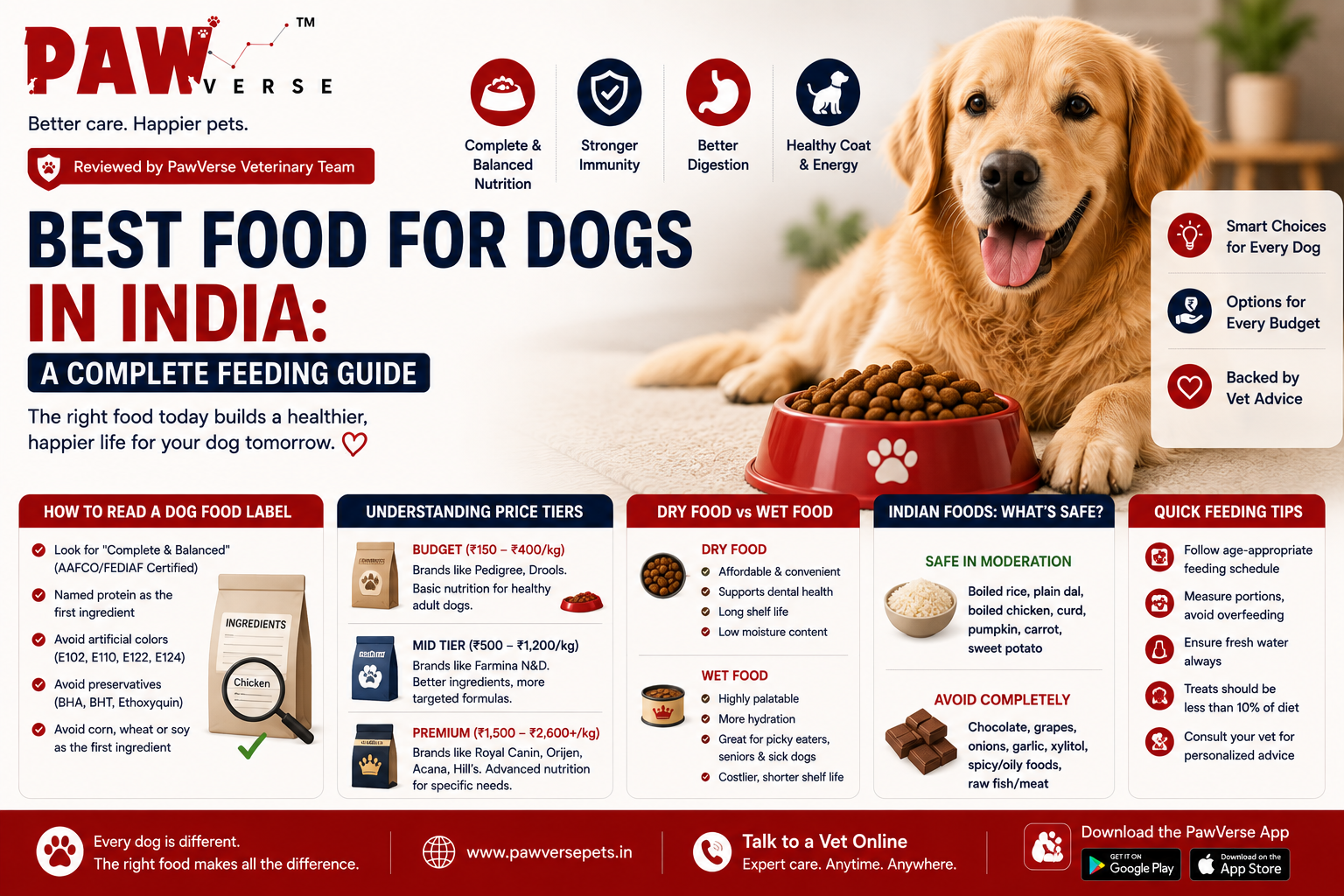
How to Read a Dog Food Label
A few checks take the guesswork out of comparing products, regardless of brand or price point.
Look for "complete and balanced." Reputable food will state it meets AAFCO (American) or FEDIAF (European) nutritional standards for a specific life stage, puppy, adult, or senior. This means the formula has actually been tested or formulated to meet minimum nutritional requirements, not just assembled to taste good.
Check that a named protein leads the ingredient list. "Chicken," "lamb," or "fish" as the first ingredient is a good sign. "Meat and animal derivatives" without naming the species is vaguer and generally considered a lower-quality indicator by Indian vets.
Watch for these red flags, commonly flagged by Indian veterinarians on packaging:
Artificial colors listed as E102, E110, E122, or E124
Preservatives listed as BHA, BHT, or ethoxyquin
Corn, wheat, or soy as the first or second ingredient, ahead of any named protein
None of this means every food with these ingredients is unsafe, but they're reasonable signals to weigh against price and your dog's specific needs.
Understanding the Price Tiers
Indian dog food broadly falls into three tiers, and it's worth knowing what you're actually paying for at each level rather than assuming price alone tells the story.
Budget tier (roughly Rs 150 to 400 per kg): Brands like Pedigree and Drools dominate this space. These provide basic complete and balanced nutrition suitable for most healthy dogs, and Indian-made brands in this tier have genuinely improved in formulation quality in recent years. This tier makes sense for healthy adult dogs without specific dietary needs, especially in multi-dog households where cost adds up fast.
Mid tier (roughly Rs 500 to 1,200 per kg): Brands like Farmina N&D sit here, often imported, with more emphasis on named protein sources, grain-free or grain-inclusive options, and formulas targeted at specific needs like skin and coat health.
Premium tier (roughly Rs 1,500 to 2,600+ per kg): Royal Canin, Orijen, Acana, and Hill's Science Diet lead this category. Royal Canin is the brand most frequently recommended by Indian vets, largely due to decades of veterinary nutrition research and genuinely breed-specific and condition-specific formulas. Hill's, through its Prescription Diet line, is typically used for dogs with diagnosed medical conditions under veterinary guidance rather than for general everyday feeding. Orijen and Acana focus on high animal protein content marketed as "biologically appropriate."
Typically, the more you spend, the more targeted the formula will be and the better the quality control. Of course, a healthy dog without special needs doesn’t need to be on the most expensive tier to do well. Premium food is worth the cost in dogs with breed predispositions, allergies or medical conditions where a targeted formula really helps.
Dry Food vs Wet Food in Indian Conditions
This matters more in India than in cooler climates, because heat and humidity change the practical trade-offs.
Dry kibble is the practical everyday choice for most Indian households. It's shelf-stable in humidity, more affordable per meal, supports dental health through the chewing action, and is nutritionally complete on its own. The main drawback is low moisture content, which matters more during Indian summers when dogs need extra hydration support anyway.
Wet food wins on palatability and moisture, which makes it genuinely useful for picky eaters, dogs recovering from illness, senior dogs with dental issues, or simply dogs in very hot, humid cities where extra moisture in the diet helps. The trade-offs are cost and the need for refrigeration after opening, which isn't always convenient in every household.
Many Indian pet parents use a mix, dry food as the base diet with wet food mixed in occasionally for palatability or during particularly hot months.
Is Homemade Food a Good Option?
Homemade food can absolutely work, but it has to be done properly, and "properly" is where most homemade diets in India fall short without anyone realizing it. Dogs have specific requirements for protein, calcium-to-phosphorus ratio, and certain vitamins that don't happen automatically from feeding rice, dal, and vegetables, however well-intentioned the meal is.
If you want to feed homemade, the safest approach is planning the diet with a vet rather than assembling it from general internet advice, especially for puppies and growing dogs, where nutritional gaps during development can cause lasting issues. A well-planned homemade diet is a legitimate choice. An improvised one, however healthy it looks on the plate, often isn't providing what it appears to.
Everyday Indian Foods: What's Safe and What Isn't
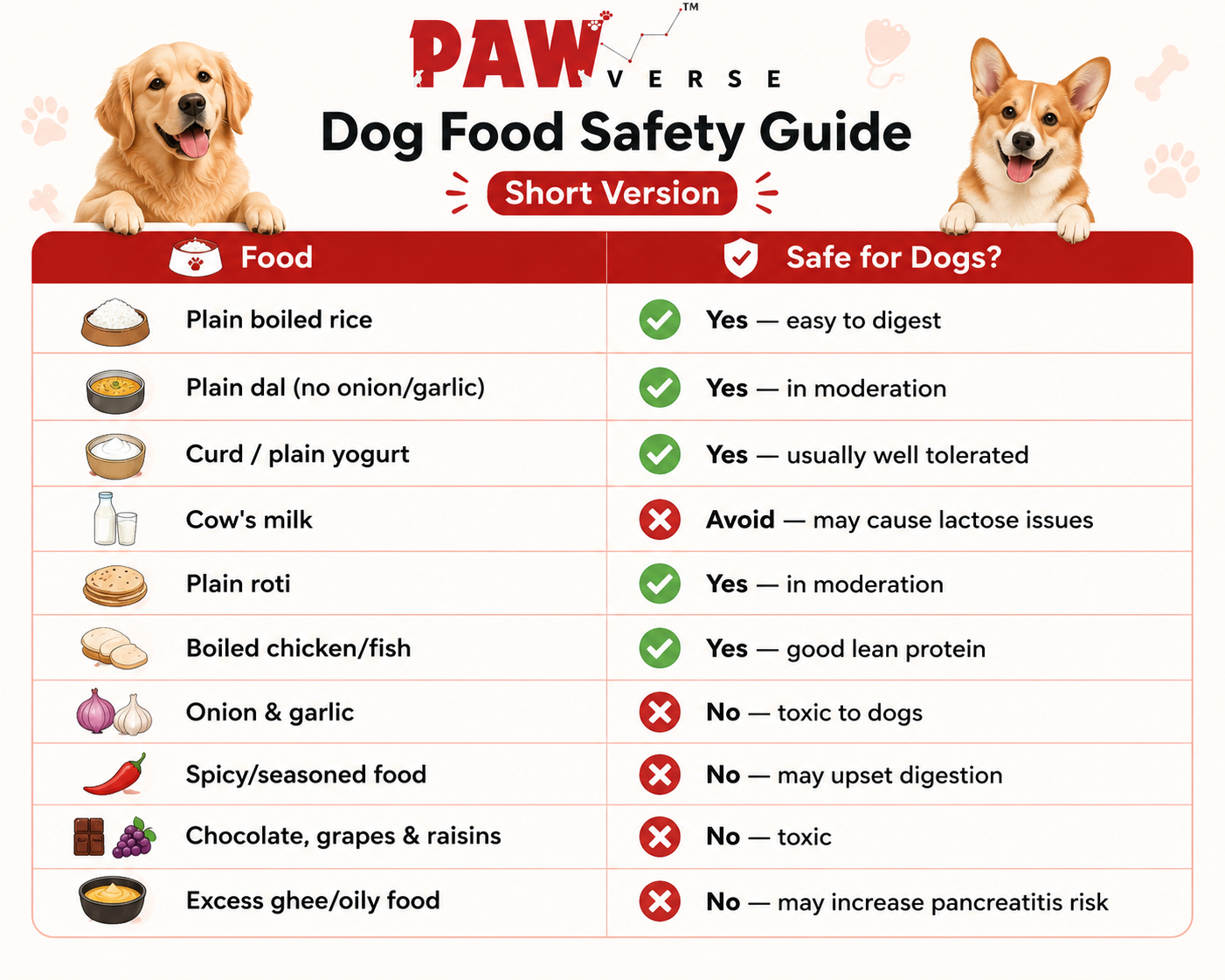
Food | Safe for Dogs? |
Plain rice, boiled | Yes, easily digestible, often used for bland diets |
Dal (plain, no onion or garlic) | Yes, in moderation, good protein source |
Curd or plain yogurt | Yes, often better tolerated than milk |
Cow's milk | Best avoided, many dogs are lactose intolerant |
Roti (plain, no butter or ghee excess) | Yes, in moderation, not a primary nutrition source |
Boiled chicken or fish, unseasoned | Yes, good lean protein |
Onion, garlic | No, toxic to dogs even in small amounts |
Spicy or heavily seasoned food | No, causes digestive upset, not nutritionally appropriate |
Chocolate, grapes, raisins | No, toxic, avoid entirely |
Excess ghee or oily food | No, contributes to pancreatitis risk over time |
This is a starting reference, not a complete list. If you're ever unsure about a specific food, it's worth checking before offering it rather than assuming.
Feeding by Life Stage
Puppies need higher protein and fat content to support rapid growth, along with DHA for brain development, which is why puppy-specific formulas exist rather than just smaller portions of adult food. Our puppy care guide India covers feeding frequency and transition timing in more detail.
Adult dogs need a maintenance formula balanced to their activity level, an active working breed has very different calorie needs than a sedentary apartment companion of the same size.
Senior dogs, generally from around 7 years for most breeds, often benefit from formulas with adjusted calorie content to prevent weight gain as metabolism slows, along with added joint support ingredients like glucosamine, especially in larger breeds prone to joint issues.
Feeding by Breed Size
Larger breeds generally do better on fewer, larger meals with kibble sized for bigger mouths, and often benefit from foods formulated to support joint health given their higher risk of hip and elbow issues. Smaller breeds tend to have faster metabolisms relative to their size and often do well on nutrient-dense formulas in smaller kibble sizes suited to smaller jaws. Indian Pariah Dogs and other native breeds generally do well on standard adult formulas without needing specialized breed-specific diets, reflecting their naturally robust digestive adaptation to varied diets.
Common Feeding Mistakes
A few patterns show up repeatedly and are worth naming directly. Switching foods abruptly rather than transitioning over 7 to 10 days is one of the most common causes of avoidable digestive upset. Judging food quality by price alone, without checking the actual ingredient list, means sometimes overpaying for marketing rather than substance, and other times underfeeding nutritionally on a budget option that could have been a slightly better choice at a similar price. Feeding table scraps alongside a complete commercial diet unbalances an otherwise well-formulated food and contributes heavily to obesity, one of the most common preventable health issues in Indian pet dogs. And assuming a homemade diet is automatically healthier than commercial food, when an unbalanced homemade diet can actually be more nutritionally deficient than a basic budget-tier commercial option.
When to Talk to a Vet About Diet
Reach out to a vet if your dog has a diagnosed health condition that might benefit from a specific therapeutic diet, if you're planning a homemade diet and want to make sure it's properly balanced, if your dog shows signs of a food sensitivity like chronic itching or digestive upset, if you're unsure how to transition between life stages or breed-specific formulas, or if your dog is under or overweight and you want a structured feeding plan to address it.
You don't need to visit a clinic in person for most diet questions. Through PawVerse, you can book an online vet consultation to talk through your dog's specific nutritional needs and get a plan that fits your budget and lifestyle.
Frequently Asked Questions
Q: Is Pedigree or Drools actually bad for dogs?
A: No, this is a common misconception. Budget-tier Indian brands like Pedigree and Drools provide complete and balanced nutrition suitable for most healthy adult dogs, and Indian-made options in this category have genuinely improved in formulation over recent years. They're a reasonable choice for a healthy dog without specific dietary needs, particularly in multi-dog households.
Q: Do I need to feed my dog imported food to be healthy?
A: No. Imported premium brands often offer more targeted formulations for specific breeds or health conditions, but a healthy dog with no special dietary needs doesn't require imported food to thrive. The right choice depends on your individual dog, not on where the food was manufactured.
Q: Can I feed my dog a fully vegetarian diet in India?
A: Dogs are omnivores and can technically survive on a well-planned vegetarian diet, but it requires very careful planning to meet protein and amino acid needs that are more easily met through animal protein. This isn't a diet to improvise, and it's worth planning closely with a vet if this is a firm requirement for your household.
Q: How do I switch my dog to a new food without stomach upset?
A: Transition gradually over 7 to 10 days, starting with about 25 percent new food mixed with 75 percent old food, then moving to a 50/50 mix, then mostly new food, before switching over completely. Abrupt switches are one of the most common causes of loose stool and digestive upset in otherwise healthy dogs.
Q: Is grain-free food better for dogs?
A: Not automatically. Grain-free is genuinely beneficial for dogs with a diagnosed grain sensitivity or allergy, but for a dog without one, grains like rice are a perfectly digestible energy source. Grain-free isn't a universal upgrade, it's a targeted choice for a specific need.
Q: How much should I budget monthly for good dog food in India?
A: This depends heavily on your dog's size and the tier of food chosen. A small to medium dog on a budget-tier food might cost roughly Rs 1,000 to 2,000 monthly, while a large breed on premium food can run Rs 4,000 to 8,000 or more. Cost scales with both the dog's size and the price tier, so it's worth budgeting realistically before committing to a premium option for a large breed long-term.
The Bottom Line
The best food for your dog isn't a specific brand name, it's whatever combination of quality ingredients, appropriate life-stage formulation, and consistency actually fits your dog's needs and your household's budget. Learning to read a label matters more than chasing the most expensive bag on the shelf, and a well-planned homemade diet or a solid budget commercial option can serve a healthy dog just as well as an imported premium one.
If you're ever unsure whether your dog's current diet is meeting their needs, that's a genuinely useful thing to bring up at your next vet conversation, rather than something to keep guessing about.
Talk to a PawVerse vet online now for feeding guidance tailored to your dog, or explore our Pet Health Blog for more India-specific pet care guides.
With love, Team PawVerse
Have a question about your pet?
Chat with Captain Scout and reach a verified vet, guaranteed within 30 minutes.
PawVerse Editorial Team
Practical pet health guides from the PawVerse team, written to help Indian pet parents understand what they are seeing and when to talk to a vet.
Your pet's health does not have to wait
Talk to a verified PawVerse vet from home. No travel, no waiting rooms, real answers within 30 minutes.