
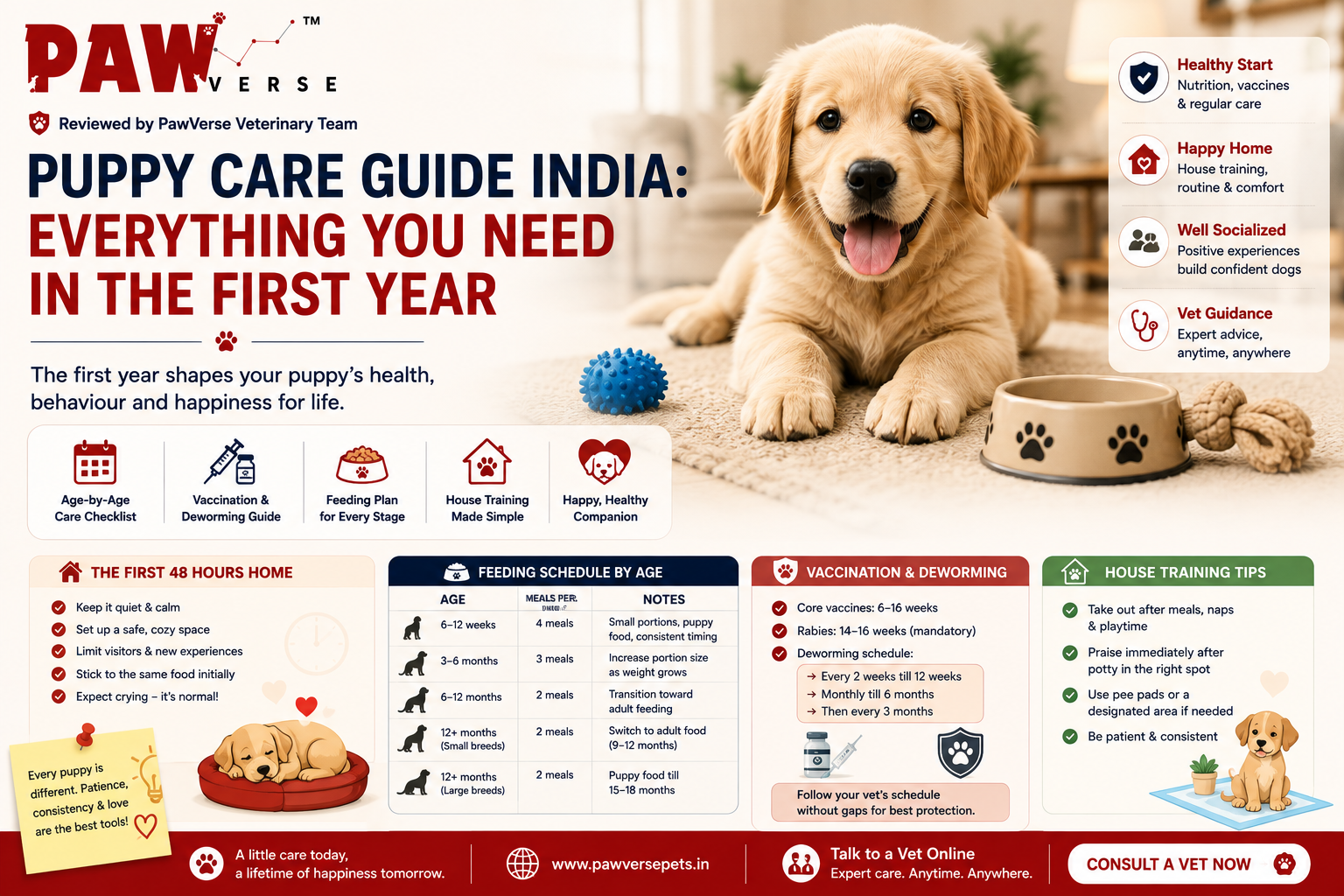
The car ride home is usually the quiet part. What surprises most new owners are the weeks after. The 3am whining, the accident on the new rug, the sudden question of whether store-bought puppy food is actually enough, or whether the neighbour’s advice about feeding roti and milk is okay to follow. The first year of a puppy’s life lays the foundation for the rest of its life. Most of the mistakes people make aren’t from carelessness, they’re from nobody laying out the basics clearly in one place.
The guide tells you what really matters in a puppy's first twelve months in an Indian home and climate, feeding, vaccination, house training, socialization and the seasonal realities most generic puppy guides don't mention at all. For breed specific climate considerations, you can refer to our region wise dog breed guide as a useful companion read. For the exact vaccination schedule, check out our puppy vaccination schedule for India.
The First 48 Hours Home
The first couple of days are more important than people think. Even in a loving new home a puppy leaving its mother and littermates is undergoing real stress and the urge to shower them with attention, visitors and new experiences immediately usually backfires.
Keep the first two days quiet Instead of letting your puppy free roam the whole house right away, create one area with a bed, water and a few toys, and let him explore gradually. Limit visitors for the first few days and if you have children, teach them early on to approach calmly instead of running up. If the puppy came with a particular food, feed that same food at first even if you plan to switch later, sudden changes on top of a stressful transition often cause digestive upset.
Don’t be shocked to hear some crying at nite for the first few nights. This is normal and will generally work itself out in a week to ten days as the puppy gets used to sleeping without his littermates.
Feeding a Puppy in India, by Age
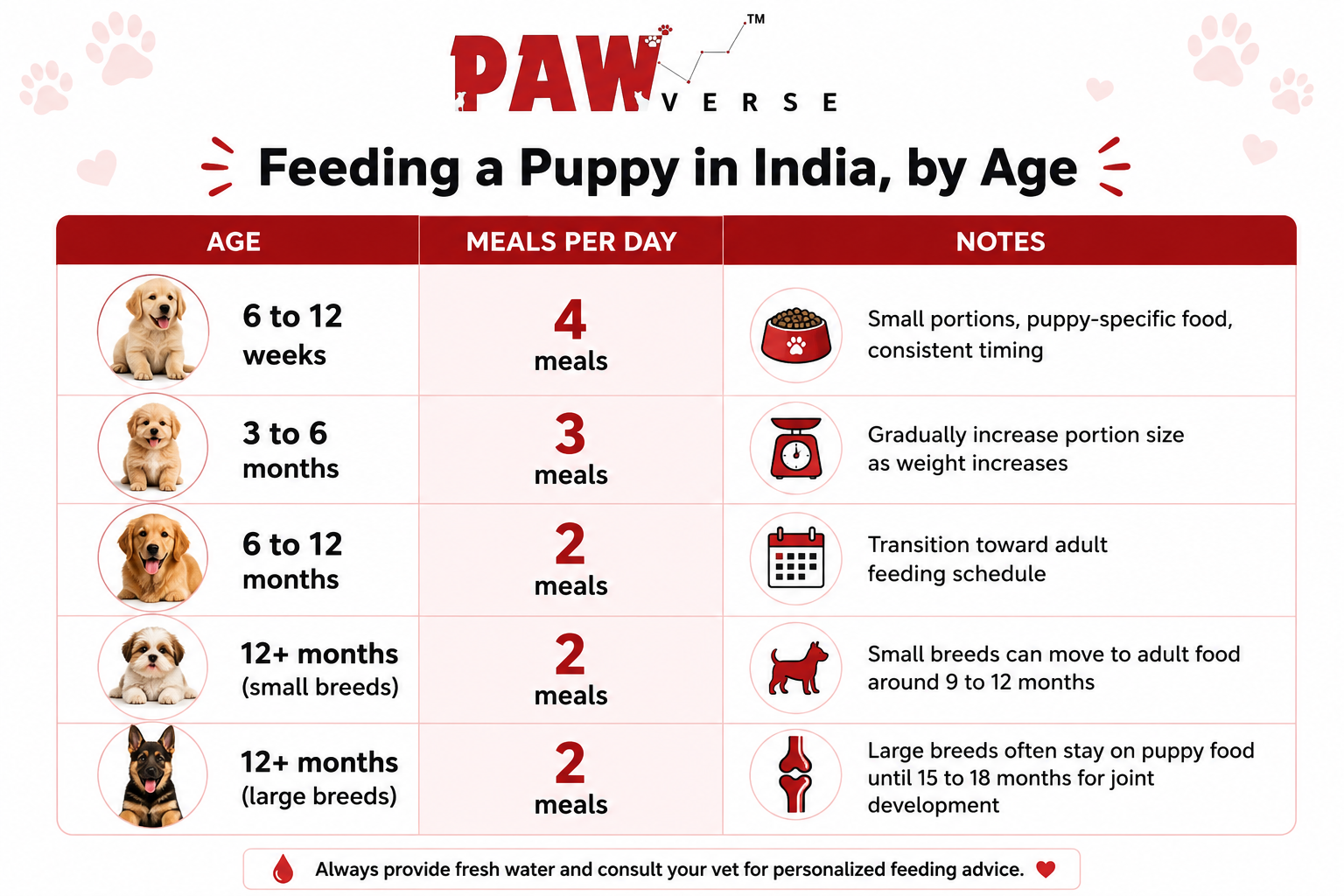
A few things specific to feeding in India are worth knowing directly. Homemade diets of roti, rice, and dal can work if properly balanced, but they very often aren't, and puppies have much higher nutritional demands than adult dogs for growth and bone development. If you're leaning toward a homemade diet, this is worth planning with a vet rather than guessing, since deficiencies during the growth phase can cause lasting issues.
Cow's milk is a common instinct to offer but isn't ideal, many dogs, including puppies, are lactose intolerant to some degree, and it often causes loose stool. Fresh water is what a puppy actually needs alongside meals, not milk.
Avoid feeding from the table or free-feeding throughout the day, both make portion control difficult and set up begging habits that are hard to undo later.
Vaccination and Deworming
This deserves its own full guide rather than a summary here, our puppy vaccination schedule for India covers the complete age-by-age breakdown, costs, and what to expect after each dose. The short version: the core vaccine series runs from around 6 to 16 weeks, rabies vaccination starts around 14 to 16 weeks and is legally required, and deworming typically happens on a schedule alongside vaccination, roughly every two weeks until 12 weeks of age, then monthly until 6 months, then quarterly as an adult.
Don't skip or delay doses without checking with a vet first, gaps in the schedule can leave a puppy under-protected during exactly the window when maternal immunity has faded but full vaccine protection hasn't kicked in yet.
House Training in an Indian Home
Most Indian homes and apartments come with their own layout challenges for house training, tiled floors that don't absorb accidents the way carpet does, balconies that seem like an obvious bathroom spot but aren't always safe, and multi-story buildings where getting outside quickly isn't always possible.
A consistent routine works better than any specific method. Take the puppy out or to a designated spot first thing in the morning, after every meal, after waking from naps, and right before bed, these are the times a puppy is most likely to need to go. Praise immediately after they go in the right spot, rather than after they come back inside, timing matters for a puppy to make the connection.
For apartment living without easy outdoor access, a designated indoor spot with pee pads or a turf mat can work as a bridge, especially for very young puppies who can't yet hold it for the time it takes to get downstairs. Accidents during training are normal and expected, punishment after the fact doesn't help since puppies don't connect a delayed correction to the act itself, it just teaches them to be afraid of you finding the mess.
Socialization: The Window That Closes Fast
The most open time for a puppy’s brain to make positive associations with new experiences is between the ages of 3 and 14 weeks and it closes gradually as they get older. This is the one window that is most important to prevent fear and aggression issues later in life. Unfortunately, this window is often missed because it coincides with the vaccination window, when owners are understandably cautious about outside exposure.
Balance here matters. You are not fully protected by the vaccine until about a week after the last dose in the puppy series, but if you wait that long to start socialising, you lose a critical window of development. Vets recommend a happy medium: carrying your pup in situations that aren’t high risk, rather than putting them on the ground in public spaces, introducing them to healthy, fully vaccinated adult dogs in controlled settings like a friend’s house, and exposing them to a wide variety of sounds, surfaces and people in your home and safe spaces before they’ve even finished their vaccine series.
Try to get positive exposure to different types of people, children, people in uniforms, people with umbrellas or hats, different surfaces, tile, grass, gravel and everyday sounds, traffic, doorbells, kitchen noises. Overwhelming is not the goal, shorter, calmer, positive exposures work better than longer or more intense ones
Sleep and Rest
Puppies sleep far more than most new owners expect, often 18 to 20 hours a day when very young, tapering down gradually through the first year. This is normal and necessary for development, not a sign of illness, unless it's paired with lethargy, appetite loss, or other symptoms.
A consistent sleep space, ideally a crate or a defined bed area, helps with both house training and general security. Puppies that are constantly disturbed during rest can become cranky or anxious, similar to an overtired child, it's worth protecting nap time rather than treating a sleeping puppy as available for play anytime.
Puppy Proofing an Indian Home
Puppies explore with their mouths, and Indian homes have a few specific hazards worth checking for beyond the generic list. Loose electrical wires are common and genuinely dangerous. Mosquito repellent devices and liquids, common in most Indian homes, are toxic if chewed or ingested. Certain houseplants popular in Indian homes, including money plant and areca palm varieties, can be toxic to dogs. Spice containers and cooking areas, particularly anything with onion, garlic, or excessive salt, need to be kept out of reach. Balcony and window safety matters more than people initially think, a curious puppy can slip through gaps that seem too small to worry about.
Get down to a puppy's eye level for a few minutes in each room to spot what you'd otherwise miss.
Monsoon and Summer Considerations for Puppies
Puppies are more vulnerable to seasonal health issues than adult dogs, since their immune systems and temperature regulation are still developing. During monsoon, this means extra care around fungal skin infections and stomach upsets from contaminated water, covered in more detail in our monsoon dog care guide, with an even lower tolerance for exposure than an adult dog would have. Keep a puppy's paws and coat thoroughly dried after any outdoor time, and avoid puddle water entirely.
During Indian summers, puppies overheat faster than adult dogs due to their smaller body mass and less developed cooling systems. Avoid outdoor time during peak heat entirely for puppies under 6 months, and watch closely for excessive panting, lethargy, or reluctance to move, which can indicate heat stress developing faster than it would in an adult dog.
Common First-Year Mistakes
A few patterns come up often enough to call out directly. Skipping or delaying vaccine doses because the puppy "seems fine" is one of the most common and most risky, protection during this window isn't optional. Free-feeding or feeding table scraps sets up habits that are genuinely difficult to reverse later. Under-socializing out of caution during the vaccine window, while understandable, often costs more in behavioral issues later than the small added risk of careful, low-exposure socialization would have. And treating a puppy's sleep as flexible playtime, rather than protected rest, tends to create an overtired, harder to manage puppy.
Warning Signs That Need a Vet
Sign | What It May Mean |
Not eating for more than 12 to 24 hours | Puppies have low reserves, needs prompt attention |
Vomiting or diarrhea, especially repeated | Risk of rapid dehydration in puppies |
Lethargy or unusual weakness | Could indicate infection or low blood sugar |
Pale gums | Possible anemia or shock, needs urgent care |
Visible worms in stool | Needs deworming evaluation even if on schedule |
Excessive crying beyond the first week or two | Worth ruling out pain or discomfort |
Any fall, trauma, or suspected ingestion of a toxic item | Needs prompt evaluation regardless of symptoms |
When to Contact a Vet
Reach out to a vet if your puppy shows any of the warning signs above, if you're unsure about the vaccination or deworming schedule, if you want guidance on switching or planning a diet, or simply if something feels off and you want a second opinion before waiting it out. Puppies can decline faster than adult dogs, so the threshold for checking in should be lower.
You don't need to visit a clinic in person for general questions. Through PawVerse, you can book an online vet consultation to talk through feeding, training, or any early symptom, and get guidance on whether an in-person visit is needed. For anything urgent, our emergency vet consultation is available around the clock.
Frequently Asked Questions
Q: What should I feed my puppy in the first week at home?
A: Ideally the same food they were eating before, even if you plan to switch eventually. If you don't know what they were fed, a good quality puppy-specific food appropriate for their breed size is a safe starting point, introduced gradually rather than in large amounts on day one.
Q: When can I start taking my puppy outside in India?
A: Full protection from the core vaccine series generally isn't complete until about a week after the final dose, usually around 16 to 18 weeks. Many vets recommend a middle ground before then, carrying the puppy rather than letting them walk in public areas, and controlled exposure to healthy, vaccinated dogs in safe settings, so socialization isn't entirely delayed.
Q: How do I house train a puppy in an apartment without a yard?
A: Consistency matters more than access to outdoor space. Take the puppy to the same designated spot, whether that's outside or an indoor pee pad area, at consistent times, right after waking, eating, and before bed, and praise immediately when they go in the right place. A turf mat or pee pad can bridge the gap for very young puppies who can't yet hold it long enough to get outside.
Q: Is homemade food okay for a puppy, or does it need to be commercial food?
A: Homemade food can work, but puppies have higher and more specific nutritional needs than adult dogs for proper growth, and an unbalanced homemade diet during this window can cause lasting issues. If you want to feed homemade, it's worth planning the diet with a vet rather than assuming rice, dal, and roti alone will cover it.
Q: My puppy cries all night, is something wrong?
A: Some crying in the first several nights is normal as a puppy adjusts to being away from its mother and littermates, and it typically settles within a week to ten days. If crying continues well beyond that, or comes with other symptoms, it's worth checking in with a vet to rule out discomfort or illness rather than assuming it's just adjustment.
Q: When should my puppy switch from puppy food to adult food?
A: This depends on breed size. Small breeds can typically transition around 9 to 12 months, while large and giant breeds often stay on puppy food until 15 to 18 months, since their bones and joints take longer to develop and benefit from the different nutrient balance in puppy formulas for longer.
The Bottom Line
A puppy's first year in India comes with a few extra considerations most generic guides don't cover, homemade diet planning, climate-specific care during monsoon and summer, and navigating the socialization window around India's vaccination timeline. None of it is complicated once it's laid out clearly, but getting the basics right early tends to prevent a lot of the behavioral and health issues that show up later.
If anything feels uncertain along the way, that's what a vet conversation is for, better to ask early than to guess through your puppy's most formative months.
Talk to a PawVerse vet online now, or explore our Pet Health Blog for more India-specific guides on raising a healthy puppy.
With love, Team PawVerse
Have a question about your pet?
Chat with Captain Scout and reach a verified vet, guaranteed within 30 minutes.
PawVerse Editorial Team
Practical pet health guides from the PawVerse team, written to help Indian pet parents understand what they are seeing and when to talk to a vet.
Your pet's health does not have to wait
Talk to a verified PawVerse vet from home. No travel, no waiting rooms, real answers within 30 minutes.