
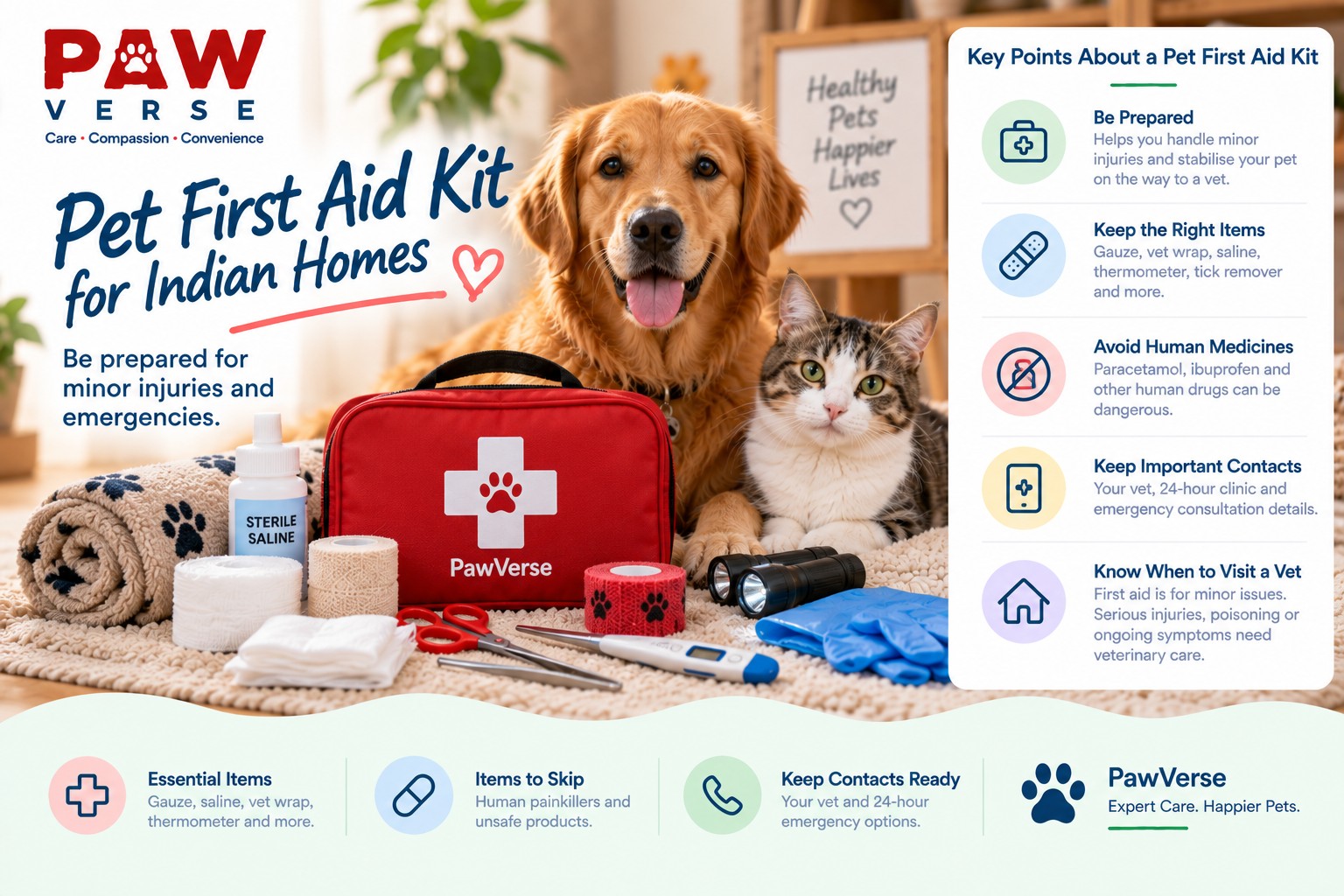
It is 11pm, your dog has just stepped on broken glass, and the bleeding is real. Or your cat has torn a claw, or a tick is attached somewhere you cannot easily reach. This is the moment you find out whether your home has a first aid kit for your pet, or only a half-empty box of human bandages and a strip of tablets you are not sure are safe to give.
A pet first aid kit does one job: it lets you handle minor injuries and stabilise your pet on the way to a vet. It never replaces veterinary care for anything serious. This guide covers what to keep in it, what to leave out (the "leave out" list matters as much as the "keep" list), how to store it in Indian conditions, and where first aid stops and a vet visit starts.
What a First Aid Kit Is For, and What It Is Not
First aid buys time. It controls bleeding, protects a wound, flushes an eye, removes a tick, and helps you move a hurt animal safely. It is not a way to treat illness at home, diagnose a problem, or avoid a vet visit for something that needs one.
That second point is worth sitting with, because most mistakes with pet first aid are not about missing items, they are about reaching for the wrong ones. A kit full of human medications is more dangerous than an empty one, a theme we cover in more depth in our guides on pet medicine without a prescription and pet poisoning emergencies.
The Core Kit: What to Keep
Most veterinary sources agree on the same core items, and many of them are things you can buy at an ordinary pharmacy.
Item | What It Is For |
|---|---|
Sterile gauze pads and rolls | Covering wounds and controlling bleeding |
Non-stick (non-adherent) pads | Placing directly on a wound so the dressing does not stick |
Self-adhesive vet wrap | Holds a dressing in place and sticks to itself, not to fur |
Medical tape | Securing gauze and bandages |
Sterile saline (plain, no additives) | Flushing wounds and rinsing eyes |
Digital thermometer and lubricant | Taking a rectal temperature, since this gives the most accurate reading |
Tweezers and a tick remover | Removing splinters, thorns, and ticks |
Bandage scissors (blunt tip) | Cutting dressings safely, including removing a bandage |
Disposable gloves | Protecting your hands and keeping a wound clean |
Needleless syringe or eyedropper | Flushing a wound or giving a liquid only when a vet has told you to |
Instant ice pack | Minor swelling, wrapped in cloth so it never touches skin directly |
Small torch | Seeing a splinter, tick, or wound properly in poor light |
Clean towel or blanket | Warmth, wrapping a pet for transport, and handling a cat who does not want to be caught |
Pet-safe antiseptic | Cleaning around a wound, in a product your vet has recommended |
Nylon leash | Restraint and safe transport |
A normal body temperature for dogs and cats is roughly 38 to 39.2°C (about 100.5 to 102.5°F). A reading well outside that range, or any fever alongside other symptoms, is a reason to call a vet.
Paperwork and Contacts: The Part Everyone Forgets
When something goes wrong, you will not remember phone numbers or vaccination dates. Keep a copy of your pet's medical records, including vaccination status and the rabies certificate, a list of any medications your pet takes, and a clear recent photo of your pet in case they get lost. Store these in a waterproof pouch inside the kit. If you use a digital record, such as PawVerse's Unique Paw ID, a screenshot saved on your phone works as a backup.
Your contact list should include your regular vet, the nearest 24-hour clinic, and an online emergency vet consultation. It is worth saying that India does not currently have a widely available, dedicated national animal poison control hotline, which is why a reachable vet contact matters more here than it might in other countries. Find your nearest round-the-clock option before you need it, as our guide on finding the best vet clinic near you explains.
What to Leave Out
This is the section that can genuinely prevent a tragedy.
Human painkillers. Paracetamol (acetaminophen) can be fatal to cats, and ibuprofen and similar anti-inflammatories are toxic to dogs. Never include them in a pet kit or give them as a first aid measure.
Hydrogen peroxide for wounds. Use only sterile saline to flush wounds, not hydrogen peroxide or rubbing alcohol, both of which can damage healthy tissue and slow healing.
Hydrogen peroxide to induce vomiting. Some older kit lists include it for suspected poisoning. If you keep it at all, treat it as something to use only when a vet or poison specialist directly tells you to, and never as a routine reaction to "my pet ate something." Inducing vomiting can cause serious harm with some substances, as our pet poisoning emergency guide explains.
Antihistamines and other medications without vet guidance. Some kit lists include an antihistamine for allergic reactions, but only in a specific product, form, and dose your vet has confirmed for your pet. Many human cold and allergy products also contain decongestants, which are dangerous for pets. If you want any medication in the kit, ask your vet first and write the exact product and dose on the label.
Leftover prescriptions. An old course of antibiotics is not a kit item, for the reasons covered in our guide on buying pet medicine without a prescription.
Adjusting the Kit for Your Household
Dogs. Add a muzzle or a soft cloth, since even the gentlest dog may bite when in pain. The caveat matters: never muzzle a pet that is vomiting, choking, coughing, or struggling to breathe, and for flat-faced breeds, use a towel wrap instead, since restricting an already narrow airway is risky.
Cats and kittens. A towel is often more useful than a muzzle for wrapping a frightened cat. If you share your home with a newborn or rescued kitten, add a safe heat source and a small bottle of honey or glucose syrup, because our fading kitten syndrome guide is one of the few emergencies where specific first aid steps, warm first, then a sugar source on the gums, genuinely help before you reach a vet.
Rabbits, guinea pigs, birds, and other small pets. A small carrier, a towel, and the contact of a vet who actually treats your species matter more than almost any item on the list. Exotic emergencies such as appetite loss in rabbits and guinea pigs are same-day situations, as our guides on raising a rabbit and guinea pig care explain.
India-Specific Storage Tips
Heat and humidity are the main enemies of a kit in most Indian homes. Keep it in a cool, dry spot away from direct sun, not on a balcony shelf or in a car, and use an airtight container to protect supplies through monsoon. Check expiry dates on saline, antiseptics, and any medication every six months, and replace anything used. Store it where every adult in the household knows how to find it, and out of reach of children and pets, since many first aid items are hazardous if chewed or swallowed.
Using the Kit: The First Moves
Stay calm, since a panicked handler makes a hurt pet more frightened. If your pet is in pain, protect yourself first, using a muzzle or towel only where it is safe to do so. For bleeding, apply firm, direct pressure with clean gauze and keep it there rather than lifting to check. For an eye or wound with debris, flush gently with sterile saline. Do not pull out an object that is embedded in a wound. For a tick, use a tick remover or tweezers, grip as close to the skin as possible, and pull straight out steadily without twisting. Then wrap your pet in a towel, call a vet, and head to the clinic. Make the call while you are on the way, not before you leave.
When First Aid Stops and a Vet Starts
Situation | What to Do |
|---|---|
Bleeding that does not slow after several minutes of firm pressure | Emergency vet immediately |
Difficulty breathing, collapse, or seizure | Emergency vet immediately, see our dog emergency symptoms and cat emergency symptoms guides |
Suspected poisoning or toxin ingestion | Call a vet immediately, do not wait for symptoms, see our pet poisoning emergency guide |
Cat straining to urinate with little or no urine | Emergency vet immediately, see our cat urinary blockage guide |
Embedded object, deep wound, or suspected fracture | Vet visit, do not remove or manipulate |
Burns or heat exposure with collapse or heavy panting | Emergency vet immediately |
Bite or scratch from a stray or unknown animal | Vet immediately, and a doctor for any person involved |
Build or Buy?
A pre-made kit is convenient and portable, but commercial kits are often generic, and may lack items suited to your pet or include things you should not use. A DIY kit lets you match the contents to your pet's size, species, and medical history. The practical middle path is to buy a basic kit for the bandaging supplies, then check it against the lists above and add what is missing, such as the thermometer, saline, tick remover, and your paperwork pouch.
Print-and-Keep Checklist
[ ] Sterile gauze pads and rolls
[ ] Non-stick pads
[ ] Self-adhesive vet wrap
[ ] Medical tape
[ ] Sterile saline (plain)
[ ] Digital thermometer and lubricant
[ ] Tweezers and tick remover
[ ] Blunt-tip bandage scissors
[ ] Disposable gloves
[ ] Needleless syringe
[ ] Instant ice pack
[ ] Small torch
[ ] Clean towel or blanket
[ ] Pet-safe antiseptic (vet-recommended)
[ ] Leash, and a muzzle or soft cloth where appropriate
[ ] Copy of medical records, vaccination certificate, and a recent photo
[ ] Contacts: regular vet, nearest 24-hour clinic, online emergency vet
[ ] Any pet-specific extras (kitten heat source and glucose, small pet carrier)
[ ] Expiry dates checked this month
The Bottom Line
A good pet first aid kit is small, cheap, and mostly made of ordinary supplies, and it is only as useful as it is complete, current, and stored properly. Just as important is knowing what to keep out of it, human medications and hydrogen peroxide among them, and knowing when first aid ends and a vet starts. Build the kit before you need it, write your contacts on the lid, and check it twice a year.
Talk to a PawVerse vet online now to review your pet's records and get guidance on what to keep in your kit, and reach our emergency vet consultation any time of day if your pet is hurt and you are unsure what to do next.
With love, Team PawVerse
Have a question about your pet?
Chat with Captain Scout and reach a verified vet, guaranteed within 30 minutes.
Frequently Asked Questions
A: The core is sterile gauze, non-stick pads, vet wrap, tape, sterile saline, a digital thermometer, tweezers and a tick remover, blunt scissors, gloves, a towel, and your pet's records and vet contacts, plus any extras for your specific species.
PawVerse Editorial Team
Practical pet health guides from the PawVerse team, written to help Indian pet parents understand what they are seeing and when to talk to a vet.
Your pet's health does not have to wait
Talk to a verified PawVerse vet from home. No travel, no waiting rooms, real answers within 30 minutes.