
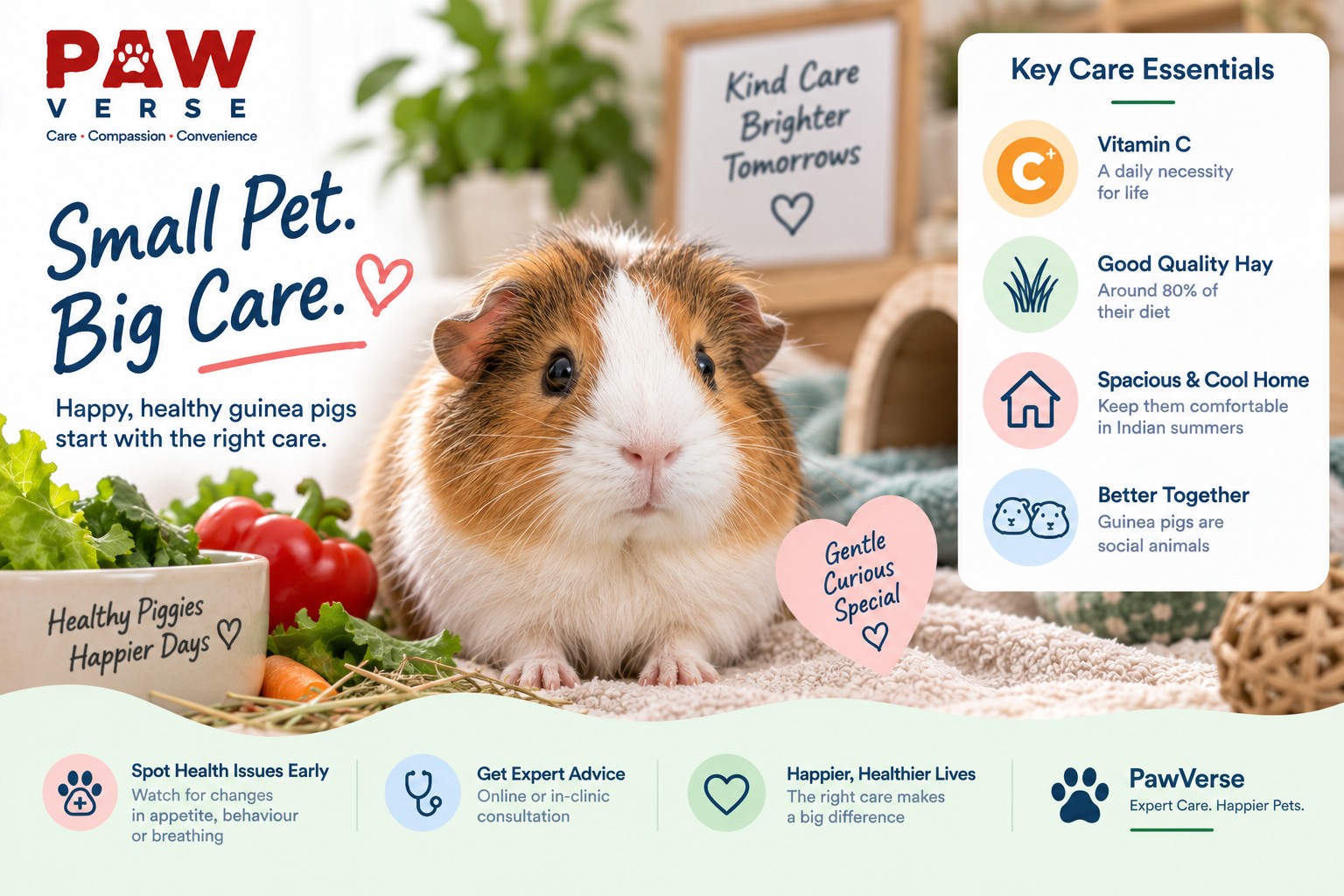
More than any other animal, guinea pigs are chosen as "starter pets" because they are quiet, gentle, manageable, and appear to require little upkeep. Then a new owner learns something that no one at the pet store brought up: guinea pigs have a strict dietary requirement that, if neglected, can result in a serious and totally avoidable illness. This guide explains how to keep a guinea pig healthy in an Indian home, including what to do if something doesn't seem right and your regular veterinarian hasn't actually treated one.
The Vitamin C Problem
Guinea pigs are not like most animals, including rabbits and hamsters. Guinea pigs cannot make their own Vitamin C inside. If they don't have a reliable source of diet they develop scurvy, a real documented disease that causes joint pain, lethargy, poor coat condition and a weakened immune system. This is not something to be taken as an occasional supplement. It is a permanent dietary necessity for life.
This is also where a common and perfectly understandable mistake takes place: rabbit pellets and guinea pig pellets are not interchangeable. Rabbit formulas usually are not fortified with Vitamin C, Guinea pig specific pellets are. It is important to feed fresh vegetables, especially bell peppers, and leafy greens that are naturally high in Vitamin C on a daily basis, along with a guinea pig specific pelleted diet, not just as an occasional treat.
Diet Basics Beyond Vitamin C
The basis of a healthy guinea pig diet is similar to that of rabbits: around 80 percent good quality hay, which helps digestion and the natural wearing down of continuously growing teeth. It is supplemented with a small amount of guinea pig specific pellets and fresh vegetables daily. Iceberg lettuce has little nutritional value – so avoid it. Sugary treats, including fruit, should be kept to a real minimum – not a daily habit. Always provide fresh water and check it daily, guinea pigs can be surprisingly adept at fouling up or blocking a water bottle spout.
Housing and Temperature
Cage size matters more than most starter setups provide, guinea pigs need considerably more floor space than the small display cages often sold alongside them, since they don't climb or use vertical space the way some other small pets do. Flooring should be solid, not wire, wire flooring is a genuine cause of a painful foot condition called bumblefoot, covered further below.
Temperature sensitivity deserves real attention in Indian conditions. Guinea pigs are vulnerable to heat stress, similar in principle to rabbits, and need a cool, shaded, well-ventilated space during Indian summers, never direct sun or a closed, poorly ventilated room. A consistently cool area with good airflow, and never a spot near a window that turns into a sunbox by afternoon, matters more than people expect for an animal often kept in what looks like a perfectly reasonable corner of a room.
Guinea Pigs Are Herd Animals
This is a genuine welfare point, not just a nice-to-have. Guinea pigs are strongly social and generally do better, both behaviorally and in overall health, living in pairs or small same-sex groups rather than alone. A solitary guinea pig isn't automatically miserable, but isolation is a real consideration worth weighing seriously if you're planning to bring just one home.
Common Health Problems
Respiratory infections are one of the most common and most serious issues in pet guinea pigs, and they can progress quickly, watch for sneezing, nasal or eye discharge, and labored breathing, none of which should be left to resolve on their own. Bumblefoot, a painful inflammation and infection of the foot pad, develops from wire flooring, dirty bedding, or obesity, and needs veterinary treatment rather than home management once it's established.
Dental overgrowth is a genuine ongoing concern, since guinea pig teeth, like rabbit teeth, grow continuously throughout life, and insufficient hay or a jaw misalignment can lead to painful overgrowth requiring a vet to correct. Mites and lice cause visible scratching, hair loss, and flaky skin, and need proper diagnosis rather than a generic pet shop remedy. And vitamin C deficiency, covered above, remains one of the most preventable yet still common issues seen in pet guinea pigs specifically.
Why Appetite Loss Is an Emergency in Guinea Pigs Too
If you've read our guide on raising a rabbit in India, this will sound familiar, and for good reason, the underlying biology is similar. Guinea pigs have fast metabolisms and limited energy reserves, and a guinea pig that stops eating or stops producing droppings can decline seriously within as little as 12 to 24 hours.
This should be treated as a same-day emergency, not something to monitor overnight. As with rabbits, this is very often secondary to an underlying cause, dental pain, an infection, or digestive slowdown, that a vet needs to identify and treat, rather than something that resolves with home remedies or patience.
Signs of Illness Are Easy to Miss
Guinea pigs are prey animals, and like rabbits, they instinctively mask illness and vulnerability as long as possible. A guinea pig that seems "a little quiet" or slightly less interested in food is often further along in a developing problem than that behavior would suggest. Daily habits, checking that your guinea pig is eating normally, producing normal droppings, and moving around as usual, are the most reliable way to catch a problem early, since waiting for obvious symptoms often means waiting too long.
The Exotic Vet Gap, and Where Online Vet Consultation Fits In
Guinea pigs run into the same practical problem covered in our guides on rabbits and other pocket pets: general small-animal vets in India often have limited hands-on experience with them, even when a clinic technically accepts the appointment. This is exactly where an online vet consultation for guinea pigs becomes genuinely useful, not just as a convenience, but often as the fastest way to reach someone who actually understands guinea pig physiology, for everyday diet and housing questions, early symptom triage, and figuring out quickly whether something needs an urgent in-person visit. If you're searching for an online doctor for guinea pigs because your local options seem thin, that instinct is a reasonable one given how real this access gap is.
True emergencies, sudden loss of appetite, labored breathing, unresponsiveness, or suspected bumblefoot, still need in-person veterinary care, and a good online consultation will tell you this clearly rather than trying to manage it entirely remotely.
Warning Signs Table
Sign | What It May Mean |
Not eating or no droppings for 12-24 hours | Treat as a same-day emergency |
Sneezing, nasal or eye discharge | Possible respiratory infection, needs prompt care |
Labored or noisy breathing | Needs urgent veterinary attention |
Limping or reluctance to bear weight on a foot | Possible bumblefoot, needs treatment |
Drooling or difficulty eating | Possible dental overgrowth |
Visible scratching, hair loss, flaky skin | Possible mites or lice |
Rough coat, lethargy, joint discomfort | Possible Vitamin C deficiency |
Sudden quietness or reduced activity | Early sign of illness, don't wait to see if it passes |
Frequently Asked Questions
Q: How do I take care of a guinea pig properly in India?
A: Basically a diet that provides Vitamin C (guinea-pig-specific pellets and fresh vegetables), about 80 percent hay as the basis of their diet, a cage with a solid floor and plenty of space, a cool, well-ventilated place away from direct sources of heat, and a companion (another guinea pig of the same sex, ideally, as they really are social animals).
Q: Is there an online vet for guinea pigs in India?
A: Yes, online vet consultation is increasingly used for guinea pigs specifically, given how hard genuinely experienced in-person exotic care can be to find locally. It's well suited to diet and housing questions, early symptom triage, and general guidance, with true emergencies still needing in-person care.
Q: Can guinea pigs eat the same pellets as rabbits?
A: No, this is a common and important mistake to avoid. Guinea pig pellets are fortified with Vitamin C, which guinea pigs cannot produce on their own, while rabbit pellets generally aren't, since rabbits don't have the same requirement.
Q: How fast can a guinea pig get seriously sick?
A: Faster than many owners expect. A guinea pig that stops eating or producing droppings can decline within 12 to 24 hours given their fast metabolism and limited energy reserves, so this should be treated as a same-day emergency rather than monitored overnight.
Q: Are guinea pigs a good pet for kids?
A: Generally yes, they're known for a gentle, calm temperament that tends to tolerate careful handling well, making them a popular choice for families. Supervision still matters, both for the child's sake and the guinea pig's, especially with younger children.
The Bottom Line
Guinea pigs are genuinely good starter pets, but "starter" doesn't mean simple. The Vitamin C requirement alone catches out a huge number of well-meaning first-time owners, and their fast metabolism means appetite loss needs same-day attention rather than a wait-and-see approach. Given how hard genuinely experienced guinea pig care can be to find in person across much of India, an online vet or doctor consultation for your guinea pig is often a faster, more reliable way to get real answers than searching for a local exotic specialist from scratch.
Talk to a PawVerse vet online now for your guinea pig's diet, housing, or health questions, and don't wait if you notice a sudden drop in appetite or activity.
With love, Team PawVerse
Have a question about your pet?
Chat with Captain Scout and reach a verified vet, guaranteed within 30 minutes.
PawVerse Editorial Team
Practical pet health guides from the PawVerse team, written to help Indian pet parents understand what they are seeing and when to talk to a vet.
Your pet's health does not have to wait
Talk to a verified PawVerse vet from home. No travel, no waiting rooms, real answers within 30 minutes.