
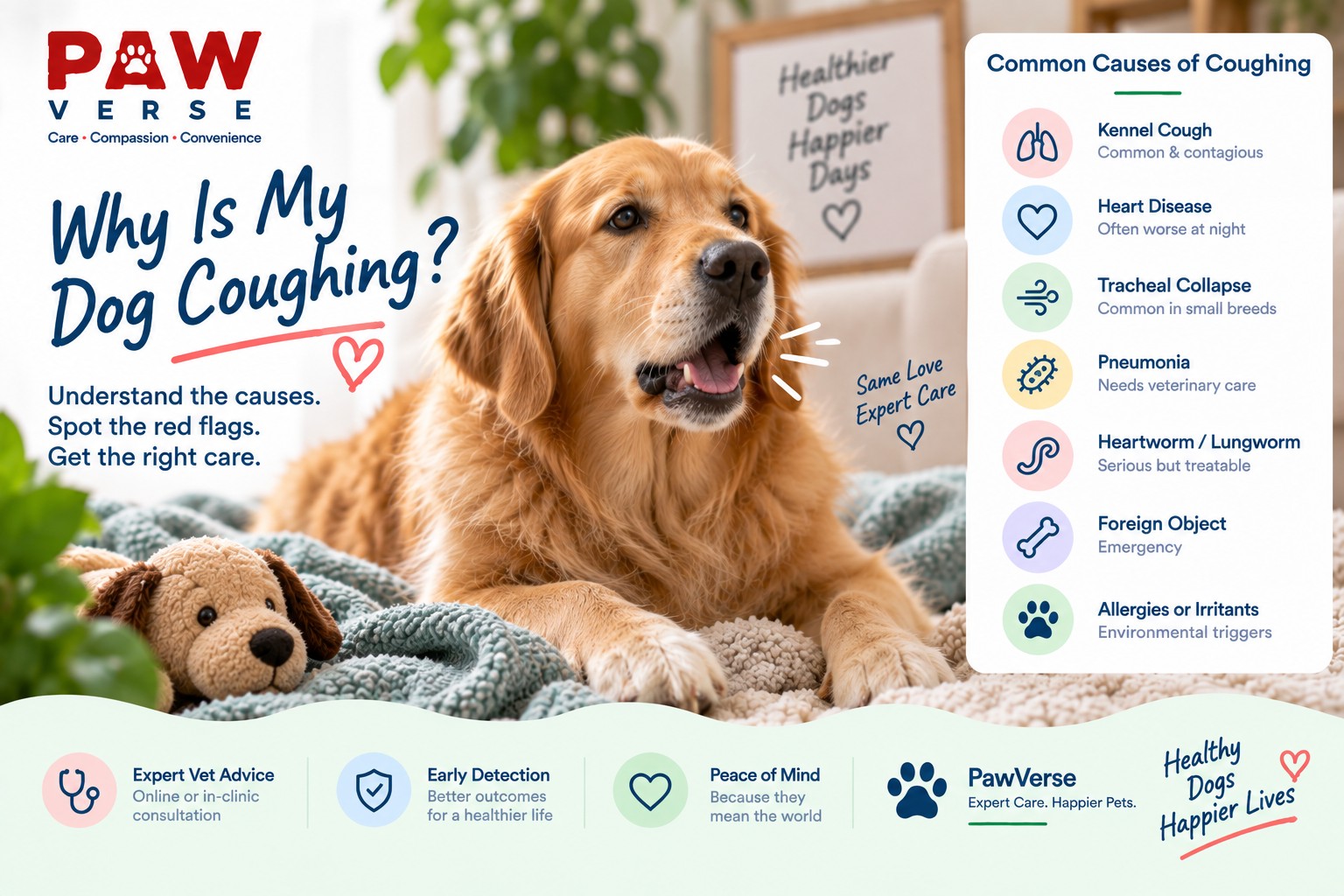
That dry, honking hack from across the room, or the wet, rattly cough that seems to get worse once your dog settles down for the night, coughing is one of those symptoms that can mean almost nothing or something genuinely serious, and the sound alone rarely tells you which. This guide walks through why dogs cough, what the pattern and timing can tell you, and exactly when it's time to stop listening and start acting.
Why Is My Dog Coughing?
"There's a very wide range of causes for dog cough, and the general category (dry versus wet, occasional versus constant, daytime versus nighttime) is more important than the cough itself in telling us what's going on," says Dr. McCarthy. Kennel cough is one of the most common causes of infectious respiratory disease, especially in dogs that have recently been in contact with other dogs at a park, groomer or boarding facility. One serious, and often under-appreciated, cause is heart disease, specifically congestive heart failure, especially in older dogs and in some predisposed breeds. Tracheal collapse is when the cartilage of the windpipe collapses and narrows. It is common in small breeds, such as Yorkshire Terriers and Pomeranians. Other causes include a foreign object stuck in the throat, environmental allergies or irritants, pneumonia, heartworm or lungworm infection and, in older large dogs, laryngeal paralysis, a condition affecting the structures that control airflow into the windpipe.
The honest starting point is that coughing is a symptom, not a diagnosis in itself, and the same sound can be caused by something as mild and self-limiting as a respiratory infection, to something as serious as a cardiac or airway problem. A cough alone is not as important as the pattern, timing and what else is going on with your dog. Age and breed make a big difference in the odds as well. A young dog with a sudden cough after a trip to the groomer is statistically a very different picture from a 10 year old small breed dog with a gradually worsening cough over several weeks, even if the sound itself is similar.
Why Is My Dog Coughing at Night?
Night time cough deserves special comment, as it is a classic presentation for a few specific causes. Heart-related coughing is associated with fluid build-up in or around the lungs and is typically worse at night and when your dog is lying down, because the fluid redistributes when lying horizontally, as opposed to standing or moving about during the day. Tracheal collapse may also seem worse at night or immediately after a dog gets up from a rest, since the transition itself may trigger an episode. Kennel cough, too, sometimes seems more noticeable at night simply because the house is quieter and the dog is more still, making a daytime cough that got lost in normal activity suddenly stand out.
If your dog’s coughing is notably worse at night or when at rest, particularly if it’s a new development in an older dog, it’s worth bringing this combination up directly to a vet, rather than assuming it’s incidental, as it’s one of the more recognisable signals of a cardiac cause.
Can Kennel Cough Cause Coughing?
Yes and it is one of the most common causes overall. Kennel cough is a highly contagious respiratory infection caused by a combination of bacteria (Bordetella bronchiseptica) and viruses. It is easily spread anywhere dogs gather, such as boarding facilities, dog parks, grooming salons and puppy classes. It often produces a characteristic dry, harsh, honking cough, sometimes precipitated or aggravated by pressure on the throat from a collar or leash, and it may be associated with a mild fever or loss of appetite, but many dogs so affected otherwise appear fairly normal in energy and behaviour.
Most cases resolve on their own within one to three weeks, just like a common cold, but it's worth the trip to the vet to confirm the diagnosis and rule out anything more serious, especially with puppies or dogs with other health conditions. The Bordetella vaccine, a non-core vaccine usually recommended for dogs with regular exposure to other dogs, reduces the risk and severity, covered in more detail in our puppy vaccination schedule for India.
Can Heart Disease Cause Coughing?
Yes, and this is one of the more important causes to understand given how often it's dismissed as "just getting older." As heart function declines, particularly in congestive heart failure, fluid can build up in or around the lungs, and the enlarged heart itself can press against the airways, both of which trigger coughing, often worse at night or after exercise. This tends to develop gradually and is frequently accompanied by other subtle signs, including faster breathing at rest, that owners often miss until the pattern is pointed out to them.
We've covered this in real depth, including a specific, genuinely useful home monitoring technique that veterinary cardiologists recommend, in our guide on why dogs breathe fast. If your dog is coughing and you've also noticed faster breathing at rest or during sleep, that combination is worth a vet visit rather than continued monitoring at home.
Can Allergies Cause Coughing?
Yes, though it's a less common cause in dogs than infectious or cardiac causes. Environmental allergens, dust, pollen, mold, or irritants like smoke or strong cleaning fumes, can trigger coughing in sensitive dogs, usually alongside other allergy signs like itching or watery eyes. It's worth distinguishing true coughing from reverse sneezing, a common and usually harmless phenomenon where a dog makes a loud, snorting, honking sound while rapidly pulling air in through the nose, often triggered by excitement or allergens, that many owners mistake for a cough or a choking episode. Reverse sneezing episodes are typically brief and resolve on their own, unlike a persistent cough.
Why Is My Dog Coughing After Drinking?
This is a fairly common and usually minor pattern. Some dogs cough briefly after drinking due to mild throat or laryngeal irritation, drinking too quickly, or water going down slightly wrong, similar to how a person might cough after swallowing water the wrong way. An occasional cough right after drinking, with no other symptoms, usually isn't a concern.
If this happens consistently, every time or nearly every time your dog drinks, it's worth a closer look, since it can be an early sign of tracheal irritation, tracheal collapse, or in some cases a laryngeal issue that's triggered specifically by the act of swallowing. A pattern that's consistent and repeated deserves a vet's opinion rather than being written off indefinitely as a quirk.
When Is Coughing an Emergency?
A few patterns cross clearly into emergency territory. Coughing accompanied by pale, blue, or grey gums signals a genuine oxygen problem and needs immediate care. Coughing up blood, or a cough paired with sudden collapse or extreme difficulty breathing, is always an emergency. A dog pawing at the mouth, retching without producing anything, or showing signs of choking may have a foreign object obstructing the airway, which needs urgent attention rather than waiting to see if it clears on its own. Our dog emergency symptoms guide covers the broader list of signs that mean stop monitoring and get to a vet immediately, several of which can appear alongside coughing specifically.
What Does a Dry Cough Mean?
A dry, harsh, or honking cough, without any mucus or fluid produced, is the classic presentation of kennel cough, especially in its early stages, and is also typical of tracheal collapse, often described as sounding like a goose honk. Environmental irritants and allergies also tend to produce a dry cough rather than a wet one. Interestingly, early heart-related coughing can sometimes start out relatively dry before progressing, so a dry cough alone doesn't rule out a cardiac cause, particularly in an older dog or one with a known heart murmur.
What Does a Wet Cough Mean?
A wet, moist, or productive-sounding cough, sometimes followed by swallowing or gagging as if bringing something up, suggests fluid or mucus is present in the airways, which points toward pneumonia, more advanced kennel cough, or fluid buildup from congestive heart failure. This type of cough generally deserves more prompt attention than a dry cough, since it suggests the airways or lungs themselves are directly involved rather than just irritation higher up in the throat.
What You Can Do at Home for a Mild Cough
If your dog has a mild, dry cough, is otherwise eating, drinking, and behaving normally, and you suspect kennel cough from recent exposure to other dogs, a few things can help while you monitor. Switch to a harness instead of a collar temporarily, since pressure on the throat can trigger or worsen coughing episodes. Keep your dog away from other dogs until the cough resolves, given how contagious kennel cough is. Use a humidifier or let your dog spend a few minutes in a steamy bathroom, which can help soothe airway irritation. And avoid strenuous exercise until the cough has cleared. None of this replaces a vet visit if the cough persists, worsens, or comes with any of the warning signs below, it's simply reasonable supportive care for a mild, likely self-limiting case.
Should I Take My Dog to a Vet?
In most cases, yes, unless the cough is a single, isolated incident with an obvious explanation, like a brief cough right after drinking that doesn't repeat. A cough that persists beyond a day or two, that's paired with lethargy, appetite loss, or labored breathing, that's specifically worse at night or with exertion, or that started after known exposure to other dogs, all warrant a vet visit. Puppies, senior dogs, and dogs with known heart conditions deserve a lower threshold for checking in, given how quickly some underlying causes can progress in these groups.
Warning Signs Table
Sign | What It May Mean |
Dry, honking cough after exposure to other dogs | Likely kennel cough |
Cough worse at night or when lying down | Possible heart-related cause |
Cough plus faster breathing at rest | Possible heart disease, needs evaluation |
Wet, productive cough | Possible pneumonia or fluid buildup |
Coughing up blood | Emergency, seek care immediately |
Pale, blue, or grey gums | Emergency, seek care immediately |
Retching or pawing at the mouth without result | Possible airway obstruction, emergency |
Cough lasting more than a few days | Needs veterinary evaluation |
When Should I Contact a Vet?
Reach out to a vet if your dog's cough persists beyond a couple of days, if it's paired with lethargy, appetite loss, or faster breathing at rest, if it's specifically worse at night, or if you know your dog was recently around other dogs in a group setting. You don't need to visit a clinic in person for an initial assessment, through PawVerse, you can book an online vet consultation and describe the cough's pattern and timing, which genuinely helps narrow down the likely cause. For coughing up blood, pale or blue gums, or any sign of choking or severe breathing difficulty, our emergency vet consultation is available around the clock.
The Bottom Line
Most dog coughing traces back to something manageable, kennel cough, mild irritation, or an occasional reaction to drinking too fast, and resolves within a few days. What changes the picture is a cough that's persistent, wet, worse at night, or paired with faster breathing, lethargy, or appetite loss, all of which are worth a vet's attention rather than continued home monitoring, especially in older dogs where a cardiac cause becomes more likely.
Talk to a PawVerse vet online now if your dog has developed a new or worsening cough, or explore our Pet Health Blog for more guides on keeping your dog healthy.
With love, Team PawVerse
Have a question about your pet?
Chat with Captain Scout and reach a verified vet, guaranteed within 30 minutes.
Frequently Asked Questions
A dry, harsh, or honking cough without any mucus is the classic presentation of kennel cough, especially in its early stages, and is also typical of tracheal collapse.
PawVerse Editorial Team
Practical pet health guides from the PawVerse team, written to help Indian pet parents understand what they are seeing and when to talk to a vet.
Your pet's health does not have to wait
Talk to a verified PawVerse vet from home. No travel, no waiting rooms, real answers within 30 minutes.