
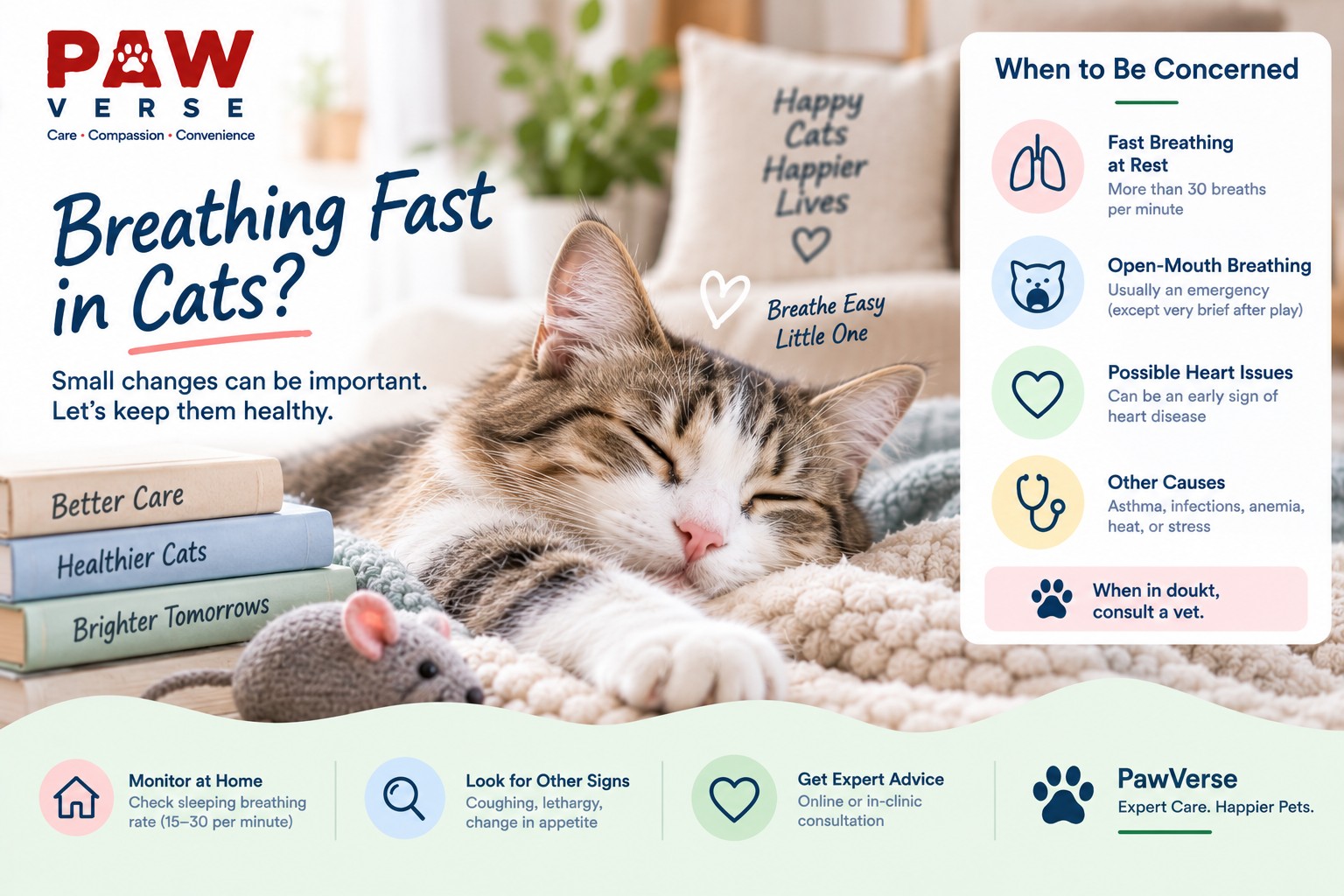
Your cat is curled up asleep, and you notice their sides moving a little quicker than usual. With a dog, you might not think twice. With a cat, this deserves genuine attention, and not because cats are more fragile, but because of a specific fact most cat owners have never been told: cats hide heart disease so effectively that fast breathing at rest is sometimes the only warning sign before a real crisis, and it can appear weeks or months before anything else looks wrong.
This guide covers what normal cat breathing actually looks like, why panting means something different in cats than it does in dogs, and a specific home monitoring technique veterinary cardiologists recommend given how common silent heart disease is in cats.
Normal vs Abnormal Breathing in Cats
A healthy cat's resting or sleeping breathing rate is typically between 15 and 30 breaths per minute. To check this yourself, wait until your cat is deeply asleep or resting quietly, not purring, since purring can make an accurate count difficult, and not twitching through a dream. Watch one full rise and fall of the chest and belly as one breath, and count for 30 seconds, then multiply by two, or count for 15 seconds and multiply by four.
Healthy breathing in cats should involve the chest and belly moving together gently, without noticeable effort. Pronounced belly movement, where your cat appears to be visibly using their abdomen to force each breath, is a sign of labored breathing and worth taking seriously regardless of the actual rate you count.
Why Panting in Cats Is Different From Panting in Dogs
This is the single most important distinction in this entire guide. In dogs, panting is a normal, everyday cooling mechanism. In cats, it is not. Open-mouth breathing or panting in a cat should generally be treated as an emergency, with the narrow exception of very brief panting immediately after intense play or excitement, the kind that resolves within a couple of minutes on its own. Outside of that specific situation, a cat breathing with an open mouth, an extended neck, or elbows held out away from the body is showing signs of real respiratory distress, not simply cooling down or getting some air, and this warrants prompt veterinary attention rather than a wait-and-see approach.
Common, Less Concerning Causes
Brief, hard exertion from intense play can cause temporary open-mouth breathing that settles within a couple of minutes, this is the one real exception to the panting rule above. A warm room can cause a mild, temporary increase in breathing rate that resolves once your cat moves somewhere cooler and has time to settle. Situational stress, a car ride, a vet visit, an unfamiliar environment, can also cause a temporary rise, though because cats express so little of their distress outwardly, it's still reasonable to keep an eye on how quickly it resolves once the stressor is removed.
Serious Causes Worth Understanding
Hypertrophic cardiomyopathy (HCM), a thickening of the heart's main pumping chamber, is the most common heart disease in cats, affecting as many as 1 in 7 cats, and it frequently causes no obvious symptoms at all in its early stages, sometimes not even a detectable heart murmur. As HCM progresses, it can lead to congestive heart failure, where fluid builds up in or around the lungs, and fast or labored breathing, sometimes with panting, is one of the most common resulting symptoms. Because cats mask illness so well generally, HCM-related heart failure can seem to appear "out of nowhere," with a cat going from apparently fine to seriously unwell quickly, which is exactly why the monitoring approach in the next section matters so much.
Feline asthma and bronchitis are distinct, genuine respiratory conditions causing labored breathing, wheezing, and coughing, identified by Cornell's feline health researchers as one of the three most common causes of respiratory distress in cats. Pleural effusion, fluid collecting around the lungs rather than inside them, is another of those three leading causes, often linked to underlying heart disease. Pneumonia and upper respiratory infections, especially common in kittens, can also drive faster breathing as the body works to compensate. Anemia reduces the blood's oxygen-carrying capacity, forcing faster breathing to compensate, usually alongside lethargy and pale gums. Heatstroke is less common in cats than dogs but does occur, especially in warm, poorly ventilated spaces, and open-mouth panting combined with changing gum color is a specific danger sign. And aortic thromboembolism, a blood clot linked to underlying heart disease, can cause sudden breathing distress alongside sudden hind-limb weakness or paralysis, covered as a true emergency in our cat emergency symptoms guide.
The Sleeping Respiratory Rate Test: Especially Valuable for Cats
Given how common silent heart disease is in cats, and how effectively cats hide early symptoms of almost anything, monitoring sleeping respiratory rate (SRR) is arguably even more valuable for cat owners than dog owners, not less.
Count your cat's breathing rate specifically while they're deeply asleep, not purring, dreaming, or drowsy, using the method described above. A sleeping respiratory rate that stays under 30 breaths per minute is generally considered normal. A rate consistently above 30 is an early warning sign worth a vet visit, even if your cat seems to be eating, playing, and behaving normally otherwise. A rate consistently above 40 breaths per minute warrants prompt veterinary attention. This single home habit, checked periodically even in a cat with no known heart issue, given how often HCM produces no audible murmur and no obvious early symptoms, is one of the most genuinely useful things a cat owner can do, and it's specifically recommended by veterinary cardiologists for cats already diagnosed with heart disease as an ongoing monitoring tool.
Warning Signs Table
Sign | What It May Mean |
Open-mouth breathing or panting, not linked to brief intense play | Treat as an emergency in cats |
Sleeping respiratory rate consistently above 30 breaths/min | Early warning sign, needs a vet visit |
Sleeping respiratory rate consistently above 40 breaths/min | Needs prompt veterinary attention |
Visible, exaggerated belly movement while breathing | Labored breathing, needs evaluation |
Neck extended, elbows splayed outward while breathing | Sign of respiratory distress |
Pale, blue, or grey gums | Emergency, seek immediate care |
Fast breathing plus sudden hind-limb weakness | Possible blood clot, emergency |
Fast breathing plus lethargy or reduced appetite | Needs veterinary evaluation |
When This Is a True Emergency
Any open-mouth breathing outside of brief post-play panting, pale, blue, or grey gums, a neck-extended or elbows-out breathing posture, collapse, or fast breathing paired with sudden hind-limb weakness all mean stop monitoring and seek emergency care immediately. Our cat emergency symptoms guide covers the fuller list of urgent signs in cats, several of which can overlap with breathing changes.
When to Contact a Vet
Reach out to a vet if you notice a sleeping respiratory rate consistently above 30 breaths per minute, any panting outside of brief post-play recovery, labored or visibly effortful breathing, or fast breathing alongside lethargy, hiding, or reduced appetite. Given how well cats mask illness generally, it's safer to check in sooner rather than waiting for more obvious symptoms to develop. Through PawVerse, you can book an online vet consultation to describe what you're seeing, ideally with an actual breath count on hand. For open-mouth breathing, pale or blue gums, or collapse, our emergency vet consultation is available around the clock.
Frequently Asked Questions
Q: Is it normal for my cat to pant like a dog sometimes?
A: Generally no. Panting is a normal cooling mechanism in dogs but not in cats, and open-mouth breathing in a cat should be treated as a possible emergency, with the narrow exception of brief panting that resolves within a couple of minutes right after intense play.
Q: What is a normal breathing rate for a cat?
A: A healthy cat's resting or sleeping breathing rate is typically 15 to 30 breaths per minute. Counting for 30 seconds and multiplying by two, while your cat is deeply asleep and not purring, is the most reliable way to check.
Q: My cat seems totally healthy, do I really need to monitor their breathing rate?
A: It's genuinely worth considering, since hypertrophic cardiomyopathy affects as many as 1 in 7 cats and frequently causes no detectable symptoms, sometimes not even a heart murmur, until it progresses. Periodically checking sleeping respiratory rate is one of the few ways to catch this kind of silent heart disease before it becomes a crisis.
Q: How is fast breathing in cats different from fast breathing in dogs?
A: The underlying causes overlap significantly, but panting itself is a much bigger red flag in cats, since it isn't a normal cooling behavior the way it is in dogs. Cats are also generally better at masking illness, so fast breathing at rest deserves a lower threshold for concern in cats than the same finding might in a dog.
Q: Can stress alone cause my cat to breathe fast?
A: Yes, situational stress like a car ride or vet visit can cause a temporary increase, but because cats hide distress so well otherwise, it's still worth watching to confirm the breathing rate returns to normal once the stressor is removed, rather than assuming stress explains it indefinitely.
The Bottom Line
Fast or labored breathing in cats deserves more immediate attention than the same finding in a dog, both because panting itself is abnormal in cats and because silent heart disease is remarkably common and easy to miss until a real crisis develops. Learning to count your cat's sleeping respiratory rate, and knowing that anything consistently above 30 breaths per minute deserves a vet's attention, is one of the most genuinely useful things a cat owner can add to their routine, whether or not your cat has ever shown any sign of a problem.
Talk to a PawVerse vet online now if you've noticed a change in your cat's breathing, or explore our Pet Health Blog for more guides on keeping your cat healthy.
With love, Team PawVerse
Have a question about your pet?
Chat with Captain Scout and reach a verified vet, guaranteed within 30 minutes.
PawVerse Editorial Team
Practical pet health guides from the PawVerse team, written to help Indian pet parents understand what they are seeing and when to talk to a vet.
Your pet's health does not have to wait
Talk to a verified PawVerse vet from home. No travel, no waiting rooms, real answers within 30 minutes.