
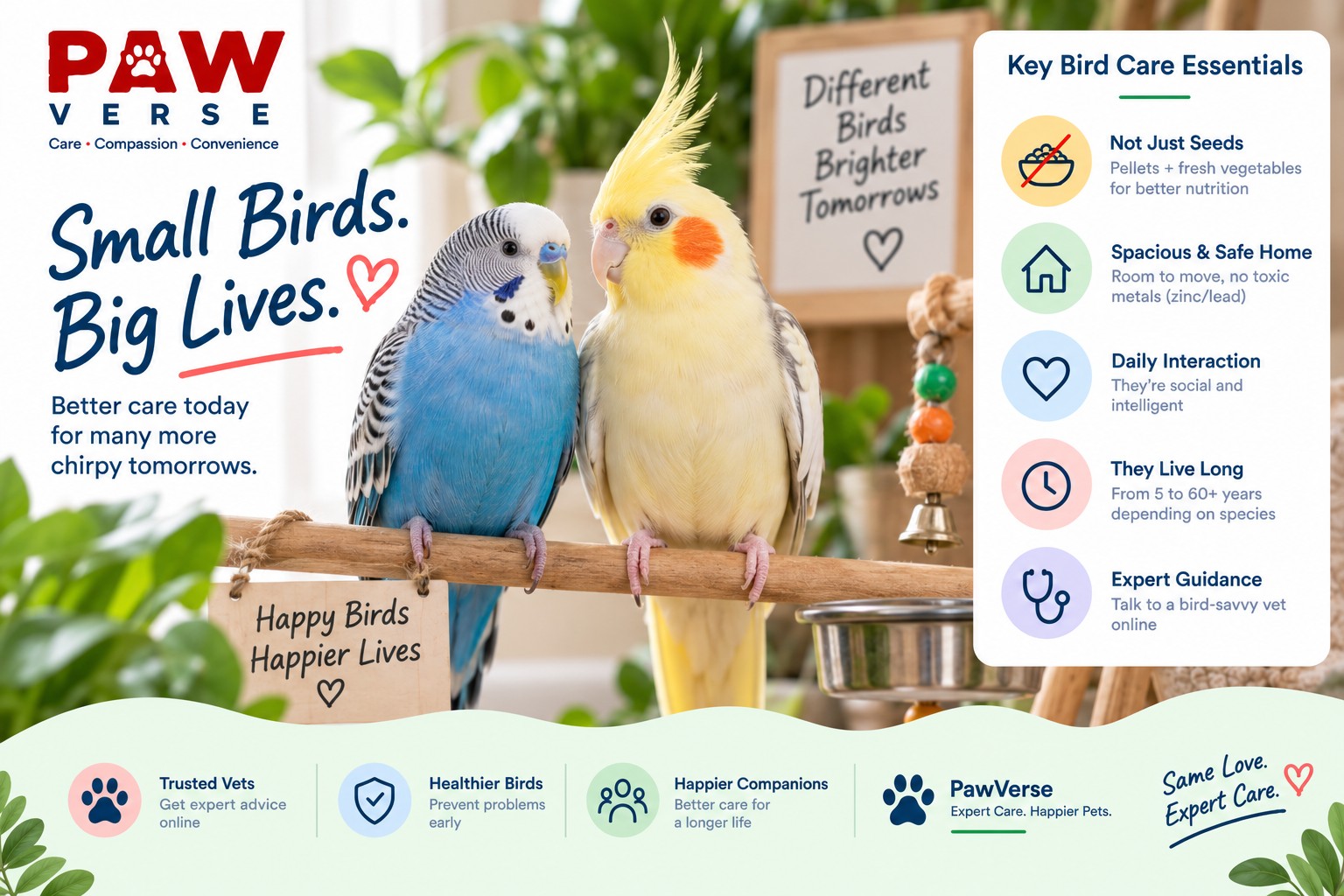
A budgie feels like a low-commitment pet, small cage, quiet, easy to leave with a neighbor for a weekend. Then you find out a healthy budgie can live 8 to 10 years, a cockatiel can live 15 to 20, and certain larger parrots genuinely outlive the people who bought them, with African Greys and macaws living well past 40, sometimes past 60. That's not a footnote, it changes what "getting a pet bird" actually means as a decision. This guide covers what real bird care looks like in an Indian home, past the small cage and the birdseed most new owners start with.
How Long Do Pet Birds Actually Live?
This is worth knowing before anything else, since it reframes every other decision that follows. Budgerigars typically live 5 to 10 years, cockatiels 15 to 20, lovebirds 10 to 15, and larger parrots, African Greys, Amazons, and macaws among them, can live 40 to 60 years or more with good care. A bird bought on impulse is a commitment that can span decades, sometimes needing a plan for what happens to the bird after the original owner can no longer care for it, a genuinely unusual planning consideration compared to almost any other common pet.
Before You Buy: Is It Even Legal?
This deserves a direct mention rather than an assumption. Several commonly sold birds in India, including the classic green parakeet, are actually native protected species and illegal to own under the Wildlife Protection Act. Our guide on pet bird legality in India covers exactly which species are legal, which aren't, and what to do if you already own a protected one, worth reading before you acquire a bird, not after.
Diet: Why Seed-Only Feeding Fails Birds
A bowl of seeds looks like a complete diet, and it isn't. Seeds are calorie-dense but nutritionally incomplete on their own, and long-term seed-only feeding is one of the most common causes of preventable malnutrition in pet birds. A pelleted base diet formulated for your bird's specific species, supplemented with appropriate fresh vegetables, is what most avian vets actually recommend, with seeds treated as an occasional addition rather than the main event. Avocado, chocolate, caffeine, and onion are toxic to birds and should never be offered, even as a small taste.
Cage Size and a Safety Risk Most Owners Never Check
Cages sold as "starter" setups are very often too small for genuinely comfortable, long-term housing, birds need enough room to fully extend their wings and move around, not just perch in place. Bar spacing matters too, wide enough gaps can allow a small bird to squeeze through or get a head caught.
One safety detail worth checking directly: inexpensive cages and their hardware, latches, chain toys, cheap bells, sometimes contain zinc or lead, and birds can develop serious heavy metal toxicity from chewing on or licking these materials, which birds do constantly as part of normal behavior. This is a genuinely underappreciated risk worth verifying before you assume a cheap cage is simply a cheap cage.
Birds Need Daily Interaction, Not Just a Cage
This is where many new owners underestimate what they have bitten off. Many popular pet birds, especially budgies, cockatiels and larger parrots, are highly social and intelligent and a bird left alone in a cage most of the day with little interaction often develops real behavioral problems. Feather plucking is when a bird pulls out its feathers and it is often a sign of boredom, loneliness or stress, not purely a medical problem, but can also be caused by medical issues so it is worth checking both possibilities rather than assuming either one. Things like rotating toys, giving them time out of the cage in a bird-proofed area, and just talking to and interacting with a social species on a daily basis are more important than most beginner guides give credit.
Common Health Issues
Respiratory infections, mites, egg binding in females, and overgrown beaks and nails are all common issues covered in more depth in our guide on pet bird legality and health in India, worth reading alongside this one for the fuller health picture. Malnutrition from seed-only diets, covered above, remains one of the most preventable yet still common problems seen in pet birds specifically.
Why Birds Hide Illness So Well
Birds are prey animals, and have evolved to conceal illness far more thoroughly than most mammals do, because showing weakness would make them an obvious target in the wild. A bird that looks sick to the naked eye is usually much farther along in its health crisis than the same appearance would be in a dog or cat. Keep an eye out for consistently fluffed feathers, tail bobbing with breathing, sitting at the bottom of the cage or decreased vocalization and don’t wait for more obvious signs to contact a vet, our bird legality and health guide details this pattern further.
The Avian Vet Gap, and Where Online Vet Consultation Fits In
Finding a vet in India with genuine, hands-on bird experience is harder than finding one for dogs or cats, and often harder than finding one for other exotic pets too, avian medicine is its own specialty, and truly qualified practitioners are concentrated in a small number of clinics, mostly in major cities. This is exactly why searching for an online vet for a bird, or an online doctor for a bird, has become a genuinely reasonable first move for a lot of Indian bird owners, rather than settling for a local doc for bird care who may have limited real experience with avian patients. Online consultation is well suited to diet and housing questions, behavioral concerns like feather plucking, and early symptom triage, helping you figure out quickly whether something needs an urgent in-person visit to a genuinely bird-experienced vet.
Warning Signs Table
Sign | What It May Mean |
Fluffed feathers held for extended periods | Possible illness or attempt to conserve body heat |
Tail bobbing with each breath | Sign of respiratory distress |
Sitting at the bottom of the cage | Possible illness or weakness |
Sudden feather plucking | Possible boredom, stress, or a medical cause |
Discharge from eyes or nostrils | Possible infection |
Noticeable change in droppings | Worth monitoring, can indicate diet or health issues |
Decreased vocalization or activity | Early, easy-to-miss sign something is off |
Labored breathing or open-mouth breathing | Needs urgent veterinary attention |
Frequently Asked Questions
Q: How do I take care of a pet bird properly?
A: The real basics go beyond a cage and birdseed, a pelleted diet with fresh vegetables rather than seeds alone, a cage large enough for full wing extension, daily interaction and mental stimulation for social species, and awareness of how long you're actually committing to, since many pet birds live well over a decade.
Q: Is there an online vet or doctor for birds in India?
A: Yes, and it's a genuinely practical option given how concentrated real avian expertise is in a small number of specialty clinics. Online vet consultation works well for diet, housing, and behavioral questions, and for early triage, with true emergencies still needing prompt in-person care from a genuinely bird-experienced vet.
Q: How long do pet birds actually live?
A: It varies significantly by species, budgies typically 5 to 10 years, cockatiels 15 to 20, and larger parrots like African Greys and macaws 40 to 60 years or more. This is worth factoring into the decision to get a bird at all, since it's a substantially longer commitment than most people initially assume.
Q: Is a seed-only diet really a problem if my bird seems fine?
A: Yes, seed-only diets are calorie-dense but nutritionally incomplete, and the resulting malnutrition often develops gradually enough that a bird can seem outwardly fine for a while before problems become apparent. A pelleted base diet with fresh vegetables is generally the better long-term choice.
Q: How do I know if my bird is lonely or bored versus sick?
A: This genuinely can be hard to tell apart, since feather plucking and reduced activity can stem from either cause, and they sometimes overlap. A vet can help rule out medical causes first, after which addressing loneliness or boredom directly, more interaction, toy rotation, time outside the cage, is the appropriate next step.
The Bottom Line
A pet bird is a bigger commitment than the small cage and quiet chirping suggest, sometimes spanning decades, and real care means more than seeds and a cage, a proper diet, adequate space, and genuine daily interaction all matter more than most first-time owners expect. Given how hard truly experienced avian care can be to find locally across much of India, an online vet or doctor consultation for your bird is often the fastest way to get guidance that actually reflects avian-specific expertise.
Talk to a PawVerse vet online now for your bird's diet, housing, or health questions, and take the time to understand what you're committing to before bringing one home.
With love, Team PawVerse
Have a question about your pet?
Chat with Captain Scout and reach a verified vet, guaranteed within 30 minutes.
PawVerse Editorial Team
Practical pet health guides from the PawVerse team, written to help Indian pet parents understand what they are seeing and when to talk to a vet.
Your pet's health does not have to wait
Talk to a verified PawVerse vet from home. No travel, no waiting rooms, real answers within 30 minutes.