
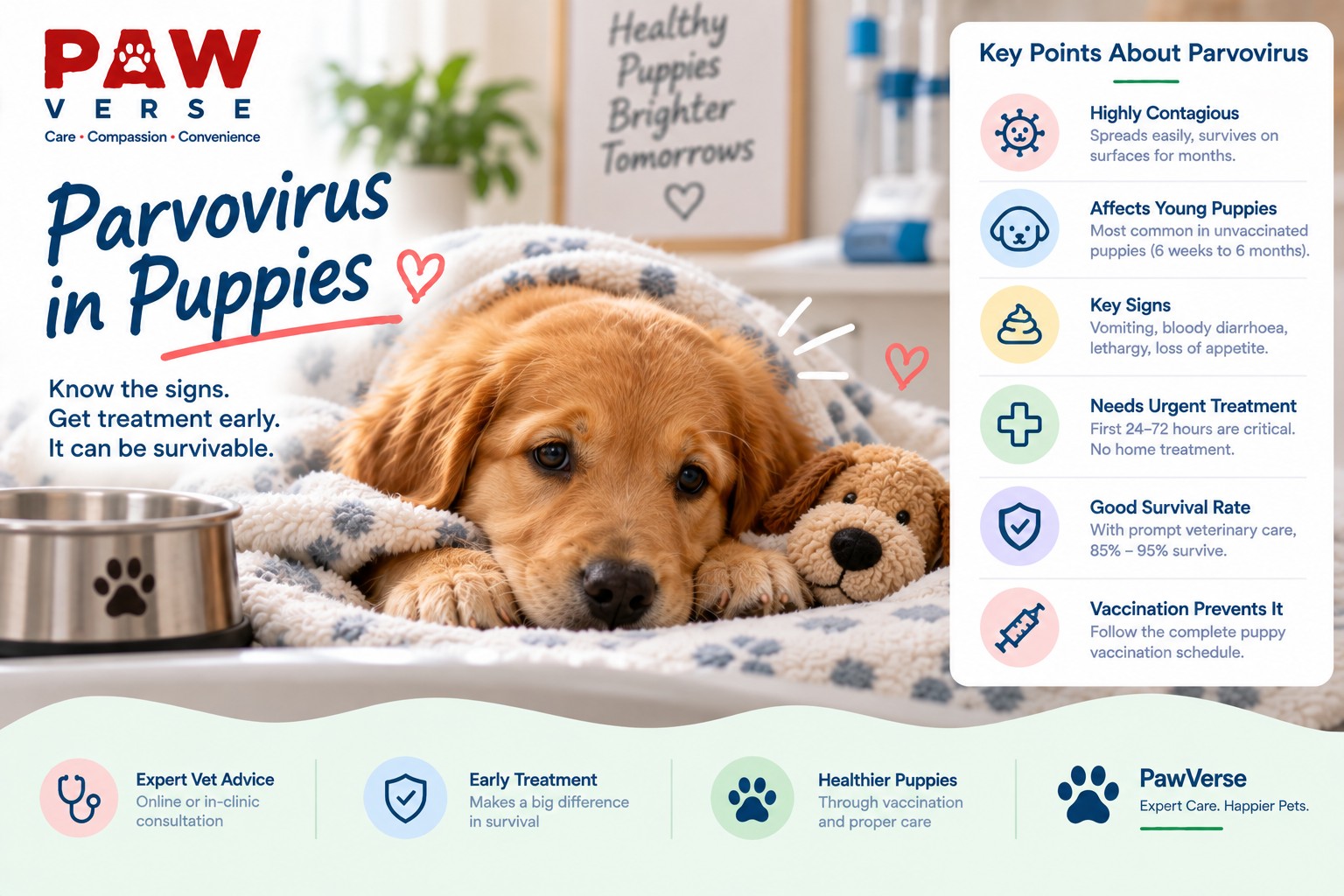
Ask any vet what parvo smells like and they will answer before you finish the question. The diarrhoea has a sharp, rotten odour that most people who have dealt with it never forget. In a ten-week-old puppy, that smell can show up on a Friday, and without treatment, the puppy can be gone by Sunday. This is one of the few topics in pet care where the right response is not "wait and watch," it is "go now."
This guide covers what parvovirus actually is, the earliest signs, why survival comes down almost entirely to speed, and what treatment and outcomes genuinely look like for Indian pet parents.
What Parvovirus Actually Is
Canine parvovirus (CPV) is a highly contagious virus that targets the fastest-dividing cells in a puppy's body, which happens to mean two places at once: the lining of the intestines and the bone marrow. That combination is what makes it so destructive. The gut lining breaks down, causing severe vomiting and bloody diarrhoea, while the bone marrow damage weakens the immune system at the exact moment the body needs it most. In very young puppies, the virus can also affect the heart muscle, sometimes causing sudden death with almost no warning.
Parvovirus mainly strikes unvaccinated or partially vaccinated puppies roughly 6 weeks to 6 months old. This age window exists because maternal antibodies, protection passed from the mother, fade before the vaccine series is far enough along to take over, leaving a gap where a puppy has little protection from either source. This is exactly why our puppy vaccination schedule for India emphasises not skipping or delaying doses during this window.
Why India Sees This So Often
Parvovirus is a year-round risk in India, but clinics report clear surges during seasonal transitions, particularly around the onset of monsoon and in the depths of winter. The scale of India's street and community dog population matters here too, since the virus survives in soil and on surfaces for months, an unvaccinated puppy walked in a park or lane that an infected dog passed through weeks earlier can pick it up with no direct contact at all. Certain breeds, including Rottweilers, Doberman Pinschers, and Pit Bull type dogs, are frequently reported as more susceptible, though any unvaccinated puppy of any breed is genuinely at risk.
Early Signs, Before It Looks Like an Emergency
This is worth reading closely, because the very first sign is rarely vomiting or diarrhoea. Puppies are naturally curious and food-driven, so a sudden change in temperament, unusual quietness, reduced interest in play, seeking out dark or hidden corners of the house, often shows up before any physical symptom. Loss of appetite typically follows. Within a day, this usually progresses to repeated vomiting and profuse, often bloody diarrhoea with a distinctive foul smell, alongside rapid dehydration and lethargy that can progress to collapse.
If you notice the early behavioural change alone, in an unvaccinated or partially vaccinated puppy, that is already a reason to contact a vet, not a reason to wait for the diarrhoea to confirm it.
Why Speed Decides the Outcome
There is no cure for parvovirus itself. Treatment is entirely supportive, keeping the puppy alive and stable long enough for its own immune system to clear the virus. The most dangerous period is the first 24 to 72 hours after symptoms appear, and a puppy that gets aggressive veterinary care during that window has a genuinely different outlook than one whose treatment starts late. There is no safe way to manage this at home with electrolyte water and hope, that approach is how most untreated parvo puppies die.
Survival Rates: The Real Numbers
With prompt, aggressive veterinary treatment, survival rates are generally reported between 85% and 95%. Puppies that are already fully vaccinated but somehow still contract a mild breakthrough case tend to do even better, with some sources reporting survival above 95% in that group, since their immune system has some existing defence to work with.
Left completely untreated, the picture reverses sharply: mortality is around 90%, and of the small share that survive without treatment, only a fraction recover without lasting complications. The gap between those two numbers is the entire point of this guide. Parvovirus is frequently survivable, but only when real veterinary treatment starts fast.
What Treatment Actually Involves
Diagnosis is usually confirmed with a fecal SNAP ELISA test, a quick in-clinic test that takes about ten minutes. Once confirmed, hospitalisation is the standard of care, typically involving intravenous fluids to correct dehydration, anti-nausea medication, antibiotics to manage secondary bacterial infection while the immune system is compromised, and close monitoring of blood values. Nutrition matters too, since the damaged intestines need support to heal, and vets will often reintroduce feeding carefully once vomiting is controlled. A typical hospital stay runs five to seven days for a puppy that responds well, though more severe cases can take longer.
A newer option, a canine parvovirus monoclonal antibody treatment, received conditional approval in the United States in 2023 and has shown strong results in trials, targeting the virus directly rather than only managing symptoms. Availability in India is not something we can confirm as standard at this time, so ask your vet directly whether it is an option in your city rather than assuming it is available everywhere.
For families where full hospitalisation is genuinely not affordable, outpatient treatment, more limited fluid therapy and medication given on a return-visit basis rather than an overnight stay, exists as a less intensive alternative. It is not equivalent to hospitalisation and generally carries a lower success rate, but discussing this option honestly with your vet is better than no treatment at all if cost is the real barrier.
What Parvo Treatment Costs in India
As a rough guide, a full hospitalised stay typically runs somewhere between ₹10,000 and ₹50,000 across the treatment period, depending on the city, the clinic, and how many days of care are needed. This is a wide range because severity varies enormously, a puppy caught early with a milder case costs meaningfully less to treat than one who arrives in advanced shock. Treat any number you read, including this one, as a starting estimate and ask your vet directly for a cost expectation once they have actually assessed your puppy.
If You Suspect Parvo Right Now
Contact a vet or emergency clinic immediately, do not wait to see if symptoms worsen to confirm your suspicion first. Keep the puppy isolated from any other dogs in the household while you arrange transport, the virus spreads easily through contact with infected faeces, contaminated surfaces, and even on shoes and hands. If you have other unvaccinated puppies or dogs at home, keep them completely separate. Bring a stool sample if you can do so safely, this can speed up testing on arrival.
Our guide on why your dog is vomiting and why your dog has diarrhoea cover these symptoms individually, but in an unvaccinated or partially vaccinated puppy, both together, especially with lethargy, are reason enough to treat this as a potential parvo emergency rather than working through general causes first.
After Your Puppy Comes Home
Recovery does not end at discharge. The environment needs real disinfection, parvovirus is resistant to most household cleaners, and bleach diluted appropriately is one of the few things reliably effective against it. Wash all bedding, and keep any new unvaccinated puppies away from the affected area for several months given how long the virus persists in soil and on surfaces. For puppies with longer or double coats, trimming the fur around the hindquarters and tail during recovery helps prevent further fecal contamination while diarrhoea is still resolving.
It is also worth knowing that some puppies show temporary behavioural changes after surviving parvo, increased fearfulness, separation anxiety, or mild uncharacteristic aggression, related to the trauma of the illness and hospitalisation itself. This generally settles with patience and a calm routine, but it is a normal part of recovery worth being prepared for rather than a sign something else is wrong.
Warning Signs Table
Sign | What It Means |
|---|---|
Sudden quietness, hiding, reduced play in an unvaccinated puppy | Possible early parvovirus, contact a vet now |
Loss of appetite following behaviour change | Progressing, needs same-day evaluation |
Vomiting plus foul-smelling, bloody diarrhoea | Treat as a parvovirus emergency |
Lethargy, collapse, or inability to stand | Advanced, needs immediate emergency care |
Pale or white gums | Possible shock, emergency |
Any of the above in a puppy under 16 weeks | Do not wait, vaccination protection may be incomplete |
The Bottom Line
Parvovirus is one of the clearest cases in all of puppy care where hesitation costs lives. The earliest sign is often just a puppy who seems a little too quiet, well before the vomiting and diarrhoea that most people associate with the disease. With prompt, aggressive treatment, the large majority of puppies survive. Left untreated, the outcome reverses almost completely. If you have any suspicion at all in an unvaccinated or partially vaccinated puppy, the right move is to call a vet immediately, not to wait for certainty first.
Talk to a PawVerse vet online now if you are unsure whether your puppy's vaccination schedule is on track, and reach our emergency vet consultation immediately if you suspect parvovirus, this is not a situation to manage from home.
With love, Team PawVerse
Have a question about your pet?
Chat with Captain Scout and reach a verified vet, guaranteed within 30 minutes.
Frequently Asked Questions
It is uncommon but possible, since no vaccine offers 100% protection, and puppies with an incomplete or improperly timed vaccine series remain vulnerable. Fully vaccinated puppies who do contract it tend to have significantly milder symptoms and considerably better survival odds than unvaccinated puppies.
PawVerse Editorial Team
Practical pet health guides from the PawVerse team, written to help Indian pet parents understand what they are seeing and when to talk to a vet.
Your pet's health does not have to wait
Talk to a verified PawVerse vet from home. No travel, no waiting rooms, real answers within 30 minutes.